

A research manager resignation letter is a formal document. It is used to inform your employer of your decision. This letter officially states your intent to leave your role.
Writing this letter can seem daunting. It doesn’t have to be. We’ve got you covered. We’ll share various templates. These templates include examples and samples.
Use these as your guide. Make the process easier. Customize them to fit your situation. Craft your letter with confidence and clarity.
Research Manager Resignation Letter
Below is a sample of a Research Manager Resignation Letter:
[Your Name]
[Your Address]
[Your Phone Number]
[Your Email Address]
[Date]
[Research Manager’s Name]
[Research Manager’s Title]
[Company Name]
[Company Address]
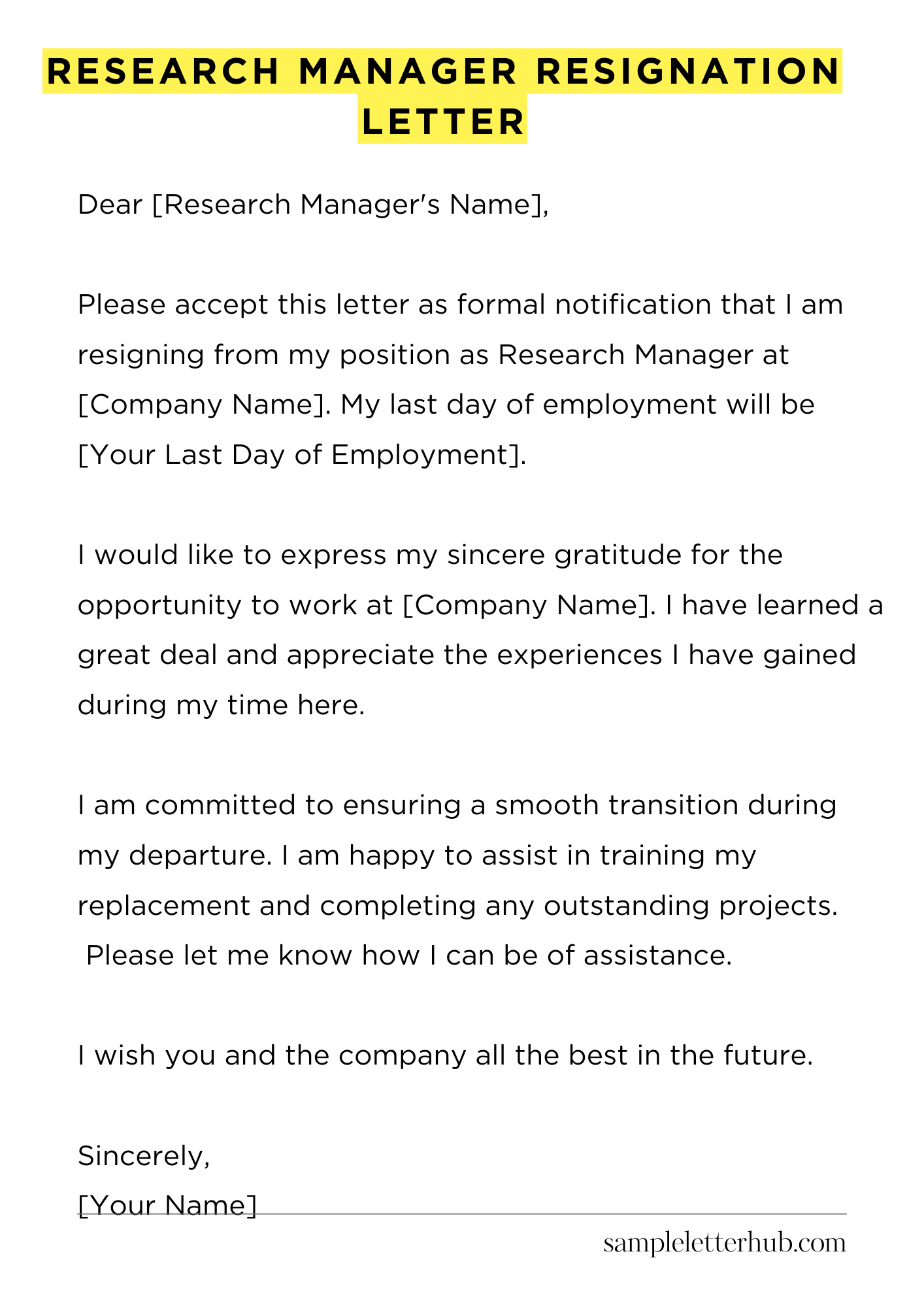
Dear [Research Manager’s Name],
Please accept this letter as formal notification that I am resigning from my position as Research Manager at [Company Name]. My last day of employment will be [Your Last Day of Employment].
I would like to express my sincere gratitude for the opportunity to work at [Company Name]. I have learned a great deal and appreciate the experiences I have gained during my time here.
I am committed to ensuring a smooth transition during my departure. I am happy to assist in training my replacement and completing any outstanding projects. Please let me know how I can be of assistance.
I wish you and the company all the best in the future.
Sincerely,
[Your Name]
How to Write a Research Manager Resignation Letter
Know the Basics Before You Start
Resigning from a job is a big decision, and it’s important to do it right. Especially when you are a Research Manager, you have to be professional. This is true whether you’re leaving for a new opportunity, personal reasons, or simply because you’ve had enough. Your resignation letter is a formal document that serves as your official notice.
Take it seriously. It needs to be clear, concise, and respectful. Before you start writing, make sure you know your company’s policy regarding resignation. Most companies require written notice, typically two weeks.
Also, consider the specific requirements for your role. Think about any outstanding projects or responsibilities you need to address before you leave. Planning ahead can save you a lot of hassle and make the transition smoother for everyone involved. Good preparation always pays off.
Crafting the Core of Your Letter
Now, let’s get to the writing. First, begin with a professional salutation. “Dear [Manager’s Name]” or “Dear [HR Department]” works perfectly. The body of the letter is where you state your intention to resign. Keep it short and to the point. Clearly state your resignation from the position of Research Manager and include the effective date of your last day of employment.
Use a straightforward sentence like, “Please accept this letter as formal notification that I am resigning from my position as Research Manager, effective [Date].” The key is clarity, so avoid ambiguity. After the basic statement, express your gratitude.
Acknowledge the opportunities you’ve had while working there. This shows professionalism and leaves a positive impression. You might say something like, “I am grateful for the opportunities I have been given during my time here.”
Addressing Your Responsibilities
As a Research Manager, you likely have ongoing projects and team responsibilities. Therefore, your letter should touch on these. Offer to assist with the transition. This is a very important part, as it makes things easier.
You might offer to train your replacement or complete any urgent tasks before you leave. This demonstrates your commitment to a smooth handover. Mentioning your willingness to help keeps things positive and professional.
You could add, “I am committed to ensuring a smooth transition and am happy to assist in training my replacement or completing any outstanding tasks.” Identify any essential tasks that need attention. Consider the team’s needs. A good manager always thinks about the team.
Formatting and Key Considerations
Formatting is a must. Your letter should be typed, not handwritten. Use a standard business letter format. Include your contact information (name, address, phone number, email) at the top. Use a clear, easy-to-read font, such as Times New Roman or Arial. Keep the letter concise; it should ideally be one page. Proofread carefully.
Check for any errors in grammar or spelling. A poorly written letter can damage your professional image. Make sure to sign the letter manually above your typed name. Also, make a copy for your records.
Consider if you’d like to include a sentence about your future plans, but this isn’t necessary. If you do, keep it brief and positive. Avoid negativity or personal grievances; focus on moving forward.
The Final Touches: Review and Submission
Before submitting, review everything. Read the letter aloud to check its flow and tone. Ask a trusted colleague or friend to proofread it. Their fresh perspective can catch any mistakes you might have missed. Make sure you know where to send the letter. Typically, it goes to your direct manager and/or the HR department.
Follow your company’s procedures for submitting the letter, whether it’s through email or hard copy. Once submitted, that’s it! Now, you’ve started the next stage of your career.
Be prepared for a conversation with your manager. Be prepared to answer any questions they might have about your departure. Always remain professional and positive during the exit process.
FAQs about Research Manager Resignation Letter
What are the essential elements to include in a Research Manager resignation letter?
A well-crafted Research Manager resignation letter should contain the following: a clear statement of resignation, the effective date of your departure, a concise reason for leaving (optional, but often included for professional courtesy), a brief expression of gratitude for the opportunity, and an offer to assist with the transition.
It is also advisable to include your contact information for future correspondence. The letter should be professional in tone and free of any negative comments about your current employer.
How far in advance should a Research Manager submit their resignation letter?
The standard practice is to provide two weeks’ notice, as this is often considered the industry norm. However, the required notice period may vary depending on your employment contract or company policy.
Reviewing your employment agreement is crucial to determine the appropriate notice period. If your contract specifies a longer period, you are generally expected to adhere to that.
What tone should I use in my Research Manager resignation letter?
The tone of your resignation letter should be professional, courteous, and positive. Avoid using negative language or airing grievances. Instead, express gratitude for the opportunities you’ve been given, and focus on the future. Maintain a respectful tone throughout the letter, as this letter will become part of your professional record.
Is it necessary to provide a reason for leaving in my resignation letter?
While not mandatory, it is often considered a polite gesture to briefly state the reason for your resignation. You can simply say you are pursuing other opportunities, or that you are taking a new role.
You are not obligated to go into extensive detail. Keep the reason concise and positive. If you are leaving due to a specific issue, it is usually best to address it separately with your manager, not in the formal resignation letter.
What steps should I take after submitting my Research Manager resignation letter?
After submitting your resignation letter, the next steps typically involve a meeting with your manager to discuss your departure, and the transition process.
Cooperate fully with your employer to ensure a smooth handover of your responsibilities. Follow all company procedures for exiting, such as returning company property and completing any necessary paperwork. Maintain a professional demeanor throughout the transition period.
Related:
Resignation letter due to rude boss
Resignation letter moving to another state
Resignation letter due to illness of family member
Resignation letter due to study