

A Research Associate resignation letter is a formal document. It is used to inform your employer of your decision. The letter officially ends your employment. It signifies your departure from the research position.
This can be a tricky process. Don’t worry, though. We will help you. We have crafted some helpful templates. These are samples of Research Associate resignation letters.
We’ll share examples covering various situations. You can adapt these. Make it easy for you. Get ready to craft your own perfect letter.
Research Associate Resignation Letter
Below is a sample of a Research Associate Resignation Letter:
[Your Name]
[Your Address]
[Your Phone Number]
[Your Email Address]
[Date]
[Hiring Manager Name] (If known, otherwise use title)
[Hiring Manager Title]
[Company Name]
[Company Address]
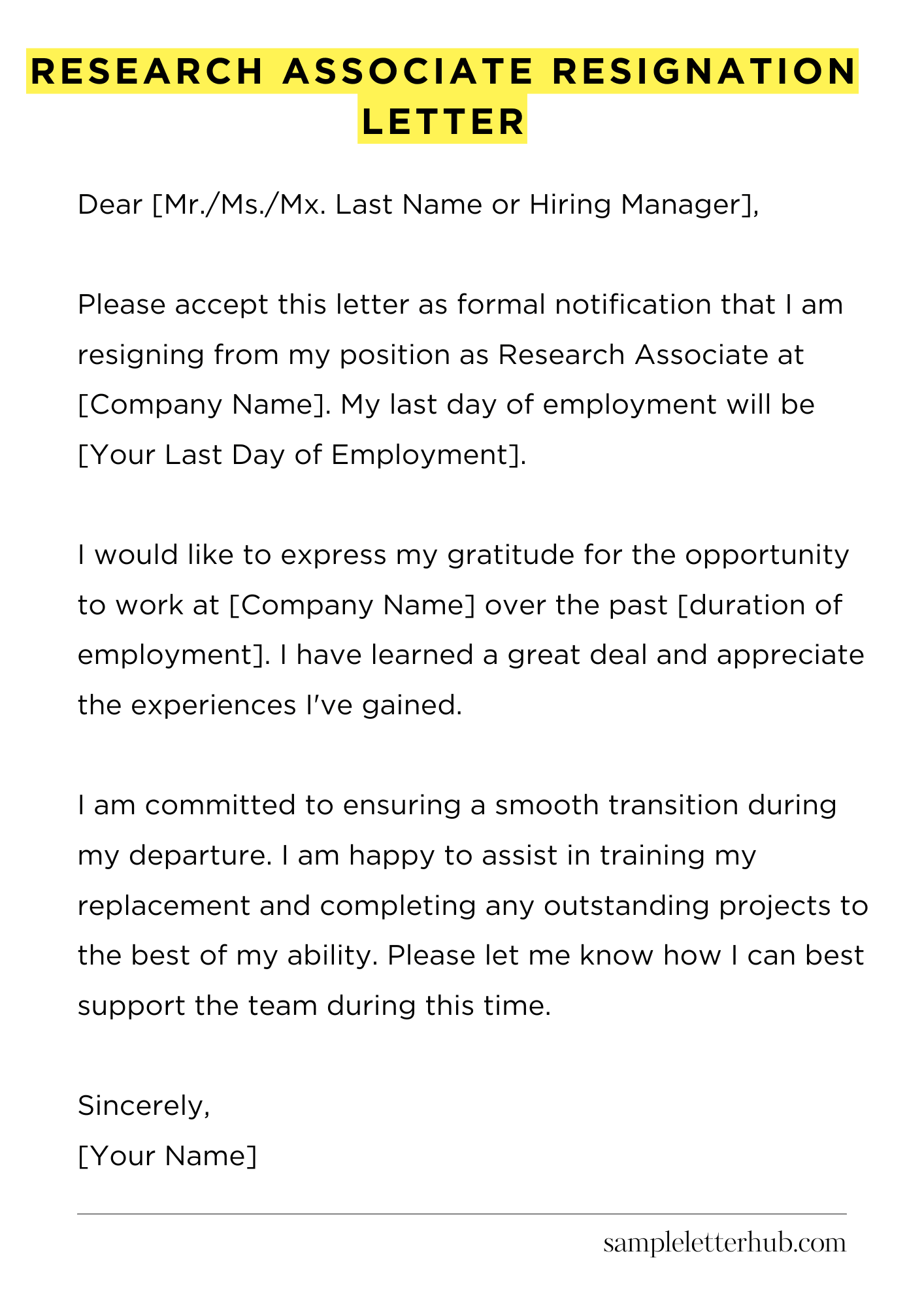
Dear [Mr./Ms./Mx. Last Name or Hiring Manager],
Please accept this letter as formal notification that I am resigning from my position as Research Associate at [Company Name]. My last day of employment will be [Your Last Day of Employment].
I would like to express my gratitude for the opportunity to work at [Company Name] over the past [duration of employment]. I have learned a great deal and appreciate the experiences I’ve gained.
I am committed to ensuring a smooth transition during my departure. I am happy to assist in training my replacement and completing any outstanding projects to the best of my ability. Please let me know how I can best support the team during this time.
I wish [Company Name] continued success in the future.
Sincerely,
[Your Name]
How to Write a Research Associate Resignation Letter
Leaving a job can be a big step. Research Associate positions often involve significant time commitments and specialized skills. It’s crucial to leave gracefully, especially if you plan on using your current employer as a reference later. A well-crafted resignation letter is the cornerstone of this process. It helps maintain professionalism and leaves a positive lasting impression.
1. Get Started: What to Include and How to Format
Your resignation letter should be concise and professional. Start with a clear and direct statement of your intent to resign. Always include the date of your last day of employment. This is critical for HR and your supervisor to process everything correctly.
Use a standard business letter format. That means proper headings, spacing, and a professional tone. Begin with your name, address, and contact information. Then, add the date, followed by your supervisor’s name and title, and their company’s address. Use a formal salutation like “Dear Mr./Ms./Dr. [Last Name]”. The letter should be brief; one page is usually enough.
2. Be Clear and Direct: The Core of Your Message
The first paragraph should state your intention to resign. Avoid beating around the bush. For example, “Please accept this letter as formal notification that I am resigning from my position as Research Associate, effective [Date].” Keep it simple and to the point. Be sure to clearly state your last day of employment.
Avoid unnecessary details about why you’re leaving in the initial statement. It’s often best to keep the focus on the formal resignation.
3. Express Gratitude: Show Your Appreciation
Even if you’re leaving for negative reasons, expressing gratitude is highly recommended. Thank your employer for the opportunity to work there. Mention specific experiences or skills you’ve gained during your time in the role. This demonstrates professionalism and a positive attitude. The key here is to keep it sincere.
You can add a sentence like, “I am grateful for the opportunities I’ve had to develop my research skills and contribute to [Company Name]’s work on [Project Name].” This is a great way to show appreciation for your experiences.
4. Offer Assistance: Smooth Transition
Offering to help with the transition is a thoughtful gesture. Consider offering to assist with the handover of your responsibilities or to train your replacement. This shows your commitment to a smooth workflow even as you leave. It makes you look reliable and professional.
You could write, “I am committed to ensuring a smooth transition and am happy to assist in training my replacement or completing any outstanding tasks before my departure.” This is highly appreciated by employers.
5. Final Touches: Closing and Submission
Close with a professional closing, such as “Sincerely” or “Best regards.” Then, sign your name above your typed name. Keep a copy of the letter for your records.
Deliver the letter to your supervisor and HR department. In most cases, it’s best to deliver a physical copy, even if you are also sending it electronically. This helps to show a formal intent.
Remember that the way you leave a job reflects on your reputation. A well-written resignation letter shows respect, professionalism, and helps preserve your professional relationships. Now you are well-prepared to move on to your next opportunity.
FAQs about Research Associate resignation letter
What is the purpose of a Research Associate resignation letter?
The primary purpose of a Research Associate resignation letter is to formally notify your employer of your intention to leave your position. It serves as an official record of your departure and provides essential information, such as your last day of employment.
It also allows you to express gratitude and maintain a professional relationship with your former employer, which can be valuable for future references and networking opportunities. A well-crafted letter can also help clarify any lingering questions about your departure.
What key information should be included in a Research Associate resignation letter?
A comprehensive Research Associate resignation letter should include your formal notification of resignation, the effective date of your departure (last day of employment), a brief statement of the reason for leaving (optional, but often included for context), an expression of gratitude to your employer and colleagues, and your contact information.
It’s also often wise to mention your willingness to assist with the transition process and any outstanding tasks or projects that need to be completed before your departure.
How much notice should I give in my Research Associate resignation letter?
The standard notice period for Research Associates typically aligns with your employment contract or local labor laws. It’s often customary to provide at least two weeks’ notice, but this may vary. Review your employment agreement or consult with your HR department to confirm the required notice period.
Providing adequate notice ensures a smoother transition for your employer and demonstrates professionalism.
Should I provide a reason for resigning in my letter?
While not mandatory, including a brief, positive statement about your reason for resigning is often a good practice. You can simply state that you are pursuing another opportunity, seeking new challenges, or relocating.
Avoid negative comments about your current employer or colleagues. Keep your explanation concise and focused on your future endeavors. If you have specific, constructive feedback, consider saving it for an exit interview.
How should I format and deliver my Research Associate resignation letter?
Your Research Associate resignation letter should be professionally formatted, typed, and printed on paper. Use a standard business letter format, including your name, address, the date, your employer’s name and address, a formal salutation (e.g., “Dear [Manager’s Name]”), the body of the letter, a closing (e.g., “Sincerely”), and your typed name and signature.
Deliver the letter to your immediate supervisor or HR representative. It’s usually best to deliver the letter in person, if possible, followed by a digital copy for their records.
Related:
Resignation letter due to rude boss
Resignation letter moving to another state
Resignation letter due to illness of family member
Resignation letter due to study