

A research analyst resignation letter is a formal document. It informs your employer of your intent to leave your job. The letter officially states your last day of employment. It also helps to maintain a professional relationship.
Planning to move on? Writing a resignation letter can be tricky. Don’t worry, we’ve got you covered. We’ll provide you with helpful examples. These include different templates and samples.
Use these to craft your perfect goodbye. Make it easy to communicate your reasons. Customize the letters for your situation. Take the stress out of this important task.
Research Analyst Resignation Letter
Below is a sample of a Research Analyst Resignation Letter:
[Your Name]
[Your Address]
[Your Phone Number]
[Your Email Address]
[Date]
[Hiring Manager Name] (If known, otherwise use title)
[Hiring Manager Title]
[Company Name]
[Company Address]
Dear [Mr./Ms./Mx. Last Name],
Please accept this letter as formal notification that I am resigning from my position as Research Analyst at [Company Name]. My last day of employment will be [Your Last Day of Employment].
Thank you for the opportunity to work here for the past [Number] years/months. I have enjoyed my time and learned a great deal during my employment. I appreciate the experiences I’ve gained and the people I’ve worked with.
I am committed to helping with the transition during my remaining time here. Please let me know how I can be of assistance in the handover of my responsibilities.
I wish you and the company all the best in the future.
Sincerely,
[Your Signature]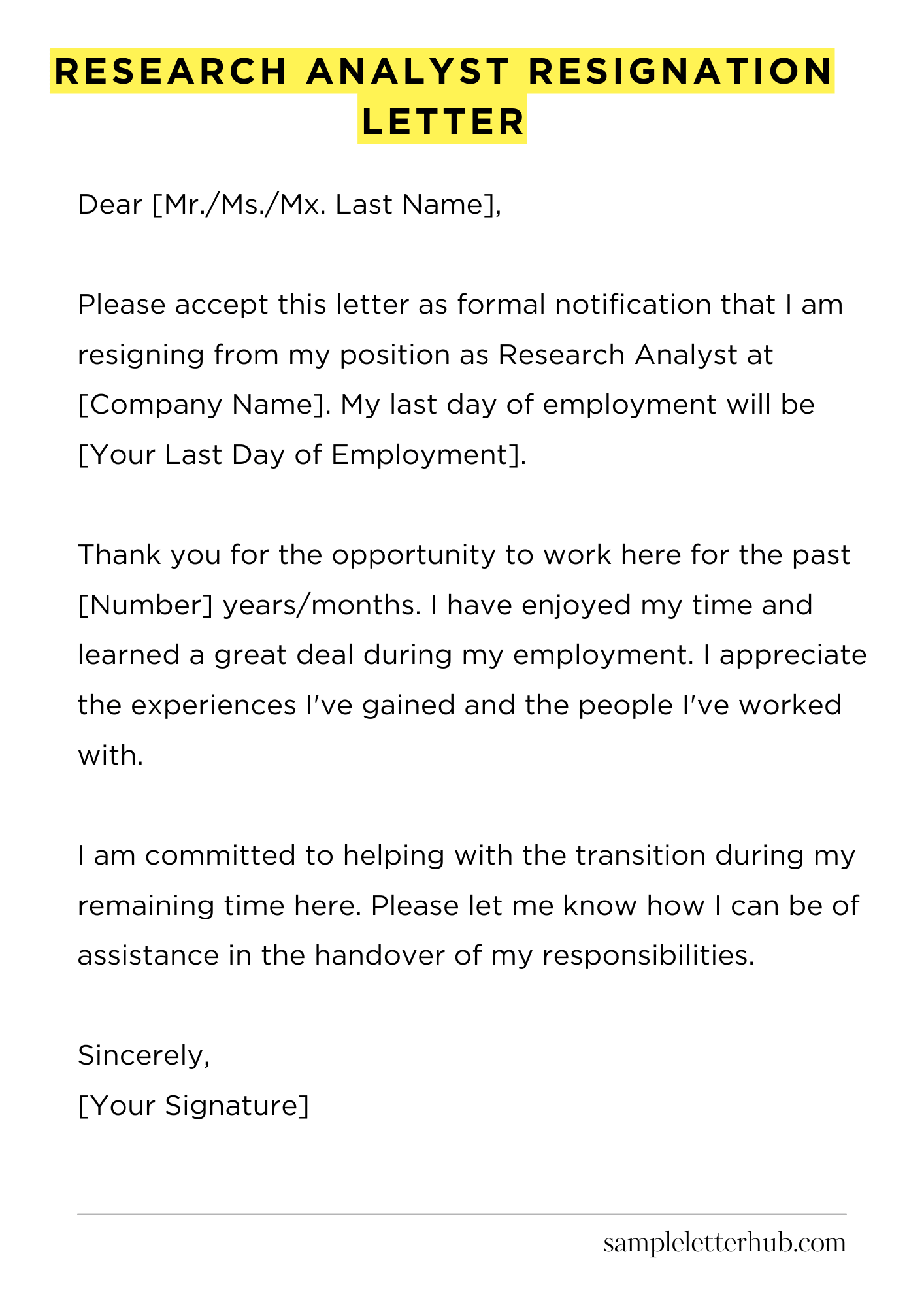
How to Write a Research Analyst Resignation Letter
1. Why is a Resignation Letter Important?
Leaving a job, especially a professional one like a Research Analyst position, requires finesse. A well-crafted resignation letter is more than just a formality; it’s a professional courtesy.
It sets the tone for your departure and can impact future opportunities. You want to leave on good terms, and a thoughtful letter is key. It helps to clarify your intentions and formally notifies your employer of your decision to move on.
2. Essential Elements to Include
Your resignation letter needs some key components. First and foremost, clearly state your intent to resign. Include the specific date of your last day of employment.
This is crucial for payroll and handover purposes. Next, express your gratitude for the opportunity to work there. You don’t need to gush, but a simple acknowledgement of the experience gained is beneficial. Consider mentioning any specific skills you developed. Keep it concise, professional, and positive. Avoid negativity. Do not provide a long list of complaints. Keep it classy.
3. Structure and Formatting: Making it Readable
Structure matters a lot! Begin with a formal salutation, addressing your letter to your direct supervisor or HR. Keep it short and sweet. Next, the body should contain the information mentioned previously: your intent, last day, and gratitude. Use clear and concise language. Proofread everything.
The final paragraph should reiterate your thanks and offer assistance during the transition period. Offer to help train someone or assist with ongoing projects. Sign off with a professional closing, such as “Sincerely” or “Best Regards,” followed by your name and title.
4. Tailoring Your Letter: Consider Your Situation
While a general template works, customize your letter. Did you enjoy working with a particular colleague or on a specific project? Briefly mention it if appropriate. If you’re leaving for another job, you don’t need to divulge details, but you can say you are pursuing another opportunity.
However, always remain professional. You can also mention the reason for your departure if you feel comfortable doing so. Be mindful of your company’s culture. For more sensitive scenarios, like if you’re not happy, keep the tone neutral.
5. Examples and Templates: Get Started Now
Finding examples online can really help. Look for templates specifically tailored to research analyst roles. Many websites offer free templates you can adapt. Start with a basic template and personalize it with your own details. Then, revise, proofread and get it reviewed by someone you trust.
Ensure everything reads smoothly and professionally. Finally, deliver the letter in the appropriate format, usually through email or a printed copy, depending on your company’s policy.
FAQs about Research Analyst resignation letter
How do I start a Research Analyst resignation letter?
The standard opening includes a formal salutation (e.g., “Dear [Manager’s Name]”), followed by a clear statement of your intent to resign from your position as a Research Analyst. You should specify your last day of employment. Keep it concise and professional.
What key information must be included in a Research Analyst resignation letter?
Essential components are: a clear statement of resignation, your official job title, the effective date of your resignation (last day of employment), and a brief expression of gratitude for the opportunity. You may optionally include a reason for leaving, but this is not always required.
Should I provide a reason for resigning in my Research Analyst resignation letter?
While not mandatory, providing a brief reason for your departure can be helpful. It’s advisable to keep this concise and positive, focusing on your future goals or opportunities. Avoid negative comments about the company or colleagues. Examples include stating “pursuing other opportunities,” or “seeking a new challenge.”
How should I express my gratitude in a Research Analyst resignation letter?
Expressing gratitude is highly recommended. Thank your employer for the opportunity to work as a Research Analyst. You can acknowledge the skills you’ve gained, the experiences you’ve had, or the relationships you’ve built. A brief and sincere expression of appreciation is usually sufficient.
Is it necessary to offer assistance with the transition in my Research Analyst resignation letter?
Offering assistance with the transition is a professional courtesy. You can state your willingness to help train your replacement, complete ongoing projects, or provide documentation. This demonstrates your commitment to a smooth handover and leaves a positive impression, but it’s not a must-have.
Related:
Resignation letter due to rude boss
Resignation letter moving to another state
Resignation letter due to illness of family member
Resignation letter due to study