

Need more insurance? A “Request to Renew Policy with Added Coverage” is how you ask your insurance company for a policy upgrade. It ensures your existing insurance policy stays active. Plus, you get extra protection. This request covers new risks or increased coverage limits.
We’re here to help! This article gives you several sample letters. These templates make writing your own request super easy. They cover various scenarios and needs. Get ready to write a solid “Request to Renew Policy with Added Coverage” today!
Whether it’s auto insurance, home insurance, or something else, we have you covered. Use our sample letters as a starting point. Simply adjust them to fit your specific situation. Our easy-to-use samples will help you renew your policy with the right added protection.
[Your Name/Company Name]
[Your Address]
[Your Phone Number]
[Your Email Address]
[Date]
[Insurance Company Name]
[Insurance Company Address]
Dear Sir/Madam,
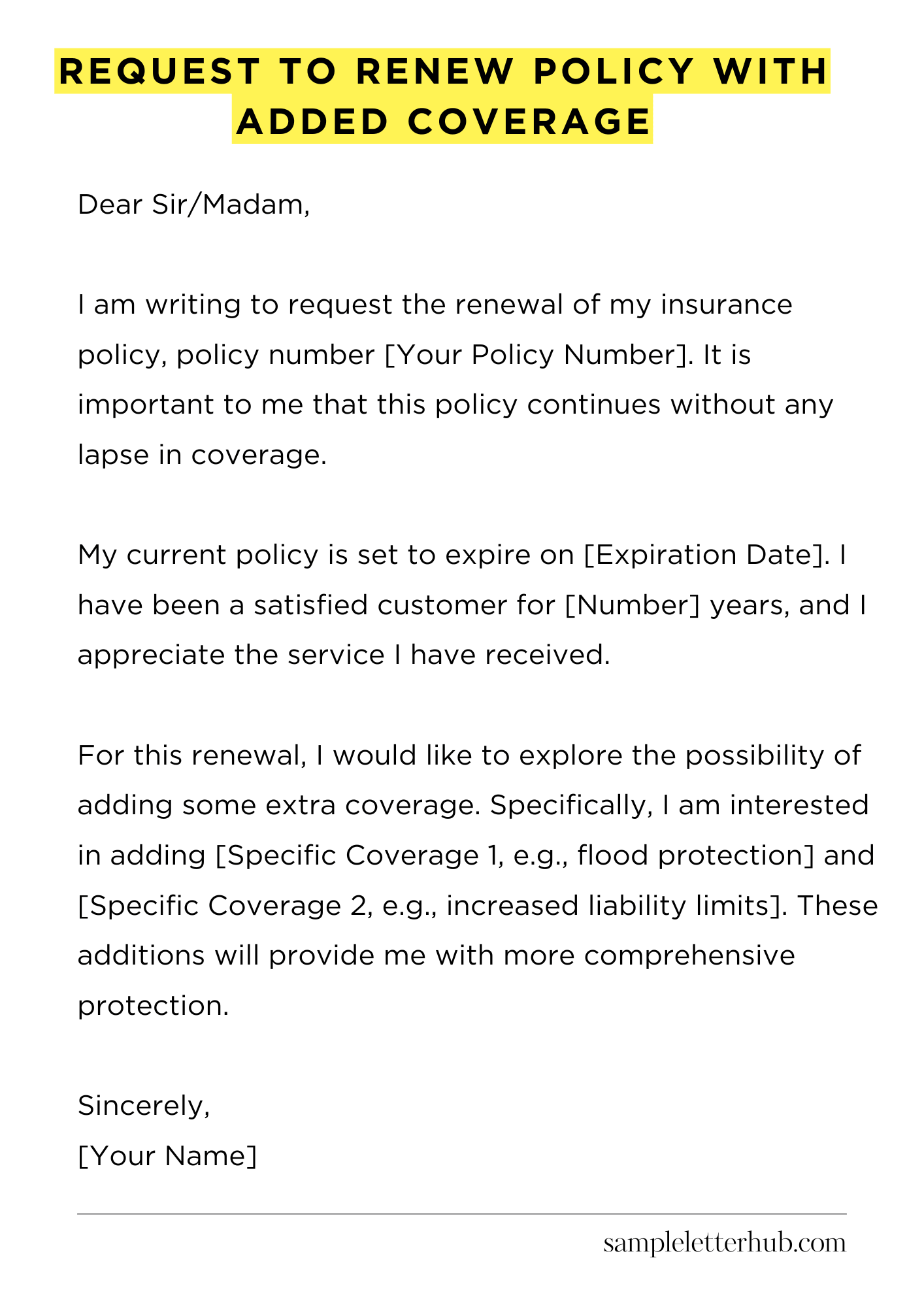
I am writing to request the renewal of my insurance policy, policy number [Your Policy Number]. It is important to me that this policy continues without any lapse in coverage.
My current policy is set to expire on [Expiration Date]. I have been a satisfied customer for [Number] years, and I appreciate the service I have received.
For this renewal, I would like to explore the possibility of adding some extra coverage. Specifically, I am interested in adding [Specific Coverage 1, e.g., flood protection] and [Specific Coverage 2, e.g., increased liability limits]. These additions will provide me with more comprehensive protection.
I would appreciate it if you could send me a quote that includes the cost of these additional coverages. Please also include the details of the coverage, so I can review them carefully. I want to make sure the policy meets my evolving needs.
If you require any further information from me, please do not hesitate to contact me at your earliest convenience. I am happy to provide any necessary documentation. I am available by phone or email.
Thank you for your time and attention to this request. I look forward to hearing from you soon regarding the renewal and the potential additions to my policy. I value your prompt response.
Sincerely,
[Your Name]
How to Write Request to Renew Policy with Added Coverage
Embarking on the process of renewing an insurance policy and augmenting its scope with supplementary coverage can seem daunting. However, armed with the appropriate knowledge and strategy, the procedure becomes markedly less perplexing.
This guide offers a comprehensive framework to aid in composing a compelling request, ensuring your needs are articulated and duly considered.
1. Initiate with Formality: The Salutation
Begin your missive with a professional salutation. This sets the tone for your entire correspondence. Use the full name of the addressee. For instance, “Dear Mr./Ms. [Last Name],” is always a good start.
Avoid overly casual greetings; formality demonstrates respect and professionalism. A clear and concise salutation ensures your letter is immediately received with the gravitas it deserves.
2. Explicitly State Your Purpose: The Introduction
The introduction should succinctly state your intent: to renew your policy and request specific add-ons. Provide your policy number without fail. This is critical for the insurer to readily identify your account. Keep the introduction brief and to the point; ambiguity can breed confusion. A crisp introduction immediately clarifies your requirements, saving time for both you and the recipient.
3. Detail Your Existing Coverage: A Précis
Briefly elucidate your current policy’s coverage parameters. This provides the insurer with context for your request. Include the type of policy, effective dates, and a concise summary of the existing protection.
This overview aids the adjuster in understanding your pre-existing coverage and highlights areas where augmentation is needed. This serves as a vital foundation for the added coverage requests.
4. Articulate the Desired Augmentations: The Core Proposition
This section is paramount. Here, enumerate the supplementary coverages you desire. Be explicit about the specifics. Detail each add-on, along with its potential benefits. Include the desired coverage limits. State why you are seeking these additions. Do you require higher liability limits? Are you looking for coverage for a new asset?
Clarity here will expedite the evaluation process. A well-articulated case substantially increases the likelihood of a positive response from the insurer. Utilize clear, precise language to avoid misinterpretations.
5. Substantiate Your Request: Justification
Provide a compelling rationale for each requested add-on. Substantiate your needs. For instance, If you’re requesting increased liability limits, explain the need based on your assets and circumstances.
Are you adding coverage for a new home or vehicle? This section offers the insurer a window into your risks and necessities. Supplying pertinent details strengthens your request. Consider incorporating relevant supporting documentation, if available, such as appraisals or property assessments. This demonstration of preparedness and attention to detail reinforces your credibility.
6. The Formal Conclusion: The Closing
Conclude with a professional closing. “Sincerely,” or “Respectfully,” are acceptable. Reiterate your contact information – phone number and email address – for prompt communication. Express your willingness to provide further information if necessary. Thank the recipient for their time and consideration. A polite and succinct closing reiterates your professionalism.
7. Polishing Your Correspondence: Review and Submission
Before dispatching your missive, meticulously proofread it for grammatical errors and inconsistencies. Ensure all information is accurate and readily understandable. Validate that you’ve included all relevant details. Make a final check for clarity. If possible, have someone else review it for a fresh perspective.
After you are sure that it’s ready, make a copy for your records before sending it via the preferred method specified by your insurance provider. You have now completed the process of writing the request. This last step helps ensure you have a copy of your work.
FAQs about Request to Renew Policy with Added Coverage
What is the process for requesting a policy renewal with added coverage?
The process typically involves the following steps: review your current policy, identify the additional coverages you need (e.g., increased liability limits, new endorsements), contact your insurance provider or broker to request the changes, provide any necessary information (e.g., updated vehicle information, property details).
If satisfied, you will need to accept the quote and make any necessary payments.
How does adding coverage affect my premium?
Adding coverage will almost certainly impact your premium, often increasing it. The extent of the increase depends on several factors, including the type and amount of additional coverage, your risk profile, and the insurance company’s pricing structure. The insurance provider will assess the new risk factors and calculate the revised premium based on the added coverage.
What types of additional coverage can I request when renewing my policy?
The types of additional coverage available vary depending on the type of insurance policy (e.g., auto, home, business). Common examples include: increased liability limits, adding coverage for specific perils (e.g., flood, earthquake), adding coverage for specific items (e.g., valuable items such as jewelry), and adding endorsements for specialized needs (e.g., business interruption insurance).
When should I request added coverage when renewing my policy?
You should request added coverage well in advance of your policy’s renewal date. This allows sufficient time for the insurance provider to assess your request, provide a quote, and for you to review the terms. It’s generally a good practice to start the process at least a few weeks before the renewal date, especially if the added coverage is complex or requires additional underwriting.
What if my insurance provider denies my request for added coverage?
If your insurance provider denies your request, they will typically provide a reason for the denial. This could be due to factors such as not meeting their underwriting criteria, the type of coverage requested not being available, or the risk being too high for them to insure.
In such cases, you may need to shop around for coverage from other insurance providers. You could also discuss with your insurance provider whether there are alternative coverages or modifications to your request that could be considered.
Related:
Resignation letter due to rude boss
Resignation letter moving to another state
Resignation letter due to illness of family member
Resignation letter due to study