

Ever need to remove a car from your insurance policy? This happens. It’s when you no longer own or use that vehicle. You might have sold it, or it’s simply not in use. You need to officially tell your insurance company. This is done with a formal request letter to remove vehicle from insurance policy. The purpose? To stop paying car insurance for a car you don’t need covered.
We get it. Writing these letters can be tricky. Don’t worry, we’re here to help. We’ve got you covered. We’ll show you examples. See some great request letter samples and request letter templates. Use these to write your own letter. Need a quick edit? No problem! This will make the process easy.
Our goal is to give you a head start. Find the perfect request letter format. Get straight to the point. No stress. You can write your letter to remove a car from insurance fast. Let’s dive in and get started.
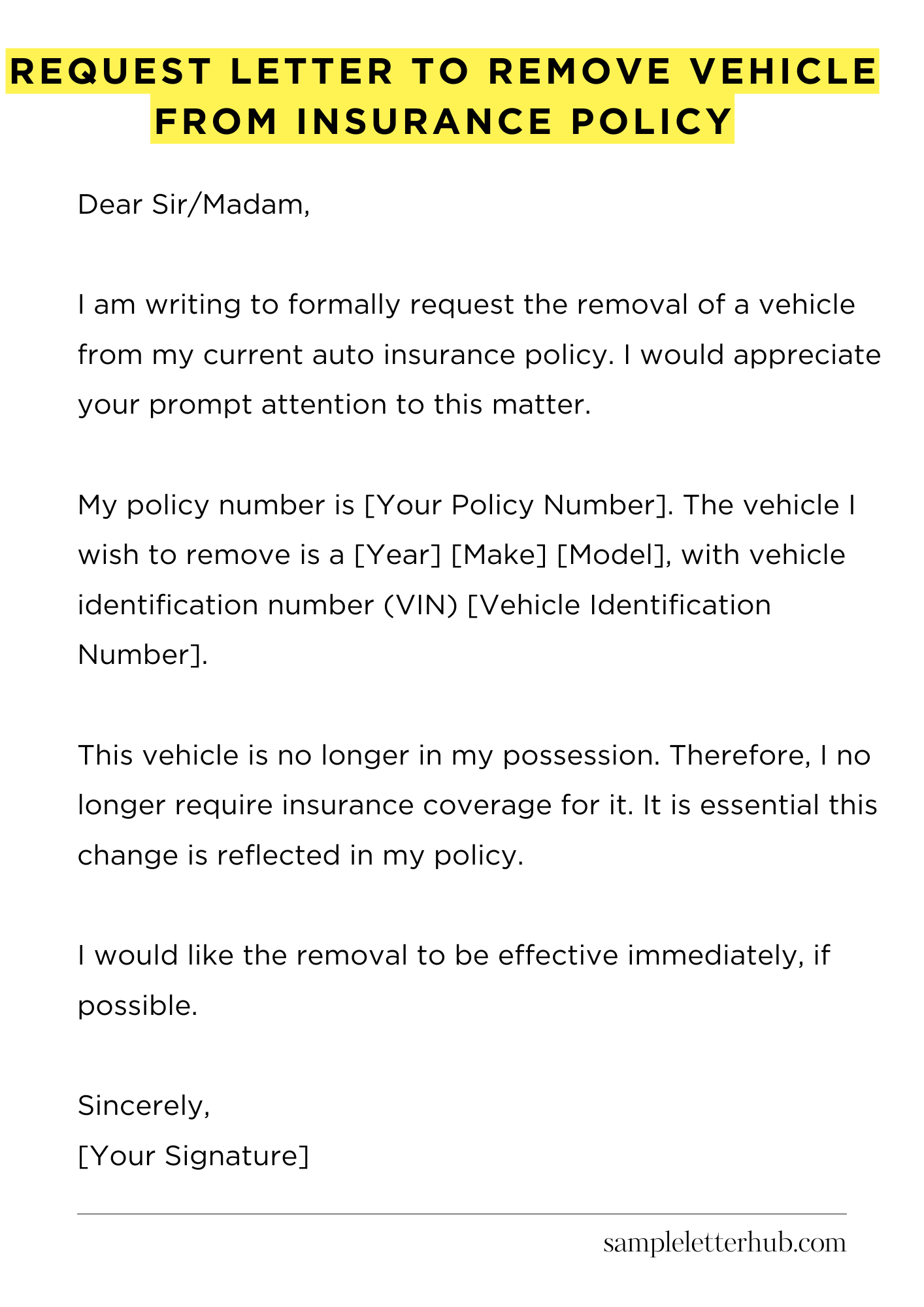
[Your Name]
[Your Address]
[Your Phone Number]
[Your Email Address]
[Date]
[Insurance Company Name]
[Insurance Company Address]
Dear Sir/Madam,
I am writing to formally request the removal of a vehicle from my current auto insurance policy. I would appreciate your prompt attention to this matter.
My policy number is [Your Policy Number]. The vehicle I wish to remove is a [Year] [Make] [Model], with vehicle identification number (VIN) [Vehicle Identification Number]. This information is important for processing my request correctly.
This vehicle is no longer in my possession. Therefore, I no longer require insurance coverage for it. It is essential this change is reflected in my policy.
I would like the removal to be effective immediately, if possible. Could you please confirm the date the vehicle will be removed from my policy? Please let me know if any further information is needed from my side to complete this process.
Also, I am curious about any potential refund I might be eligible for due to this change. I’d appreciate receiving details about this as soon as possible. Please outline the refund procedure, too.
Thank you for your time and assistance in this matter. I look forward to your confirmation.
Sincerely,
[Your Signature]
How to Write Request Letter to Remove Vehicle from Insurance Policy
Deaccessioning a vehicle from your insurance policy is a straightforward process, but a well-crafted request letter is crucial. It ensures your intentions are unequivocally understood, expediting the removal and potentially minimizing any lingering premium liabilities. Let’s delineate the steps involved in constructing a cogent request.
1. Commence with Proper Salutations
Begin your missive with a formal salutation. Address the letter to the appropriate entity within your insurance company. This is usually the underwriting department or the customer service manager.
Use their formal title. Avoid vague greetings such as “To Whom It May Concern.” Instead, investigate the specific name of the responsible party and address the letter directly to them, for example: “Dear Claims Manager, Mr. Bartholomew Higgins.” This displays a degree of professionalism and personalization.
2. Clearly Identify Yourself and the Policy
Immediately after the salutation, furnish your comprehensive identification. Include your full legal name, address, and contact information. Subsequently, furnish the specific details of the policy in question.
This entails the policy number, the inception and expiry dates of the policy, and, crucially, the precise vehicle information you wish to remove. This should include the make, model, year, and vehicle identification number (VIN). The VIN is paramount; it guarantees the correct vehicle is identified for removal.
3. Explicitly State Your Request
The core of your letter should clearly and unequivocally state your request: the removal of the specified vehicle from the insurance policy. Use direct language. Avoid ambiguity. A precise statement might read, “This letter constitutes my formal request to remove the [Year] [Make] [Model] with VIN [VIN] from policy number [Policy Number], effective [Proposed Date of Removal].”
The effective date is pivotal; it signifies the day the vehicle ceases to be insured. It is advisable to specify this date, although the insurer might have some internal procedures.
4. Explain the Circumstances
While not strictly mandatory, providing a brief explanation for the vehicle’s removal can be beneficial. Are you selling the vehicle? Did you trade it in? Is it being kept off the road, or perhaps it has been wrecked? This context clarifies your intentions and may prevent potential misunderstandings.
A succinct sentence suffices, such as: “This vehicle has been sold to [Name of New Owner] on [Date of Sale].” Or, if the vehicle is no longer roadworthy, “The vehicle is no longer operational and is currently stored at [Location].” This helps them understand the status.
5. Confirm Documentation and Subsequent Actions
Explicitly mention the documentation you will be providing or have already provided. For instance, if you are selling the car, you will want to mention that you are including a copy of the bill of sale or proof of ownership transfer.
Conversely, if the vehicle is being taken off the road, specify that you are retaining the registration. Also, inquire about any further actions they might require from your end. This proactive approach preempts any potential snags in the process, thus ensuring a seamless transaction. For example: “I have included a copy of the vehicle’s bill of sale.
Please advise on any further actions required from my side.”
6. Express Gratitude and Reiterate Contact Information
Conclude your letter with a polite expression of gratitude for their attention to your request. Reiterate your contact information, specifically your phone number and email address, in case they need to contact you for clarification. A simple “Thank you for your prompt attention to this matter.
Please do not hesitate to contact me at [Phone Number] or [Email Address] if you require further information” serves the purpose.
7. Proofread and Dispatch
Before dispatching your letter, meticulously proofread it for any grammatical or typographical errors. These errors can erode the credibility of your correspondence.
Once you are confident in its accuracy, consider sending the letter via certified mail with a return receipt requested. This provides you with documented proof of delivery and ensures a record of their acknowledgment.
Alternatively, if the insurance company accepts requests via email, retain a copy of your sent email and any response you receive. Keep copies of everything for your records. This is vital. Remember the vehicle is not officially removed until you receive confirmation from the insurance company.
FAQs about Request Letter to Remove Vehicle from Insurance Policy
What information should I include in my request letter?
Your request letter should clearly state your policy number, the vehicle’s details (make, model, year, and VIN), and the date you want the coverage to end. It’s helpful to specify the reason for removal (e.g., vehicle sold, no longer owned, no longer used). Include your full name, address, and contact information for verification purposes.
How do I submit the request letter?
The submission method varies by insurance provider. Common methods include mailing the letter to the address listed on your policy or the insurance company’s website, submitting it via an online portal if available, faxing it, or emailing a scanned copy. Always confirm the preferred submission method with your insurer.
When should I expect confirmation of the vehicle’s removal?
The timeframe for confirmation varies depending on the insurance company’s processing times. It’s generally a good idea to allow a few business days to a couple of weeks for processing.
You should receive a confirmation letter or email that states the date the vehicle was removed and any potential refund information. If you haven’t received confirmation within a reasonable timeframe, follow up with your insurer.
Will I receive a refund for the unused portion of my premium?
Whether you receive a refund depends on your policy terms and conditions. Generally, if you cancel coverage mid-term, you are entitled to a refund for the period you paid for but didn’t use.
The refund amount is calculated based on the remaining time left on your policy. Ensure you inquire about the refund process when submitting your request.
What happens if I forget to remove a vehicle from my policy?
If you fail to remove a vehicle from your policy that you no longer own, you may continue to be charged premiums. Also, your insurer may deem coverage active on the vehicle even when you do not possess it.
It’s crucial to proactively notify your insurance provider immediately after selling or otherwise no longer owning a vehicle to avoid unnecessary charges and potential complications.
Related:
Resignation letter due to rude boss
Resignation letter moving to another state
Resignation letter due to illness of family member
Resignation letter due to study
Resignation letter due to long commute