

Ever wish you could pay less each month? A request letter to lower monthly premium is how you ask. It’s a formal way to plead your case. You’re trying to save money! Its purpose is simple: to negotiate a lower payment on your bill.
We get it. Writing these letters can be tough. Don’t worry! We’ve got you covered. We’ll share request letter templates. You’ll find examples and samples too! These will make the process a breeze.
This article is your guide. Use our sample letters as your starting point. Customize them to fit your needs. Writing a request letter to reduce premium is now easier. Get ready to save!
[Your Name/Company Name]
[Your Address]
[Your Phone Number]
[Your Email Address]
[Date]
[Insurance Company Name]
[Insurance Company Address]
Subject: Request to Review and Adjust Monthly Premium – Policy Number [Your Policy Number]
Dear [Insurance Company Representative Name or “To Whom It May Concern”],
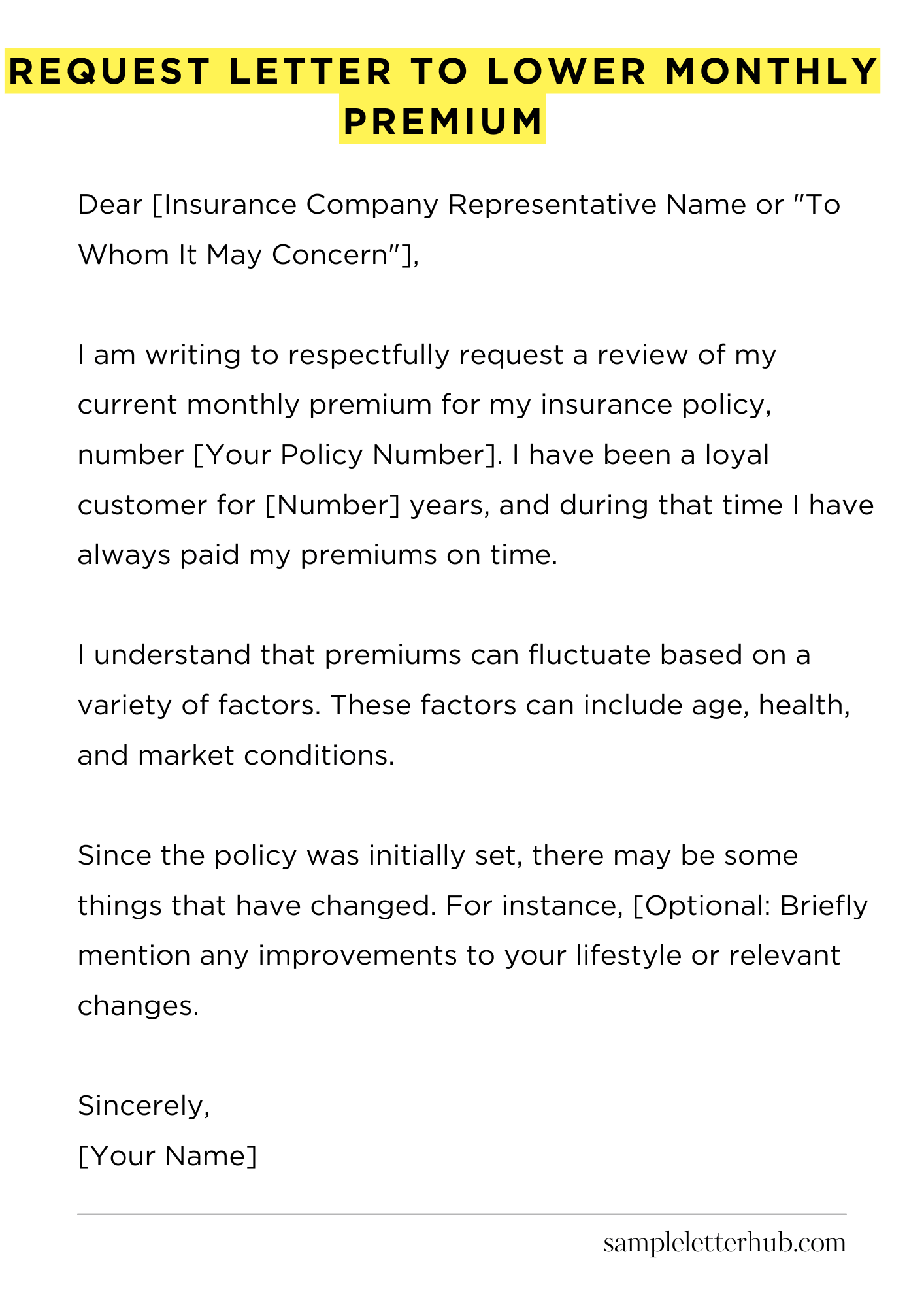
I am writing to respectfully request a review of my current monthly premium for my insurance policy, number [Your Policy Number]. I have been a loyal customer for [Number] years, and during that time I have always paid my premiums on time. This is very important to me.
I understand that premiums can fluctuate based on a variety of factors. These factors can include age, health, and market conditions. Recently, I have reviewed my financial situation, and I believe a reduction in my monthly premium would be greatly appreciated. It would ease my financial burden.
Since the policy was initially set, there may be some things that have changed. For instance, [Optional: Briefly mention any improvements to your lifestyle or relevant changes, e.g., “I have improved my health,” “I’ve installed a security system at my home,” “I now drive significantly less each month.”]. These developments may indicate a lower risk profile.
I would be grateful if you could assess my current policy and consider options to potentially lower my monthly premium. I am available to discuss my policy in further detail and provide any additional information that might be helpful. I am happy to assist in any way.
Thank you for your time, consideration, and attention to this matter. I look forward to hearing from you soon regarding this request.
Sincerely,
[Your Name]
How to Write Request Letter to Lower Monthly Premium
Negotiating a lower monthly premium for your insurance policy can feel daunting, but a well-crafted request letter can significantly improve your prospects. This guide provides a detailed roadmap to constructing a persuasive letter, helping you navigate the process with confidence.
1. Commence with Proper Salutation
Begin your letter with a formal salutation. Address the recipient by name and title, if known, to establish a professional rapport. A generic “To Whom It May Concern” is acceptable, albeit less impactful, than addressing a specific claims adjuster or underwriter. Cultivate courtesy; it sets a positive tone right from the outset.
2. Declare Your Precise Objective
Clearly state the purpose of your letter in the opening paragraph. Be unequivocal. Directly articulate that you are writing to request a reduction in your monthly premium. Provide your policy number immediately to facilitate swift processing. Don’t beat around the bush; be forthright about your intentions. Succinctness is key here.
3. Substantiate Your Justification
This is where you marshal your compelling arguments. This is the crux of the communication. Highlight any changes that have positively influenced your risk profile.
Examples include completing a defensive driving course, upgrading your vehicle with advanced safety features, or maintaining a spotless driving record. Provide concrete evidence to bolster your claims. This may include copies of certificates or driving records, if applicable. Demonstrate that you are an excellent risk to mitigate their reluctance.
4. Elaborate on Competitive Offers (If Applicable)
If you’ve received competitive quotes from other insurers, you may include them. This strategy can be highly effective. Mention the premium amount and the coverage specifics of those alternative offers.
You are showing them you are not afraid to change company. However, be judicious in your approach. Don’t be perceived as making an ultimatum; frame it as a demonstration of the market value you’ve discovered.
5. Express a Desire for Ongoing Business
Reiterate your satisfaction with the insurer’s service and your desire to remain a valued customer. Emphasize the long-term relationship you envision.
This subtly signals your investment in them. Acknowledge any positive experiences you’ve had with the company or their representatives. Show gratitude; it enhances the likelihood of a favorable response.
6. Conclude with a Call to Action
Politely request a formal response and specify a reasonable timeframe for their reply. Providing a deadline shows you expect a response.
Be sure to provide all of your contact details, including your phone number and email address, for ease of communication. Ending the letter on a note of anticipation will assist in response time.
7. Execute Final Scrutiny
Before dispatch, meticulously review your letter for any errors in grammar, spelling, and punctuation. Ensure your arguments are logical and well-structured.
A flawlessly presented letter demonstrates your professionalism and seriousness. Print a physical copy for your records. Proofread it one last time to make sure your message is not lost in translation.
FAQs about Request Letter to Lower Monthly Premium
What information should I include in the request letter?
Your request letter should clearly identify the policy (e.g., policy number, type of insurance). Explain the reason for your request. It’s helpful to include details of any financial hardship, change in circumstances (e.g., job loss, reduction in income, change in family size), or specific reasons justifying the need for a lower premium.
Be sure to provide supporting documentation (e.g., pay stubs, bank statements, proof of change in address). Clearly state the desired outcome, like a specific premium amount, or simply a reduction. Finally, be sure to include your contact information.
What supporting documents are typically required with the letter?
The specific documents needed will depend on your reason for requesting a lower premium. Generally, it’s a good idea to include documents that support your claim.
This might include proof of income reduction (e.g., termination letter, pay stubs), evidence of changes in your household (e.g., marriage certificate, birth certificate), or documentation related to any financial difficulties (e.g., medical bills, loan statements). Always include copies, not originals, and consider keeping a copy for your records.
How should I format and send the request letter?
Format your letter professionally, including the date, your name and address, and the insurance company’s name and address. Use a clear and concise tone. Be polite and respectful.
Type the letter if possible, and proofread it carefully for any errors. Send the letter via certified mail with return receipt requested. This provides proof of delivery and ensures the insurance company acknowledges receipt of your request. Keep a copy of the letter and the receipt for your records.
What are the chances of my request being approved?
The likelihood of approval varies depending on your insurance company, the type of policy, your reason for the request, and your overall circumstances.
The stronger your justification (e.g., significant financial hardship, demonstrable change in risk) and the more supporting documentation you provide, the better your chances. Insurance companies may also consider your claims history and payment record. It is always worth requesting a reduction, but be prepared for a potential denial.
What if my request is denied?
If your request is denied, the insurance company should provide a written explanation for the denial. Review their reasoning carefully. You can try to negotiate by providing additional information or clarifying any misunderstandings.
You may consider seeking quotes from other insurance providers to see if you can obtain a lower premium elsewhere. If you believe the denial is unfair, you may also be able to file a complaint with your state’s insurance regulatory agency.
Related:
Resignation letter due to rude boss
Resignation letter moving to another state
Resignation letter due to illness of family member
Resignation letter due to study