

Ever thought about boosting your insurance protection? A request letter to increase coverage amount is the official way to do it. Its purpose? To formally ask your insurance provider to up the financial safety net. This ensures you’re adequately protected in case of unforeseen events. It’s all about peace of mind.
Feeling unsure how to write such a letter? No worries! We’ve got you covered. This article presents several sample request letter to increase coverage amount templates. We’ll break down various scenarios. This will make it simple. Tailor these coverage amount increase letter examples to your unique situation.
We aim to simplify the process. These request for increased coverage letter samples will guide you. Writing your own insurance coverage increase request is now much easier. Get ready to draft a winning letter.
[Your Name/Your Company Name]
[Your Address]
[Your Phone Number]
[Your Email Address]
[Date]
[Insurance Company Name]
[Insurance Company Address]
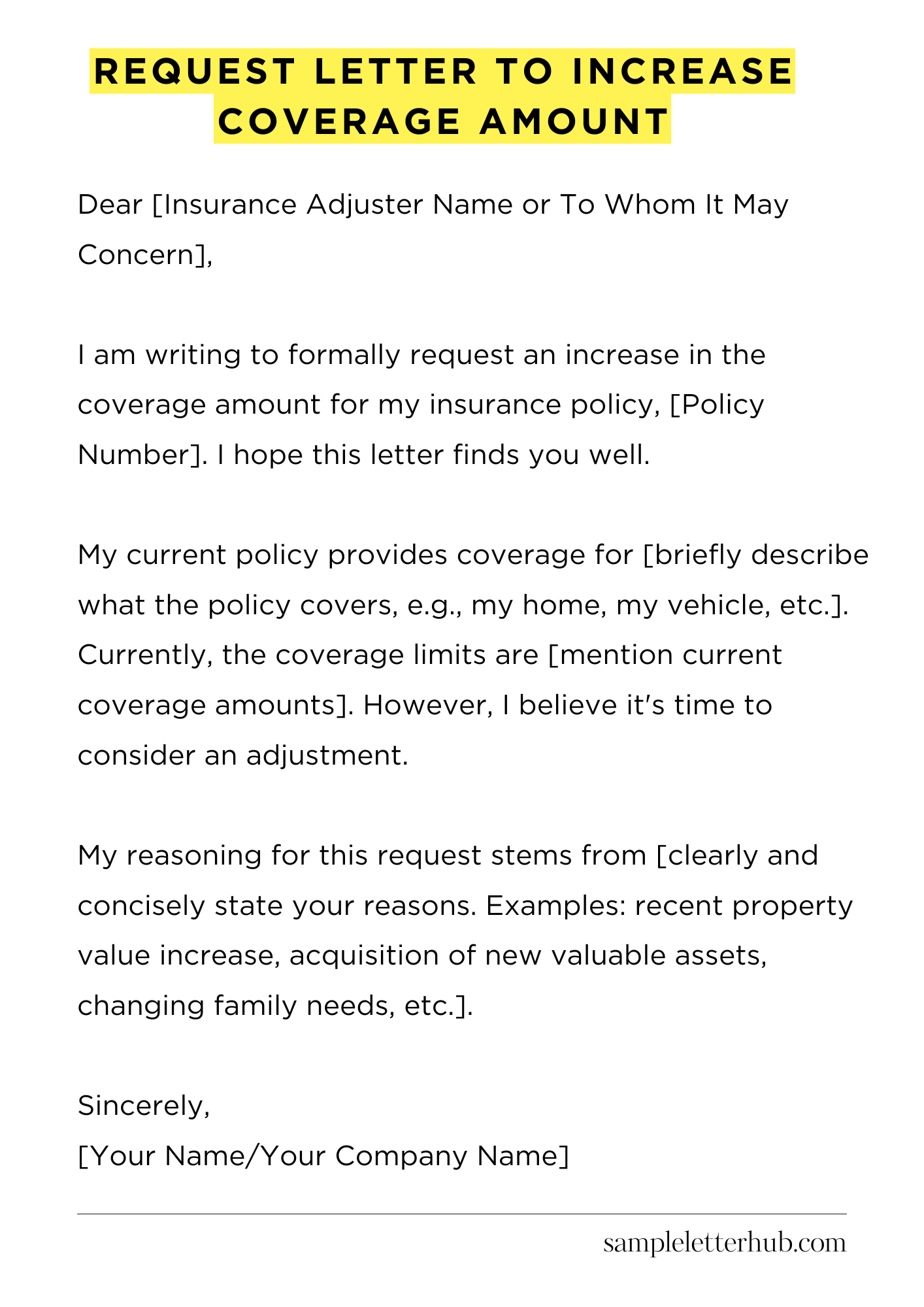
Dear [Insurance Adjuster Name or To Whom It May Concern],
I am writing to formally request an increase in the coverage amount for my insurance policy, [Policy Number]. I hope this letter finds you well.
My current policy provides coverage for [briefly describe what the policy covers, e.g., my home, my vehicle, etc.]. Currently, the coverage limits are [mention current coverage amounts]. However, I believe it’s time to consider an adjustment.
My reasoning for this request stems from [clearly and concisely state your reasons. Examples: recent property value increase, acquisition of new valuable assets, changing family needs, etc.]. It is important to me that I have proper financial protection. I want to make sure I am fully protected.
With these considerations in mind, I am requesting that you increase my coverage limit to [state desired coverage amount for each area, if applicable]. This would provide me with a greater sense of security. I would also like to discuss the premium increase associated with this adjustment.
I would appreciate it if you could review my request and contact me at your earliest convenience to discuss the details. I am available to speak by phone at [Your Phone Number] or you can reach me via email at [Your Email Address]. Please let me know the procedure for making this adjustment.
Thank you for your time and consideration. I look forward to hearing from you soon.
Sincerely,
[Your Name/Your Company Name]
How to Write Request Letter to Increase Coverage Amount
Negotiating a higher coverage amount often begins with a well-crafted letter. This crucial document serves as your formal petition, articulating the exigency for augmented financial protection. To ensure your request is not just received but also seriously considered, follow these guidelines:
1. Establish Your Premise: The Salutation and Introductory Hook
Commence with a professional salutation, addressing the recipient appropriately (e.g., “Dear Mr./Ms. [Last Name]”). Subsequently, the initial paragraph is paramount; it’s your opportunity to seize their attention.
Frame your request concisely, explicitly stating the purpose of your communication: to request an escalation in your coverage limits. Consider beginning with a sentence that emphasizes the importance of your insurance policy, immediately creating a sense of urgency. Be straightforward in stating your intentions.
2. Detail the Rationale: Articulating the Need
The core of your letter lies in substantiating your request. Provide a meticulously detailed account of the circumstances prompting the need for increased coverage.
This involves illustrating the factors that have rendered your current coverage inadequate. If it’s a matter of increased property value, provide supporting documentation. Should it involve a life change, like a new dependent, offer compelling arguments for the increment.
3. Substantiate with Evidence: Reinforcing Your Claims
Anecdotes, while impactful, are not sufficient. Bolster your claims with concrete evidence. If you’re seeking to augment property coverage, append property appraisals or recent renovation records.
For life insurance, offer medical reports or financial projections. Remember, verifiable data fortifies your case, dissuading any potential counterarguments. Attach all the supporting documents so that the receiver can verify it and be convinced.
4. Specify the Augmentation Desired: Clearly Defining Your Needs
Vagueness erodes credibility. In this section, meticulously specify the precise increase in coverage you are seeking. Instead of merely stating, “I want more coverage,” state the exact new coverage amount required. Be unambiguous in your requirements and specify the details, making sure they are crystal clear and easy to understand.
5. Outline the Benefits for the Insurer: Emphasizing Mutual Advantage
Frame your request not just as a need for you, but also as a benefit for the insurer. Acknowledge your past relationship with the insurer and the value you place on their services. Highlight any positive aspects, such as your consistent premium payments or your low-risk profile. Show how the insurer profits by your long-term loyalty and continuous trust.
6. Concluding with Professionalism: A Call to Action
Conclude your letter with a professional and assertive call to action. Reiterate your request and express your expectations for a prompt response. Include your contact information (phone number, email address). Thank the recipient for their consideration and understanding. A concise, formal closing (e.g., “Sincerely”) is essential. Ensure that you sound courteous, yet resolute.
7. Polishing and Perfection: Proofreading and Editing
Before dispatching your letter, subject it to a meticulous review. Proofread for grammatical errors, spelling mistakes, and stylistic inconsistencies. Ensure that the tone is professional, the language is clear, and the arguments are persuasive. Having a second pair of eyes scrutinize your letter can unveil any potential ambiguities or oversights. Always revise and check for mistakes.
FAQs about Request Letter to Increase Coverage Amount
What information should I include in a request letter to increase my insurance coverage?
Your request letter should clearly state your policy number, the specific type of coverage you want to increase (e.g., life insurance, auto insurance), and the desired new coverage amount.
It is also helpful to include the reason for the increase, such as a change in life circumstances (marriage, a new child, or a new home), or an increased need for protection. Be sure to include your contact information.
How do I determine the appropriate amount to increase my coverage by?
Consider your current and future financial obligations. For life insurance, factor in debts, income replacement needs, and the cost of final expenses. For other types of insurance (home, auto, etc.), assess the potential costs associated with the risks you face and estimate the value of your assets. Consult with a financial advisor or insurance professional for personalized guidance.
What supporting documentation might I need to include with my request?
The required documentation will vary depending on the type of insurance and the insurance provider. You might need to provide proof of income, medical records (especially for life insurance), or details about the asset you are insuring (for home or auto insurance). Always inquire with your insurance provider about their specific requirements.
How long does it typically take for an insurance provider to process a request for increased coverage?
The processing time can vary. It depends on factors such as the complexity of the request, the type of coverage, and the insurance provider’s internal processes.
The insurance provider will typically send you an official confirmation letter after they have approved the request. Therefore, it is important to communicate with your insurance provider and ask how long it might take to process your request.
What happens if my request for increased coverage is denied?
If your request is denied, the insurance provider will typically provide an explanation for the decision. Reasons for denial could include factors like health issues (for life insurance), a perceived high-risk profile, or the inability to meet underwriting requirements.
If you disagree with the decision, you may have the option to appeal the decision, provide additional information, or seek coverage from a different insurance provider.
Related:
Resignation letter due to rude boss
Resignation letter moving to another state
Resignation letter due to illness of family member
Resignation letter due to study
Resignation letter due to long commute