

Ever wished you could adjust the start date of an insurance policy or contract? A request letter to change policy start date is your tool. It’s a formal way to ask a company to move the official beginning of your policy coverage. This can be essential for various reasons, ensuring your coverage aligns with your needs.
Need help crafting the perfect request letter? We’ve got you covered. We’ll share several request letter to change policy start date templates. These sample letters are designed for ease. Use them as a starting point to tailor your letter. It’s all about making the writing process simpler.
We understand writing these letters can be tricky. Don’t worry, we are here to help. Our examples will guide you. You can easily adapt them to fit your specific situation. This article will help you get it right.
[Your Name]
[Your Address]
[Your Phone Number]
[Your Email Address]
[Date]
[Recipient’s Name]
[Recipient’s Title]
[Company Name]
[Company Address]
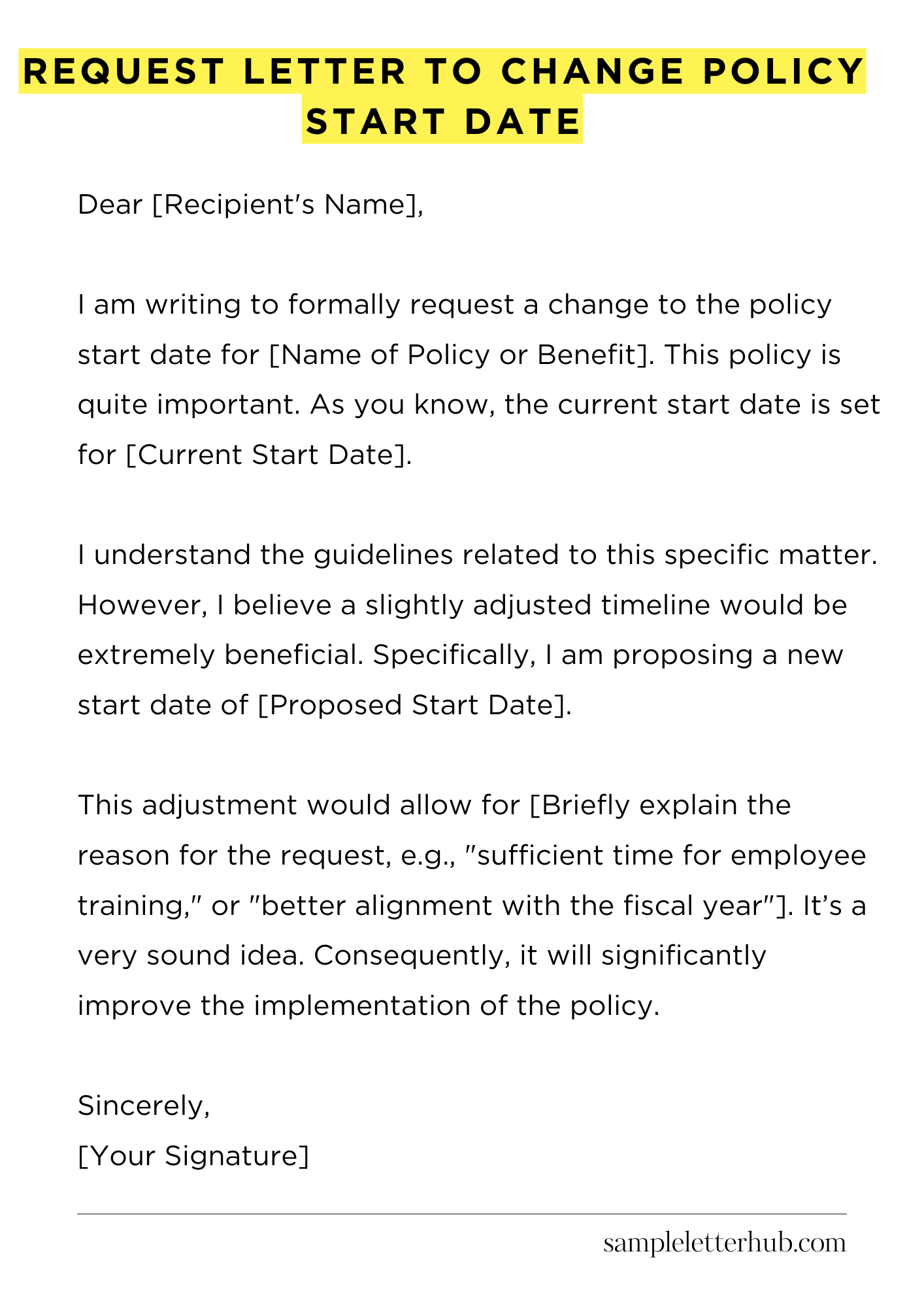
Dear [Recipient’s Name],
I am writing to formally request a change to the policy start date for [Name of Policy or Benefit]. This policy is quite important. As you know, the current start date is set for [Current Start Date].
I understand the guidelines related to this specific matter. However, I believe a slightly adjusted timeline would be extremely beneficial. Specifically, I am proposing a new start date of [Proposed Start Date].
This adjustment would allow for [Briefly explain the reason for the request, e.g., “sufficient time for employee training,” or “better alignment with the fiscal year”]. It’s a very sound idea. Consequently, it will significantly improve the implementation of the policy.
I am confident that this small shift will lead to greater efficiency and success for everyone involved. I have carefully considered the implications, and I am prepared to provide any additional information or clarification that you might need to approve this request.
I am available to discuss this matter at your convenience. I would be grateful if you would consider my request. Please let me know your thoughts.
Thank you for your time and consideration.
Sincerely,
[Your Signature]
How to Write Request Letter to Change Policy Start Date
Negotiating a policy’s commencement date can sometimes be necessary. It demands a carefully constructed request letter. This is to effectively communicate your need to the relevant authorities. Here’s a comprehensive guide to crafting a compelling request, ensuring your plea resonates and yields the desired outcome. Let’s get into the specifics.
1. Commence with Proper Salutations
The genesis of your letter should be a respectful salutation. Address the recipient by name and title whenever possible. This demonstrates a professional demeanor. If the specific individual is unknown, opt for a general title that aligns with the department or role.
Avoid generic greetings. Begin with “Dear Mr./Ms./Mx. [Surname]” or “To Whom It May Concern.” This sets a tone of professionalism from the outset.
2. The Opening Salvo: State Your Purpose Clearly
Immediately declare the intent of your missive. This is where you state why you are writing. This should be a concise statement of your request, explicitly mentioning the policy in question and the desired change.
For instance, “I am writing to formally request a modification to the commencement date of policy [Policy Name/Number].” Succinctly define the policy. Then, specify the alteration you are seeking. This prevents any ambiguity from the start.
3. Furnish Substantiating Context
The core of your argument lies in providing ample justification. Elaborate on the rationale behind your request. This is where you present your “cause”. Provide details concerning the circumstances that warrant a shift in the policy’s commencement.
This could encompass anything from unforeseen logistical challenges to personal hardships or changes in project scope. Support your claims with concrete facts, data, or evidence.
Illustrate the potential consequences of adhering to the original date. This ensures your argument is compelling and leaves a strong impact.
4. Articulate the Benefits of the Alteration
Beyond the justification, highlight the advantageous aspects of accommodating your request. Explain how modifying the start date would benefit both parties involved.
This could involve enhanced efficiency, risk mitigation, or improved alignment with project objectives. Showcase your understanding of the bigger picture. Demonstrate that the amendment is not just in your interest. It also is advantageous for the organization.
5. Present a Feasible Proposal
Clearly state the alternative date you propose. Be realistic and consider the feasibility of the change from the recipient’s perspective. It should be logical and reasonable. It’s often helpful to include a brief timeframe or outline explaining how the revised date will be implemented. This showcases that you’ve considered the practical ramifications. It also demonstrates your proactive approach.
6. Ensure a Professional Conclusion
Conclude the letter with a professional and appreciative closing. Reiterate your request and express your gratitude for the recipient’s consideration. Offer to provide additional information or clarification if required. Use a formal closing, such as “Sincerely,” or “Respectfully,” followed by your full name and title. Ensure a polished finish to leave a positive impression.
7. Polishing and Perfection: Proofreading and Format
Before dispatching your letter, subject it to a rigorous process of proofreading. Check for grammatical errors, typos, and inconsistencies in formatting.
Ensure the tone is consistent, and the language is clear and concise. A well-presented letter reinforces the professionalism of your request. It enhances the likelihood of a favorable response. Finally, maintain a clean, easy-to-read format. Employ standard fonts and spacing to enhance readability.
FAQs about Request Letter to Change Policy Start Date
What is the primary purpose of a request letter to change a policy start date?
The primary purpose of a request letter to change a policy start date is to formally petition an insurance provider, employer, or other relevant entity to adjust the commencement date of a specific policy or agreement. This is typically done when there’s a legitimate reason why the original start date is no longer feasible or aligns with the individual’s needs or circumstances.
What key information should be included in a request letter to change a policy start date?
Essential components of the request letter include the writer’s full name and contact information, the policy or agreement details (policy number, type, etc.), the original start date, the requested new start date, a clear and concise explanation for the requested change, supporting documentation (if applicable), and a polite closing with the writer’s signature.
What are some common reasons for requesting a change to a policy start date?
Common reasons include unforeseen circumstances like medical emergencies, delays in property settlement (for insurance), employment start date shifts, logistical problems impacting availability, or a failure to meet a contractually agreed upon timeline. Documentation to support the claim is often useful.
What is the best way to ensure a request to change a policy start date is successful?
To increase the likelihood of success, write the letter promptly and clearly, providing a well-articulated reason for the change. Attach supporting documentation that validates the explanation. Demonstrate a good understanding of the policy or agreement terms, and maintain a professional and courteous tone throughout the communication.
What are the possible outcomes after submitting a request to change a policy start date?
The outcomes vary, The request may be granted, leading to the new date taking effect. The request may be denied, with the original start date remaining in effect. Sometimes, a compromise is offered, like a partial change. The outcome depends on the specific policy, the validity of the reason, the entity’s flexibility, and possibly the timeliness of the request.
Related:
Resignation letter due to rude boss
Resignation letter moving to another state
Resignation letter due to illness of family member
Resignation letter due to study
Resignation letter due to long commute