


A request letter to change nominee in insurance policy is a formal document. It is a request to update the beneficiary listed on your insurance policy. The purpose is simple. It ensures your insurance benefits go to the person you choose. This change can be made at any time.
We understand this task can seem daunting. Writing a letter can be tough. Don’t worry! We’ve got you covered. This article offers several request letter samples. These templates will make it easy for you. You can adapt them to your specific needs.
We have various nominee change request letter samples. They cover different scenarios. Whether it’s a life insurance policy or another type. You can find the right example here. Use these letter templates and customize them. It’s a straightforward process.
[Your Name]
[Your Address]
[Your Phone Number]
[Your Email Address]
[Date]
[Insurance Company Name]
[Insurance Company Address]
Subject: Request to Change Nominee in Insurance Policy – Policy Number [Your Policy Number]
Dear Sir/Madam,
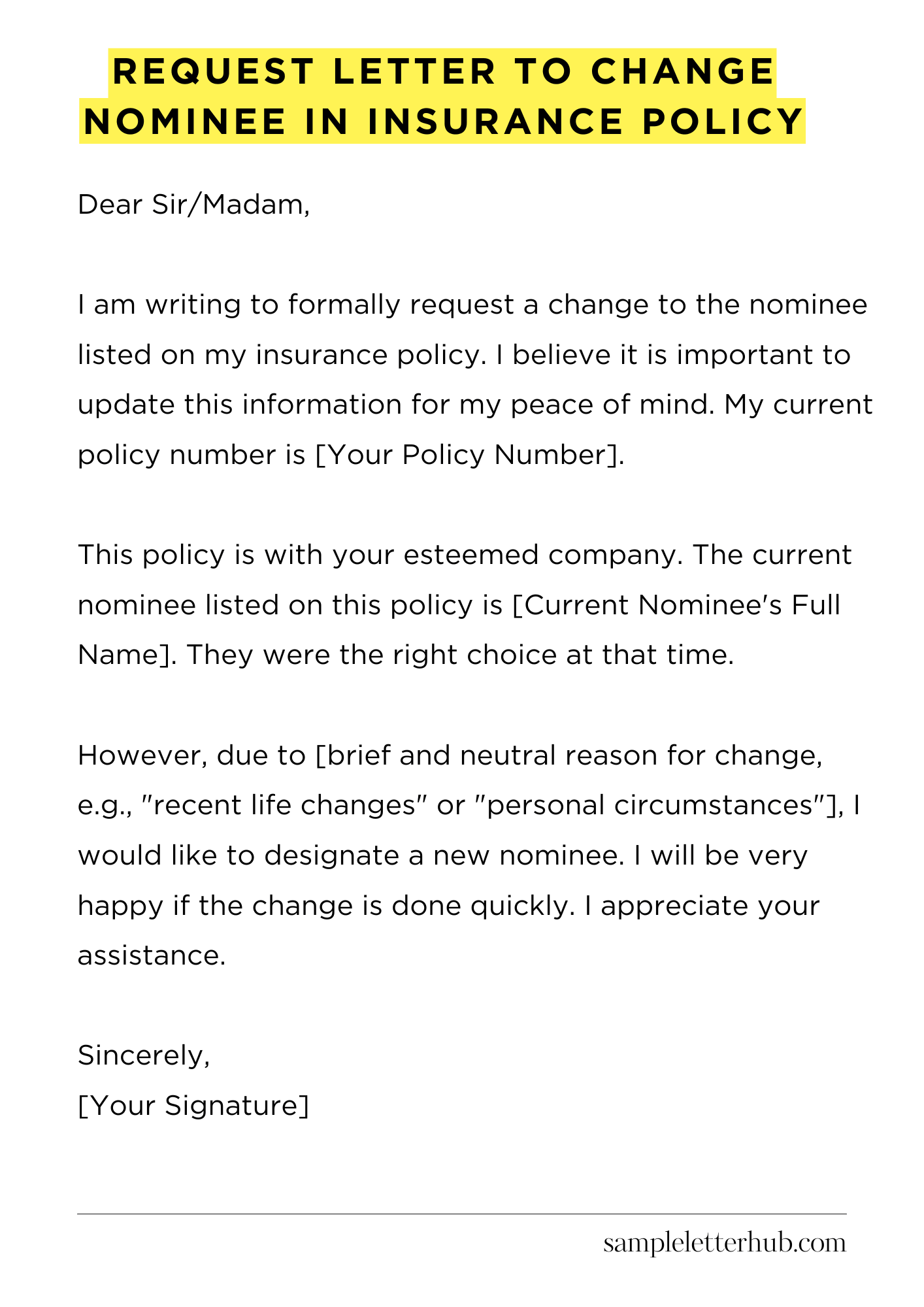
I am writing to formally request a change to the nominee listed on my insurance policy. I believe it is important to update this information for my peace of mind. My current policy number is [Your Policy Number].
This policy is with your esteemed company. The current nominee listed on this policy is [Current Nominee’s Full Name]. They were the right choice at that time.
However, due to [brief and neutral reason for change, e.g., “recent life changes” or “personal circumstances”], I would like to designate a new nominee. I will be very happy if the change is done quickly. I appreciate your assistance.
The new nominee I wish to designate is [New Nominee’s Full Name]. Their relationship to me is [New Nominee’s Relationship to You, e.g., “Spouse,” “Child,” “Parent”].
Their date of birth is [New Nominee’s Date of Birth] and their address is [New Nominee’s Address]. Please also include their contact details. Please use this number: [New Nominee’s Phone Number] or this email address: [New Nominee’s Email Address].
Please find enclosed a copy of my [relevant documents, e.g., “driver’s license” or “passport”] as proof of identification. It also contains the necessary information. I have attached it for your review.
Could you please send me the necessary forms to complete this change? Also, I would like to know the steps involved in completing this process. I will be very grateful for your assistance in this matter.
Thank you for your time and attention to this request. I look forward to your prompt response and confirmation of this change.
Sincerely,
[Your Signature]
How to Write Request Letter to Change Nominee in Insurance Policy
Navigating the nuances of an insurance policy can often feel like traversing a labyrinth. One crucial aspect is designating a nominee; however, life’s vicissitudes often necessitate changes. Modifying your nominee requires a formal request, typically in the form of a letter. Let’s delve into the mechanics of crafting this essential correspondence.
1. Initiate with Your Salutation and Address
Begin your letter with a formal salutation. “Dear Sir/Madam” is a universally accepted approach. Immediately below, provide the date, followed by your complete address. This ensures the recipient can swiftly identify the sender and the context of the communication. Precision is paramount; ensure every detail is impeccably rendered.
2. Subject Line: Crystallizing Your Intent
The subject line is your letter’s siren call. It should succinctly convey the purpose of your missive. Use a clear and concise subject line, such as “Subject: Request to Change Nominee in Insurance Policy [Policy Number].” This streamlines the processing of your request. Avoid ambiguity; brevity and clarity are your allies here.
3. Policy Particulars: Identifying the Core
The body of your letter must establish the policy’s particulars. State your full name, the policyholder’s name (if different from your own), and the policy number with unambiguous clarity. This guarantees seamless identification of the policy that needs alteration. Include the insurance company’s name and any other identifying information from your policy documents.
4. Articulating the Nominee Amendment: The Substantive Core
Now, articulate your request with precision. Clearly state that you intend to change the nominee. Provide the full name, address, relationship to you, and date of birth of the new nominee. If you’re removing a previous nominee, explicitly state that in the request. This avoids any misinterpretations. Ensure you provide all the requisite information.
5. Declaration of Consent and Verification
Include a statement affirming your explicit consent to the nominee change. This often involves a declaration that you understand the implications and that the new nominee will be entitled to the policy benefits. You may also need to reiterate that you are the rightful policyholder. Verification may include a statement about submitting necessary documentation.
6. The Formal Closure: Polishing the Peroration
Close your letter with a formal and polite closing. Phrases like “Sincerely,” “Yours faithfully,” or “Respectfully” are appropriate. After the closing, leave space for your signature and then type your full name. If you are attaching any supporting documentation, mention them clearly. A meticulously crafted closure lends credence to your request.
7. Document Submission and Record Keeping
Before dispatching your letter, make a copy for your records. This serves as invaluable proof of your communication. Send the original letter via a method that provides proof of delivery, such as registered post or courier. Retain the tracking information for your reference. Keeping a meticulous record is a prudent practice in all insurance matters.
FAQs about Request Letter to Change Nominee in Insurance Policy
What is the primary purpose of a request letter to change a nominee in an insurance policy?
The primary purpose is to formally notify the insurance provider of your decision to alter the designated beneficiary (nominee) who will receive the policy’s benefits in the event of your death. This letter ensures that the insurer updates their records accurately to reflect your current wishes.
What specific information needs to be included in a request letter to change a nominee?
The letter should include your full name, policy number, the current nominee’s name, the new nominee’s full name, date of birth, relationship to you, and contact details. It is also important to explicitly state your request for the nominee change and include your signature, along with the date. Some policies may also require supporting documents for the new nominee.
What are the legal implications of not updating the nominee in an insurance policy?
Failure to update the nominee can have significant legal implications. If the designated nominee is deceased or the relationship to the nominee has changed, the policy benefits may not be distributed as intended. The benefits might go to the original nominee’s estate, the deceased’s heirs, or the insurance company, depending on the policy’s terms and applicable laws.
How do I submit the request letter to the insurance company, and what is the typical processing time?
You typically submit the letter by mail, email, or through the online portal of your insurance provider. Always retain a copy for your records.
Processing times vary by insurer but generally range from a few days to several weeks. Following submission, you should receive a confirmation or a revised policy document reflecting the change; it is advisable to follow up if you haven’t received confirmation within a reasonable timeframe.
Can I change the nominee multiple times, and are there any limitations?
Yes, you can typically change the nominee multiple times throughout the policy’s term. However, there might be limitations depending on your specific policy terms and conditions. For example, some policies may require the consent of the existing nominee if they are irrevocable.
It is essential to review your policy document or contact your insurance provider to understand any restrictions or requirements related to nominee changes.
Related:
Resignation letter due to rude boss
Resignation letter moving to another state
Resignation letter due to illness of family member
Resignation letter due to study
Resignation letter due to long commute