

Ever need to adjust your insurance coverage? A request letter to change insurance policy term is your tool. It’s a formal way to ask your insurance provider to modify the terms of your existing policy. You might want to update coverage amounts or make other crucial adjustments. The goal is to align your insurance with your current needs.
We understand writing these letters can feel daunting. That’s why we’ve got you covered. This article offers helpful request letter templates. We’ll also share examples and samples! We want to simplify the process. This helps you change insurance policy term with ease.
Consider this your friendly guide. We’ll provide a variety of formats. Use these samples to craft your own request letter. Remember, clear communication with your insurance provider is essential. This helps you get the coverage you need.
[Your Name]
[Your Address]
[Your Phone Number]
[Your Email Address]
[Date]
[Insurance Company Name]
[Insurance Company Address]
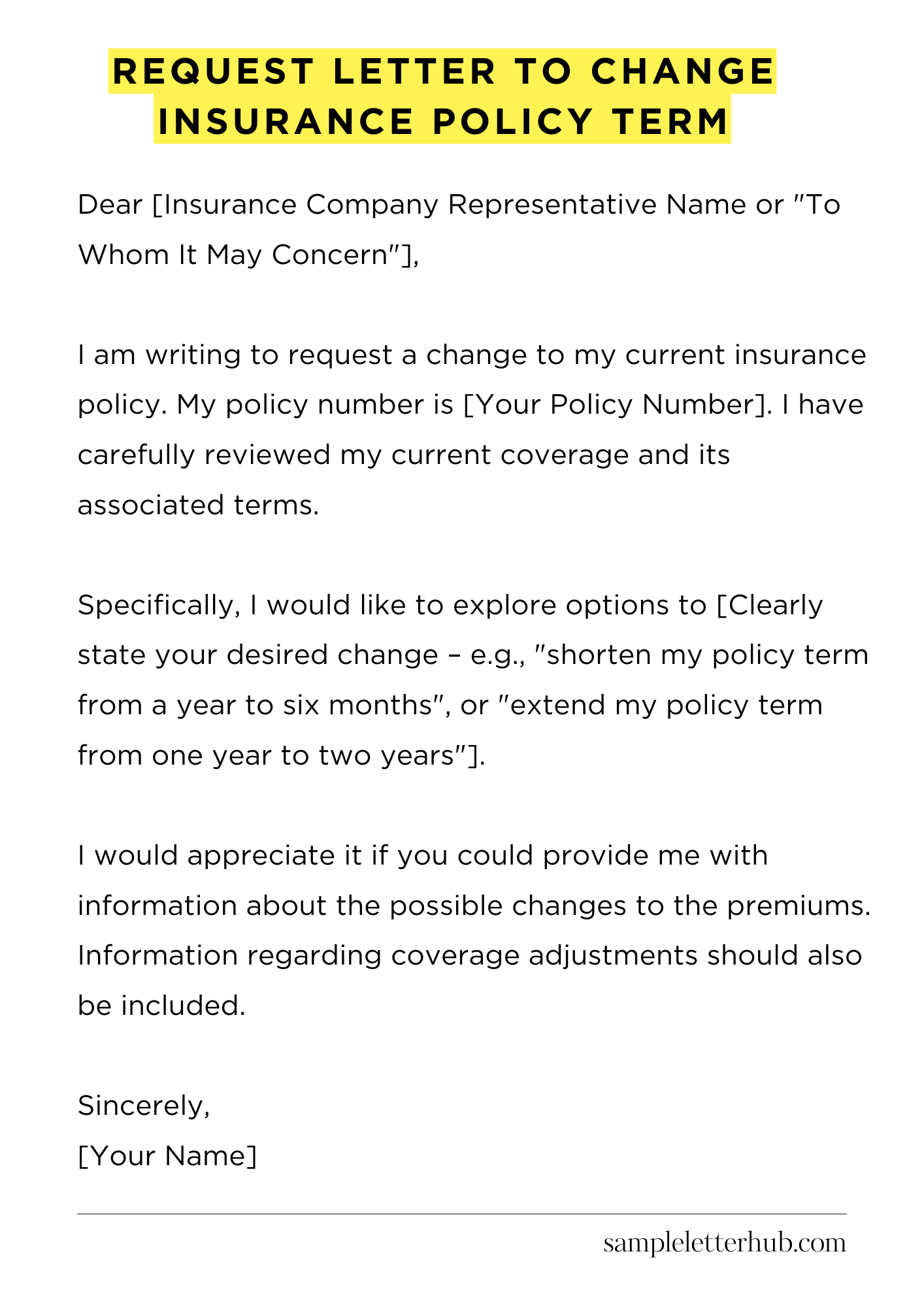
Dear [Insurance Company Representative Name or “To Whom It May Concern”],
I am writing to request a change to my current insurance policy. My policy number is [Your Policy Number]. I have carefully reviewed my current coverage and its associated terms. After some consideration, I believe adjusting the policy term would better suit my needs.
Specifically, I would like to explore options to [Clearly state your desired change – e.g., “shorten my policy term from a year to six months”, or “extend my policy term from one year to two years”]. This would allow me to [Briefly explain your reason – e.g., “better manage my budget”, or “align the policy with a longer-term financial goal”]. Understanding these points is crucial.
I would appreciate it if you could provide me with information about the possible changes to the premiums. Information regarding coverage adjustments should also be included. Understanding the impact on my existing benefits is important.
Please let me know what steps are required to facilitate this change. Are there any forms I need to complete, or documents I need to provide? I am available to discuss this further at your earliest convenience. I look forward to hearing from you soon.
Thank you for your time and assistance with this matter.
Sincerely,
[Your Name]
How to Write Request Letter to Change Insurance Policy Term
Navigating the labyrinthine world of insurance policies can sometimes feel like traversing a treacherous mountain pass. You might find yourself wanting to alter the very foundations of your coverage. A well-crafted request letter is your most potent tool.
This is a pragmatic guide to help you compose a compelling missive that prompts the desired amendments to your insurance policy’s term.
1. Commence with a Cogent Salutation
The commencement is paramount. Address your letter to the correct recipient – typically the insurance company’s customer service department or a specific claims representative, if one has been assigned to your case.
A formal salutation, such as “Dear [Name of Representative/Department],” sets the appropriate tone and projects professionalism. Verify the addressee’s particulars to eliminate any prospect of the letter being misdirected.
2. The Subject Line: A Succinct Synopsis
The subject line serves as the initial introduction to the matter at hand. It must succinctly convey the core purpose of your letter. Employ language that’s both direct and unambiguous.
Examples include: “Request for Policy Term Modification,” or “Amendment Request – Policy Number [Your Policy Number].” This ensures the recipient immediately grasps the essence of your communication.
3. Explicitly State Your Purpose
In the opening paragraph, delineate your precise objective. Clearly articulate your intention to amend the existing insurance policy term. Include crucial details like the policy number, type of insurance, and the current term.
If there are any specific clauses or sections you are targeting for alteration, mention them explicitly. Conciseness is key; be direct and avoid unnecessary verbosity.
4. Articulate the Rationale for Your Request
This is where you elucidate the “why” behind your request. Provide a cogent justification for the proposed modification. This is where you marshal your arguments and lay the groundwork for your request.
Whether it’s a change in your personal circumstances, a revised assessment of your risk profile, or a desire for different coverage, detail your reasoning. Supported by concrete evidence is highly recommended. The more convincing your rationale, the greater the likelihood of a positive outcome.
5. Specify the Desired Alterations with Precision
Clearly stipulate the precise modifications you are seeking. Specify the new policy term, any desired changes to the coverage amount, or any other pertinent details.
Precision is critical; ambiguity will only result in delays or misunderstandings. If the requested changes involve specific dates or amounts, make certain to specify them accurately to mitigate any confusion.
6. Documentation: The Bedrock of Your Case
Include any supporting documentation that bolsters your request. This might involve medical reports, financial statements, or any other relevant evidence.
Make copies of the documents and retain the originals for your records. Reference these documents within the body of your letter to maintain coherence. Remember that a comprehensive supporting document provides compelling evidence.
7. Conclusion and Closing: A Call to Action
Conclude your letter with a polite but firm call to action. Summarize your request and express your expectation for a prompt response. Include your contact information—phone number, email address, and mailing address—to facilitate communication.
Finally, close with a professional sign-off, such as “Sincerely,” or “Respectfully,” followed by your full name and signature. This final step solidifies your request.
FAQs about Request Letter to Change Insurance Policy Term
What is a “Request Letter to Change Insurance Policy Term” and why is it needed?
A “Request Letter to Change Insurance Policy Term” is a formal written document submitted to an insurance provider to request modifications to the terms of an existing insurance policy.
This letter is necessary when a policyholder desires to adjust elements such as the policy’s duration, coverage amount, or payment schedule. The need arises from changes in personal circumstances, financial situations, or evolving insurance requirements.
What specific details should be included in a request letter to change an insurance policy term?
A comprehensive request letter should include the policyholder’s full name, policy number, and contact information. Clearly state the desired changes, such as the new policy term (e.g., from a 10-year term to a 20-year term), the revised coverage amount, or adjustments to premium payment frequency.
The letter should also specify the date the changes should take effect and may include a brief explanation of the reasons for the requested modifications. It’s often beneficial to include supporting documentation, such as proof of a life event, if applicable.
What are the potential consequences of not properly submitting a request to change an insurance policy?
Failing to properly submit a request letter can lead to the denial of the requested changes. Without a valid request, the insurance policy will remain under its original terms, which might not align with the policyholder’s current needs or circumstances.
This could result in inadequate coverage, higher premiums than necessary, or difficulty in filing claims if the existing policy doesn’t meet the policyholder’s updated requirements.
How long does it typically take for an insurance company to process a request letter for a policy term change?
The processing time for a request letter to change a policy term varies depending on the insurance company, the complexity of the changes, and the volume of requests they are currently handling.
Generally, it can take anywhere from a few days to several weeks. Policyholders should inquire about the estimated processing time when submitting the letter and follow up if they do not receive a response within the stated timeframe.
Are there any associated fees or charges for changing an insurance policy term?
Whether fees or charges apply for changing an insurance policy term depends on the specific insurance company and the type of changes being requested. Some changes, such as increasing coverage amounts, may result in higher premiums. Certain policies may also have associated administrative fees for processing changes.
Policyholders should review their policy documents or contact their insurance provider to understand any potential costs related to the requested modifications before submitting the request letter.
Related:
Resignation letter due to rude boss
Resignation letter moving to another state
Resignation letter due to illness of family member
Resignation letter due to study
Resignation letter due to long commute