

So, you want to adjust how your assets are divided after you’re gone? A “Request Letter to Change Beneficiary Percentage Share” lets you do just that. It’s a formal way to update the allocation of your inheritance. This letter ensures your wishes are clearly communicated to banks, insurance companies, or other institutions holding your assets.
Need to draft one of these letters? You’re in the right place. We’ve got you covered with a selection of handy templates. These are specifically for a “Request Letter to Change Beneficiary Percentage Share.” We’ll provide several letter examples.
Want a simple solution? We make writing easier. Use our sample letters. They will help you personalize and quickly create your own “Request Letter to Change Beneficiary Percentage Share.” Let’s get started.
[Your Name]
[Your Address]
[Your Phone Number]
[Your Email Address]
[Date]
[Name of Financial Institution or Company]
[Address of Financial Institution or Company]
Subject: Request to Change Beneficiary Percentage Share
Dear [Name of Contact Person or Department],
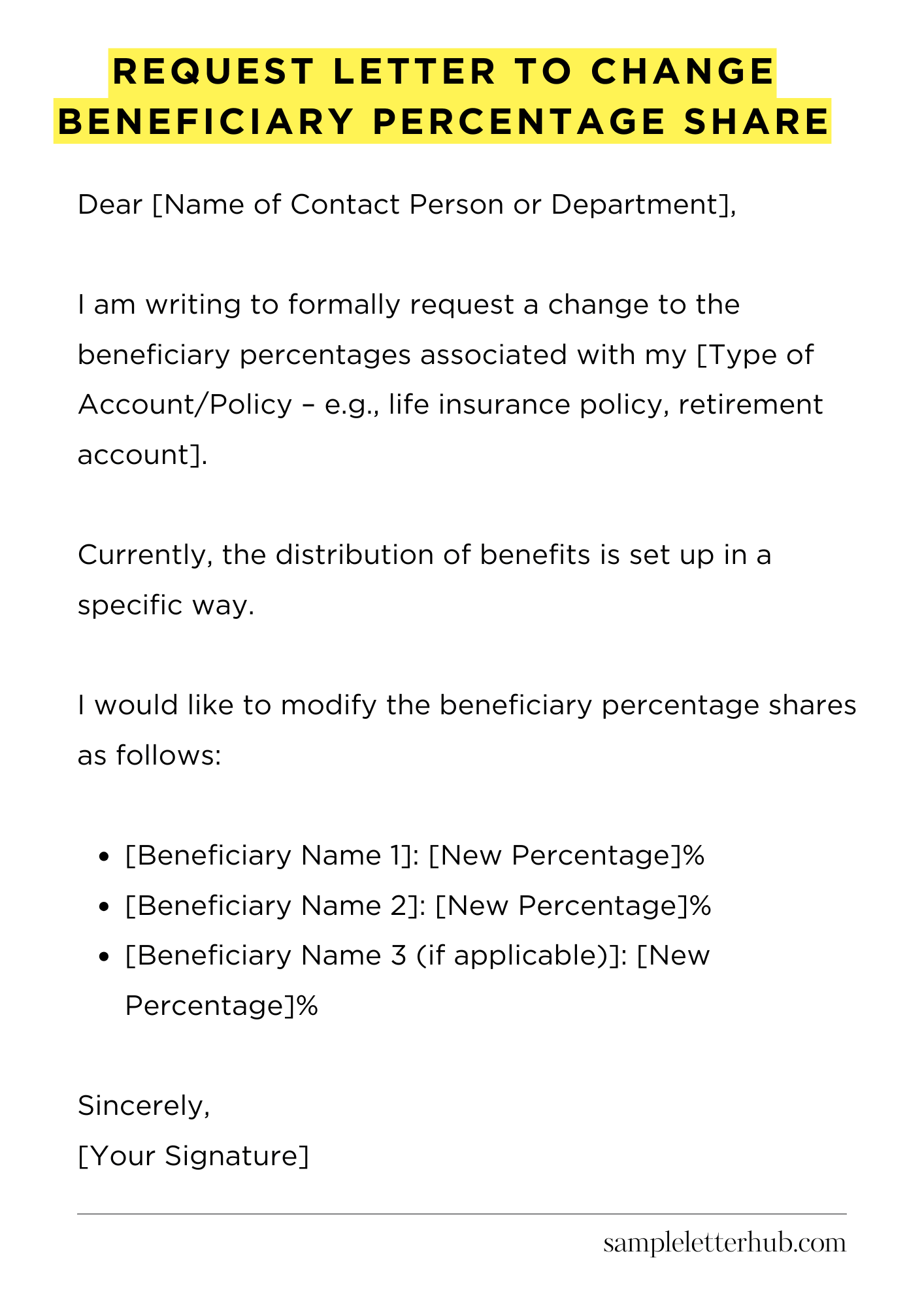
I am writing to formally request a change to the beneficiary percentages associated with my [Type of Account/Policy – e.g., life insurance policy, retirement account]. I want to make sure my wishes are correctly reflected. This is important to me, and I appreciate your help.
Currently, the distribution of benefits is set up in a specific way. However, my circumstances have changed, and I need to update the allocation of my assets. I have carefully considered this decision. I believe it is necessary to make these adjustments.
I would like to modify the beneficiary percentage shares as follows:
- [Beneficiary Name 1]: [New Percentage]%
- [Beneficiary Name 2]: [New Percentage]%
- [Beneficiary Name 3 (if applicable)]: [New Percentage]%
Please confirm receipt of this request and let me know what documentation I need to provide to facilitate this change. I’m ready to comply with the process. I am eager to get this resolved quickly.
I have included a copy of my [Relevant Document – e.g., policy document, account statement] for your reference, and my account number is [Your Account Number]. My aim is to ensure the update goes smoothly. You will find that I have attached the necessary document with this Letter.
Thank you for your time and assistance in processing this request. I look forward to hearing from you soon regarding the next steps. I am available at your convenience to discuss any questions.
Sincerely,
[Your Signature]
How to Write Request Letter to Change Beneficiary Percentage Share
1. Initiate with Precision: The Salutation and Introductory Cadence
Commence your missive with a formal salutation. Address the intended recipient meticulously, using their proper title and full name. For instance, “Dear [Name of Administrator, Title]” is a standard and effective approach.
Following the salutation, a concise introduction stating your purpose is paramount. State unequivocally that you are writing to request a modification of beneficiary designations and percentages. This upfront declaration establishes the focal point of the letter immediately.
2. The Core Tenets: Providing Context and Rationale
The succeeding section demands a detailed exposition of the situation. Explicitly identify the policy, account number, or specific instrument for which the modification is intended.
This granular detail is non-negotiable. Now, provide a compelling rationale for the requested alteration. Be straightforward; legibility is critical. Perhaps there has been a significant life event, such as a birth, marriage, divorce, or the demise of a previously designated beneficiary. Articulate the precise reasons behind the redistribution of assets.
3. Declarative Clarity: Specifying the Adjusted Percentages
This is where precision is king. Present the proposed allocation of percentages with absolute clarity. Create a table, list, or bullet-pointed structure to enhance readability.
This minimizes any potential for misinterpretation. Specify the exact percentage for each beneficiary. Make sure the total percentage assigned aggregates to 100%. Any discrepancy here could create significant legal complications. A lack of clarity at this stage is a cardinal sin.
4. Documentation: The Evidentiary Imperative
Now, prepare to furnish supporting documentation. This step reinforces your claims and validates your request. The type of documentation required will depend on the specifics of the situation and the policies of the financial institution.
However, some examples include copies of a new marriage certificate or a death certificate. You might also include copies of any existing beneficiary designation forms. Attaching the appropriate supporting documents will invariably expedite the approval process and enhance the legitimacy of your request.
5. Formalities: The Witness and Notarization Quandary
Depending on the type of account and the regulations of the relevant institution, your request letter may necessitate witness signatures or notarization. Assess the requirements carefully.
Some financial institutions demand witness verification. Others may require notarization to authenticate your signature. If either is required, make certain you comply with all procedures. Failure to do so could invalidate your request. Double-check for specific instructions to ensure meticulousness.
6. The Concluding Paragraph: The Amicable Adieu and Action Solicitation
Conclude your letter with a polite and professional closing paragraph. Express your anticipation for a positive response and your willingness to cooperate with any additional requirements.
Include an expression of gratitude for their attention to the matter. Provide your contact information, including your full address, phone number, and email address, for convenient communication. This act of courtesy demonstrates your professionalism and facilitates swift and easy communication.
7. The Proofreading Prerogative: Accuracy and the Final Scrutiny
Before dispatching your letter, engage in a rigorous proofreading exercise. Scrutinize every word, every punctuation mark, and every figure for errors. Verify the accuracy of all names, dates, and account numbers.
Consider asking a second pair of eyes to review your letter; another person can often spot errors you might have missed. Any errors can delay the entire process or create significant difficulties. Ensure that your request is unequivocally understood and legally sound.
FAQs about Request Letter to Change Beneficiary Percentage Share
What is a beneficiary percentage share and why might it need to be changed?
A beneficiary percentage share designates the portion of assets, such as life insurance proceeds, retirement accounts, or other financial instruments, that each designated beneficiary will receive upon the death of the policyholder or account owner.
Changes might be necessary due to various life events, including the birth or death of a beneficiary, divorce, remarriage, or a change in financial circumstances of either the beneficiaries or the policyholder. These changes ensure the distribution of assets reflects the current wishes and needs of the individual.
What information should be included in a request letter to change beneficiary percentage shares?
The request letter should clearly identify the policy or account information (policy number, account type, etc.), the current beneficiaries and their existing percentage shares, and the new percentages. It must explicitly state the desired changes, provide the full legal names, addresses, and any relevant identification details (e.g., date of birth, Social Security number) for all beneficiaries.
The letter usually requires the policyholder’s signature, and may need to be notarized or witnessed, depending on the specific requirements of the financial institution.
Is there a specific format required for a request letter to change beneficiary percentages?
While there isn’t a universally mandated format, it is advisable to follow a professional business letter format, including the date, the recipient’s information (financial institution’s name and address), a clear subject line (e.g., “Request to Change Beneficiary Designations”).
Some institutions might provide a specific form that should be used in addition to, or in place of, a letter; therefore, it’s best practice to check with the institution.
What are the legal considerations when changing beneficiary percentage shares?
The legal considerations vary depending on the jurisdiction and the type of asset. Generally, the policyholder must be of sound mind and not acting under duress when making the changes. Some financial instruments might require spousal consent for changes if community property laws apply.
It’s also important to adhere to the institution’s specific requirements, as failure to do so could render the change invalid. Seeking legal advice is prudent, particularly if the changes are complex or involve a significant amount of assets, or in case of any disputes between beneficiaries.
How do I submit the request letter to change beneficiary percentages?
The method of submission depends on the institution. It may be submitted via postal mail, by fax, or, in some cases, electronically. Typically, the financial institution will provide clear instructions on how to submit the request, and the policyholder should retain a copy of the letter, along with any confirmation from the institution, for their records.
Always confirm receipt and processing of the request with the financial institution to ensure the changes are implemented correctly.
Related:
Resignation letter due to rude boss
Resignation letter moving to another state
Resignation letter due to illness of family member
Resignation letter due to study
Resignation letter due to long commute