

A request letter for renewal of an insurance policy is a simple letter. Its purpose is to ask your insurance provider to extend your insurance coverage. This ensures continuous protection. It’s crucial for keeping your policy active.
Need to renew your insurance policy? We’ve got you covered. We’re sharing helpful letter templates. These are samples of request letters for insurance renewal. They simplify the process.
This article offers easy-to-use examples. Crafting your own renewal request letter will be easy. Adapt the templates to fit your specific insurance needs. Get ready to renew your insurance!
[Your Name]
[Your Address]
[Your Phone Number]
[Your Email Address]
[Date]
[Insurance Company Name]
[Insurance Company Address]
Dear Sir/Madam,
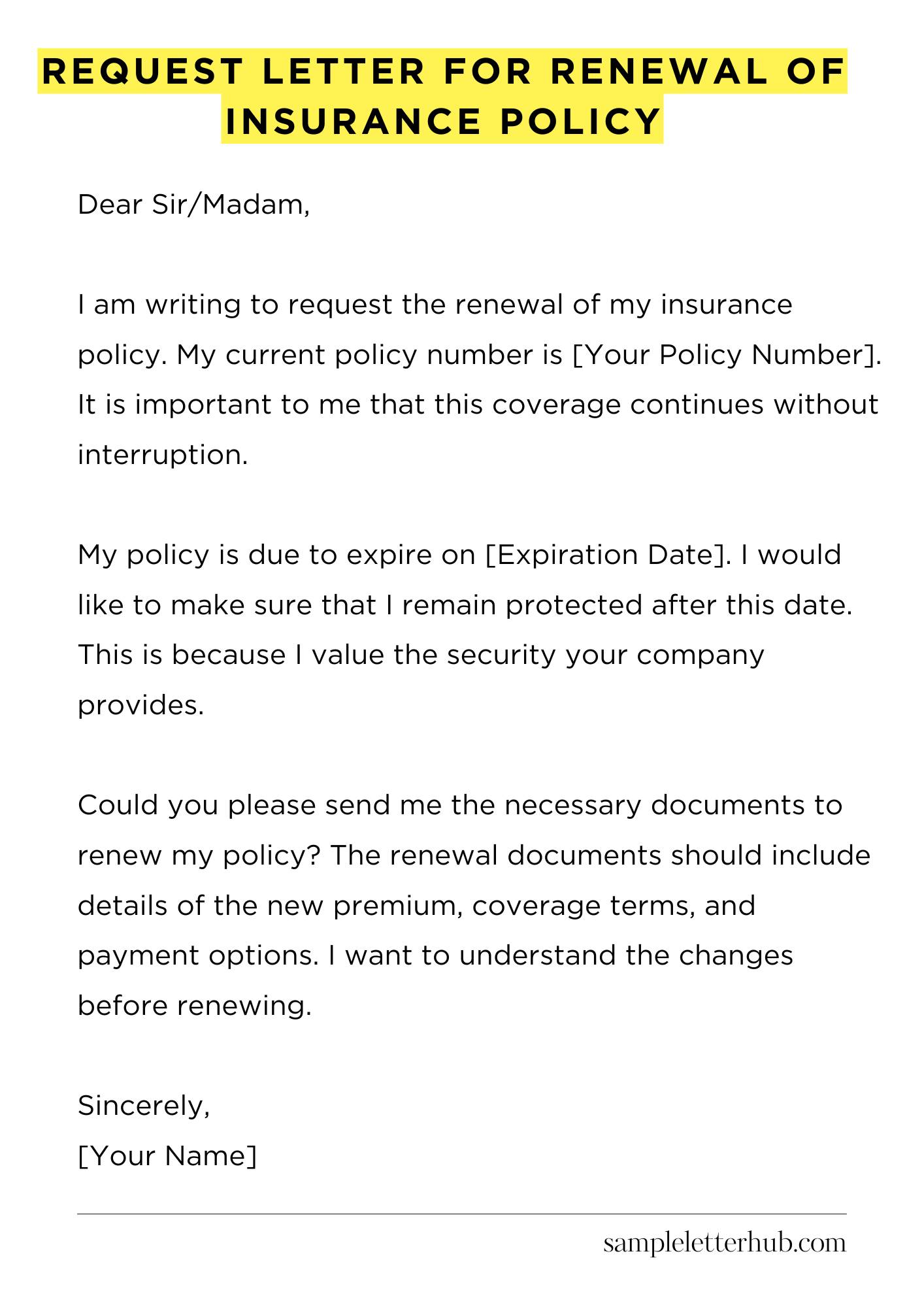
I am writing to request the renewal of my insurance policy. My current policy number is [Your Policy Number]. It is important to me that this coverage continues without interruption.
My policy is due to expire on [Expiration Date]. I would like to make sure that I remain protected after this date. This is because I value the security your company provides.
Could you please send me the necessary documents to renew my policy? The renewal documents should include details of the new premium, coverage terms, and payment options. I want to understand the changes before renewing.
I prefer to receive these documents by email. My email address is listed above. However, if that’s not possible, please mail them to the address above. I will review the documents carefully and respond promptly.
Thank you for your time and assistance. I look forward to hearing from you soon. I appreciate your prompt attention to this matter.
Sincerely,
[Your Name]
How to Write Request Letter for Renewal of Insurance Policy
Your insurance policy’s expiration date looms, a critical juncture that demands your immediate attention. Don’t let your coverage lapse! A well-crafted request letter is your first line of defense. Here’s a comprehensive guide to composing a letter that not only secures the renewal of your policy but also demonstrates your diligence to the insurance provider.
1. Commence with a Formal Salutation
Begin your missive with a salutation that reflects professionalism. Addressing the insurance provider by name, if possible, is always a superior approach. You might write, “Dear Mr./Ms. [Last Name],” or “To Whom It May Concern,” if a specific contact is unavailable. Ensure your tone is respectful and considerate from the onset, setting a positive foundation for your request.
2. Clearly State Your Objective
The crux of your letter needs to be clear and concise. Immediately state your intent: to renew your insurance policy. Include the policy number and the specific type of insurance (e.g., auto, home, health).
A direct and unambiguous opening sets the stage and helps the recipient quickly understand the purpose of your communication. For example: “This letter is to formally request the renewal of my policy number [Policy Number] for [Type of Insurance] coverage.”
3. Provide Crucial Policy Details
Accuracy is paramount in insurance matters. Furnish all the indispensable details of your policy. This includes the policy’s effective date, expiration date, and any specific coverage levels you require.
Specifying your desired effective date for the renewed policy avoids any ambiguity. Include all supplementary policy details; This will facilitate the renewal process, thus streamlining it for the insurance provider.
4. Enquire About Premium and Payment Modalities
Transparency regarding the financial aspects is essential. Request information about the renewal premium. Inquire about the different payment options available.
Whether it is through monthly installments or a lump-sum payment, specifying your preferred method early on allows for a seamless transition. For instance: “Please provide the updated premium amount and outline the payment options available for this renewal.”
5. Highlight Any Changes or Updates
Have there been any alterations to your situation since the initial policy was underwritten? Inform the insurance provider of any such changes.
This may include modifications to your address, the addition of a new vehicle, or any other relevant information that could impact your premium or coverage. Full disclosure is a prerequisite to securing the best possible rates and ensuring adequate protection. Be thorough.
6. Express Gratitude and Anticipate a Response
Conclude your letter with a gesture of goodwill and a clear expectation for a timely response. Thank the insurance provider for their service. Indicate your willingness to answer any queries they might have. For instance: “Thank you for your assistance with this matter.
Please do not hesitate to contact me if you require any further information. I look forward to receiving confirmation of my policy renewal.”
7. Finalize with a Professional Closing
The closing of your letter should mirror the formality of your salutation. Use a closing such as “Sincerely,” “Yours sincerely,” or “Respectfully,” followed by your full name. Provide your contact details, including your phone number and email address, to facilitate easy communication. A well-structured conclusion leaves a lasting impression of professionalism and attentiveness.
FAQs about Request Letter for Renewal of Insurance Policy
What is the primary purpose of a request letter for insurance policy renewal?
The primary purpose of a request letter for insurance policy renewal is to formally notify the insurance provider of the policyholder’s intention to continue coverage.
It serves as a documented communication, explicitly stating the desire to renew the existing policy and preventing any lapse in coverage. This ensures the policyholder maintains protection against potential risks covered by the policy.
What essential information should be included in a renewal request letter?
A well-structured renewal request letter should include the policyholder’s full name, address, and contact information. The policy number must be clearly stated for identification.
The letter should specify the type of insurance policy (e.g., auto, home, health) and the desired renewal period. It’s often helpful to include the effective date and any specific requests regarding changes or updates to the policy, such as address updates or alterations in coverage. Finally, the letter should be dated and signed by the policyholder.
When should the insurance policy renewal request letter be sent?
The insurance policy renewal request letter should ideally be sent to the insurance provider well in advance of the policy’s expiration date. A general guideline is to send it at least 30 to 60 days before the policy’s expiry.
This timeframe allows sufficient time for the insurance company to process the request, generate a renewal quote, and send the necessary documents. This also gives the policyholder enough time to review the new terms and conditions or discuss any questions before the policy expires.
Can I renew my insurance policy if I haven’t received a renewal notice?
Yes, you can typically renew your insurance policy even if you haven’t received a renewal notice. It’s the policyholder’s responsibility to ensure their policy remains active.
If you haven’t received a notice, you can proactively contact your insurance provider or broker, provide your policy details, and request a renewal quote. Sending a formal renewal request letter with the necessary information will help initiate the renewal process.
What if I want to make changes to my policy during renewal?
If you wish to make changes to your insurance policy during renewal, such as adjusting the coverage limits, adding or removing coverage options, or updating personal information, these details should be clearly communicated in your renewal request letter or accompanying documents.
Be as specific as possible about the desired modifications. The insurance provider will then review your requests and provide a revised quote reflecting the changes. Following the quote’s receipt, you can then confirm your approval to finalize the policy renewal.
Related:
Resignation letter due to rude boss
Resignation letter moving to another state
Resignation letter due to illness of family member
Resignation letter due to study