

Ever driven safely and wished for a reward? A “Request Letter for Premium Reduction Due to Safe Driving” is your chance. It’s a formal request to your insurance company. Its purpose? To lower your auto insurance costs. This is thanks to your proven history of safe driving.
We know writing can be tough. Don’t worry! We’ve got you covered. We’ll share sample letters for insurance premium reductions. These templates will simplify the process. Safe driving deserves recognition. These letters are your key to potential savings on your car insurance.
Ready to save some money? Use our examples for your request letter. We’ll provide various scenarios. Find the perfect fit for your situation. Get started today and possibly reduce your insurance premium! Let’s get you that premium reduction!
[Your Name]
[Your Address]
[Your Phone Number]
[Your Email Address]
[Date]
[Insurance Company Name]
[Insurance Company Address]
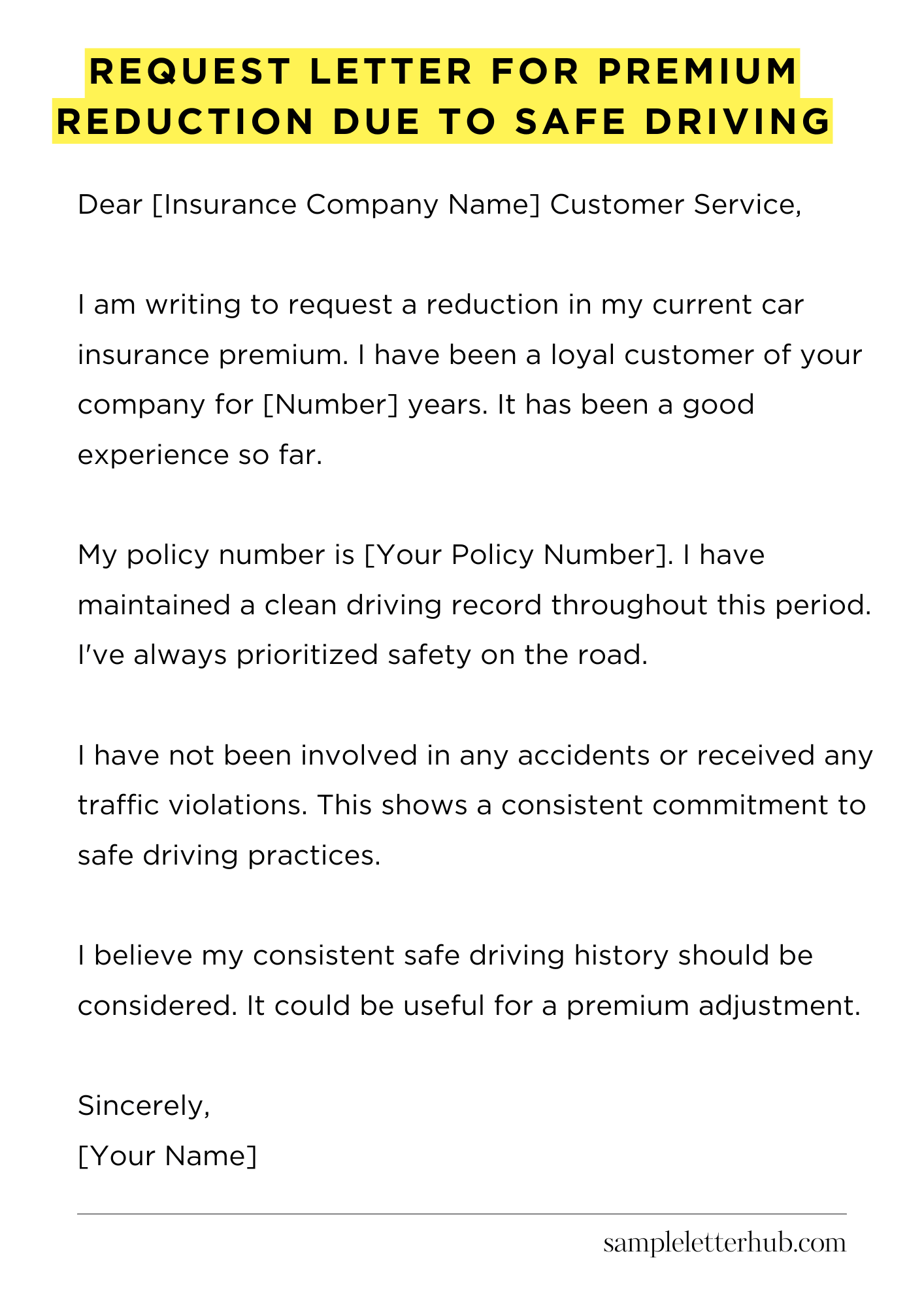
Dear [Insurance Company Name] Customer Service,
I am writing to request a reduction in my current car insurance premium. I have been a loyal customer of your company for [Number] years. It has been a good experience so far.
My policy number is [Your Policy Number]. I have maintained a clean driving record throughout this period. I’ve always prioritized safety on the road.
I have not been involved in any accidents or received any traffic violations. This shows a consistent commitment to safe driving practices. This is something I take very seriously.
I believe my consistent safe driving history should be considered. It could be useful for a premium adjustment. I am hoping you will reward my good driving habits.
I have attached copies of my driving record for your review. This includes a report from the [Name of DMV/Relevant Authority]. It confirms my clean record. I wanted to make the process easier.
Thank you for your time and consideration of my request. I look forward to your positive response. I am expecting a fair outcome.
Sincerely,
[Your Name]
How to Write Request Letter for Premium Reduction Due to Safe Driving
Navigating the labyrinthine world of insurance can be daunting, but often, demonstrating responsible behavior, such as safe driving, can yield tangible benefits. A well-crafted request letter can be the key to unlocking significant premium reductions. This guide provides a comprehensive roadmap for constructing a persuasive and effective request.
1. Commence with a Cogent Introduction
Your letter’s opening sets the tone. Begin by explicitly stating your purpose: to request a reduction in your insurance premium based on your exemplary driving record. Identify yourself clearly, including your full name, address, policy number, and the date. Be direct; ambiguity serves no purpose here. State your intent immediately; this showcases your perspicacity.
2. Substantiate Your Pristine Driving Record
This is the core of your argument, the very sine qua non of your request. Provide concrete evidence of your safe driving. This might involve a summary of your driving history, highlighting the absence of accidents, traffic violations, or claims filed against your policy.
If available, include a copy of your driving record from the DMV, and any telematics data that illustrates your driving habits. Quantify your prudence; state the number of years you’ve driven without incident. Demonstrate your commitment to safety in a compelling manner.
3. Articulate Your Rationale Persuasively
Beyond simply presenting facts, you need to provide a logical rationale for why a premium reduction is warranted. Emphasize that your safe driving history reduces the risk for the insurer.
Explain that you believe your risk profile justifies a lower premium. You’re effectively arguing that your behavior merits recognition and financial reward. Leverage the principles of risk management by explaining that you are a lower risk to the company.
4. Cite Relevant Policy Provisions (If Applicable)
Carefully review your insurance policy. Does it explicitly mention provisions for premium reductions based on safe driving records? If so, cite these directly in your letter. Refer to the specific clauses, sections, or even page numbers.
This demonstrates you have read your policy meticulously, and that you understand the terms of your contract. This also provides additional backing to your request.
5. Include Supporting Documentation
Supplement your letter with supporting documentation. This may encompass your driving record from the Department of Motor Vehicles (DMV), dashcam footage (if applicable and relevant), certificates of completion for defensive driving courses (if undertaken), or even telematics data from your insurer, if available.
Such materials are instrumental in supporting your claims, and thus strengthen your petition.
6. Conclude with a Courteous and Decisive Closing
End your letter with a clear call to action. Reiterate your request for a premium reduction, and explicitly state your expectation for a prompt response. Express your gratitude for their consideration of your request. Include your contact information (phone number and email address) again. A proactive approach is always appreciated. Be cordial but resolute.
7. Polishing and Perfection: Proofreading and Formatting
Before sending, meticulously proofread your letter for any grammatical errors or typos. Double-check all details, including policy numbers and dates. Ensure the formatting is professional and easy to read.
A well-presented letter reinforces your credibility. Consider using a formal business letter format; this enhances your overall presentation. A well-written letter reflects professionalism and underscores your commitment to detail.
FAQs about Request Letter for Premium Reduction Due to Safe Driving
What is the primary purpose of a request letter for a premium reduction due to safe driving?
The primary purpose of the request letter is to formally ask your insurance provider to lower your insurance premium because of your demonstrated safe driving record. This typically involves providing evidence of a clean driving history, which might include no accidents, traffic violations, or claims filed within a specific timeframe.
What information should I include in the request letter to maximize my chances of success?
Your request letter should include your full name, policy number, and contact information. Clearly state your request for a premium reduction and explain the reason – your safe driving record.
Provide specific details, such as the period for which you have maintained a clean record (e.g., three years), and any supporting documentation, like a copy of your driving record from the DMV, if required by your insurer. Also, be sure to include any potential incentives your insurer may offer.
What types of documentation are typically required to support my safe driving claim?
The documentation needed varies by insurance provider. Common requirements include a copy of your driving record, which can be obtained from your local Department of Motor Vehicles (DMV) or equivalent agency.
You might also be asked to provide proof of completing a defensive driving course. Some insurers might accept telematics data from a device installed in your car or a smartphone app demonstrating safe driving habits over time. It is important to look at all your potential incentives.
How long does it typically take to receive a response to my request letter?
The response time varies depending on the insurance company’s policies and current workload. Generally, you can expect to receive a response within two to four weeks. However, it’s always advisable to contact your insurer directly if you haven’t heard back within a reasonable timeframe. It is beneficial to keep track of your correspondence with your insurer.
What happens if my insurance provider denies my request for a premium reduction?
If your request is denied, the insurance provider should explain the reason for the denial. This could be due to factors such as not meeting their specific criteria, insufficient evidence, or the unavailability of discounts in your area.
You can inquire about the specific reasons for denial and whether there are any alternative ways to qualify for a premium reduction in the future. You may also consider seeking quotes from other insurance providers to see if you can find a more favorable rate based on your safe driving history.
Related:
Resignation letter due to rude boss
Resignation letter moving to another state
Resignation letter due to illness of family member
Resignation letter due to study