

Are you driving less than usual? You might be eligible for a premium reduction on your car insurance. This request letter for premium reduction due to low mileage helps you ask your insurance provider for a discount. Its main goal is to lower your car insurance premiums.
Writing such a letter can be tricky. But don’t worry! We’ve got you covered. This article offers helpful sample request letters for low mileage. You can use them as templates. These will guide you. We have included examples of letters that can make the process easy for you.
We want to simplify things for you. We provide various letter templates and sample letters. These are ready-to-use. You can customize them for your specific situation. Writing your request for a premium reduction has never been easier!
[Your Name]
[Your Address]
[Your Phone Number]
[Your Email Address]
[Date]
[Insurance Company Name]
[Insurance Company Address]
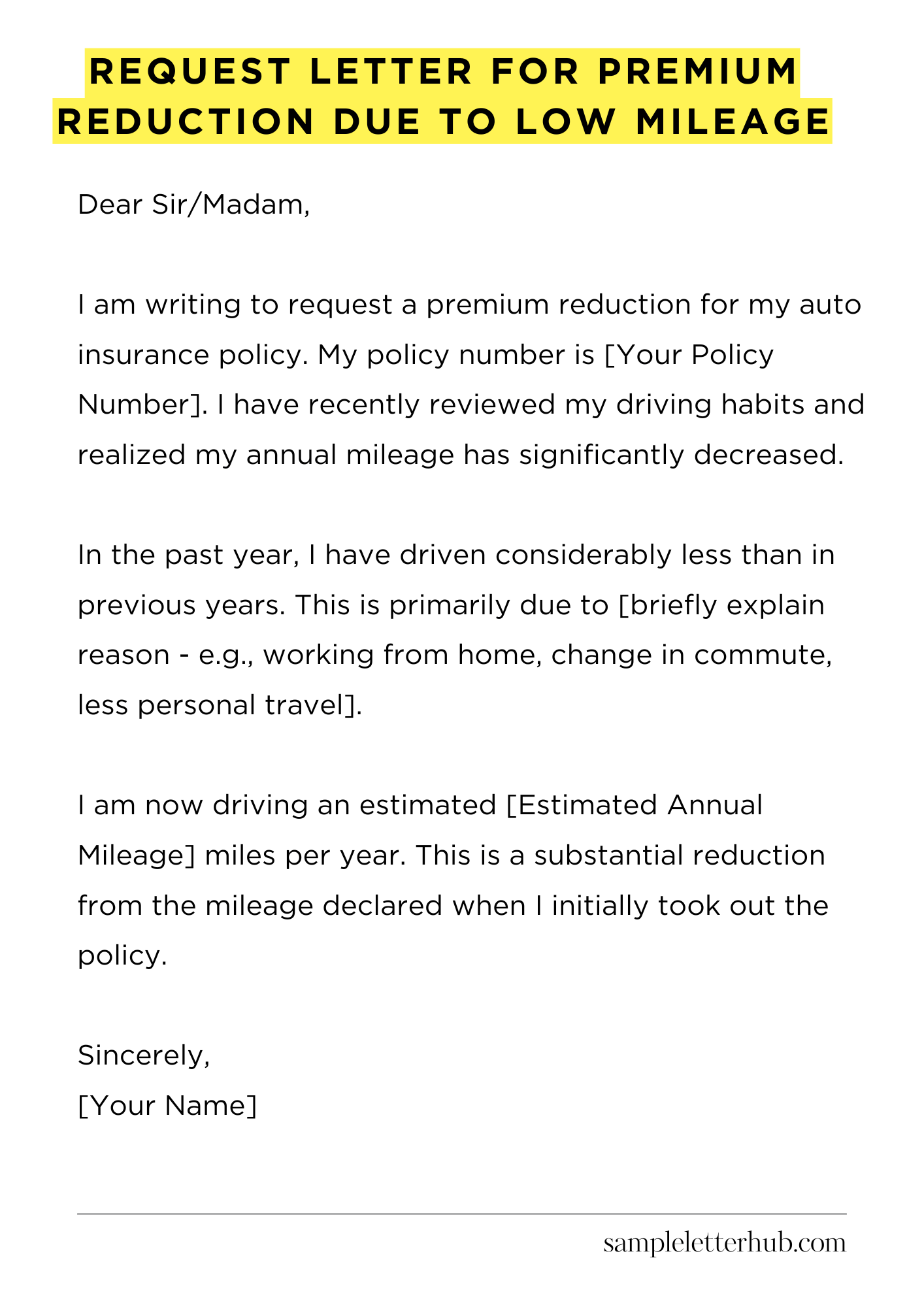
Dear Sir/Madam,
I am writing to request a premium reduction for my auto insurance policy. My policy number is [Your Policy Number]. I have recently reviewed my driving habits and realized my annual mileage has significantly decreased.
In the past year, I have driven considerably less than in previous years. This is primarily due to [briefly explain reason – e.g., working from home, change in commute, less personal travel].
I am now driving an estimated [Estimated Annual Mileage] miles per year. This is a substantial reduction from the mileage declared when I initially took out the policy.
I believe this reduced mileage qualifies me for a lower premium. I am a safe and responsible driver, and my reduced driving significantly lowers my risk. I have attached supporting documents such as recent odometer readings to support my reduced mileage claim.
I would appreciate it if you could review my policy and consider adjusting my premium accordingly. Could you please let me know the process for this adjustment, and if any additional information is needed from my end? I look forward to your positive response and confirmation of a revised premium.
Thank you for your time and consideration.
Sincerely,
[Your Name]
How to Write Request Letter for Premium Reduction Due to Low Mileage
You’ve navigated the roads with admirable restraint, logging fewer miles than anticipated. Now, it’s time to leverage that prudent driving into tangible savings. Crafting a compelling request letter is your key to unlocking those potential premium reductions. Here’s how to pen a missive that captivates your insurer and yields favorable results.
1. Commence with a Cogent Salutation
Begin your letter with a formal salutation. Address the recipient by name, if possible; otherwise, use a title like “Claims Adjuster” or “Underwriting Department.” Avoid informal greetings. This initial step sets the tone and indicates you’re serious about your request. Maintain a professional demeanor from the outset; this is paramount.
2. Explicitly State Your Purpose
The cardinal rule of effective communication: be direct. In the opening paragraph, unequivocally state your intention. Make your request immediately known.
For instance, “I am writing to formally request a reduction in my current auto insurance premium due to significantly lower-than-projected mileage.” Keep it succinct and devoid of any ambiguity. This clarity streamlines the process, immediately highlighting the crux of your correspondence.
3. Present Persuasive Justification
This is where you showcase the substance of your claim. Provide compelling evidence supporting your low mileage. Include specifics: current odometer reading, previous odometer reading (from policy inception or renewal), and the approximate mileage driven since.
Back up your claims with documentation, like receipts for services or work from home confirmations, which can serve as undeniable corroboration. The more irrefutable your substantiation, the better.
4. Articulate the Impact
In this section, you’ll subtly influence the reader to see your viewpoint. Detail the specific circumstances that led to your reduced mileage. Did you start working remotely? Did you purchase a second vehicle?
Did you experience an unforeseen period of immobility? Providing context, and explaining the why, enriches your narrative. This paints a complete picture and helps the insurer fully appreciate the rationale behind your plea for a premium adjustment.
5. Cite Policy Provisions and Industry Practices
If your policy language or industry practices support premium adjustments based on mileage, cite the relevant clauses. This demonstrates your proactive approach and familiarity with the insurance framework.
Mentioning relevant statutes, when applicable, boosts your argument, making it harder to deny the application. This demonstrates a certain level of savvy.
6. Propose a Reasonable Adjustment
While the final decision rests with the insurer, it doesn’t hurt to suggest a reasonable reduction. Review your policy details and research average reductions granted in similar scenarios.
Then, propose a percentage or a specific dollar amount you consider fair. This provides a tangible target and simplifies their evaluation process. This exhibits an understanding of the business.
7. Conclude with a Courteous Call to Action
Finish your letter with a polite and proactive closing. Express your appreciation for their time and consideration. Include your policy number and contact information.
State your willingness to provide any further information required. And, most importantly, mention when you expect a response. This will prompt the insurer to take action, bringing a swift resolution. A polite and professional closing will always leave a good lasting impression.
FAQs about Request Letter for Premium Reduction Due to Low Mileage
What is a Request Letter for Premium Reduction Due to Low Mileage, and why is it important?
A Request Letter for Premium Reduction Due to Low Mileage is a formal document you send to your insurance provider to request a decrease in your car insurance premiums.
This is relevant because lower mileage often correlates with a reduced risk of accidents, and insurers may offer discounts to reflect this decreased risk. Writing this letter is important because it can potentially save you money on your insurance costs.
What information should I include in the request letter?
Your letter should clearly state your policy details (policy number, vehicle information), the current mileage reading (supported by evidence like an odometer reading or service record), and the estimated annual mileage you anticipate driving.
It’s crucial to explain why your mileage has decreased and to specify the desired premium reduction. You should also include your contact information.
What evidence is required to support the low-mileage claim?
You’ll typically need to provide documentation to support your mileage claims. This often includes a recent odometer reading, recent vehicle service records that indicate mileage, or potentially supporting evidence like receipts for fuel or parking, especially if your reduced mileage is due to a change in your work or travel habits.
How should I format and submit the request letter?
The letter should be professional, concise, and easy to read. Use a formal business letter format, including your contact information, the insurance company’s address, and the date.
Send it via certified mail with a return receipt requested to ensure proof of delivery. You can also ask your insurance provider if they accept these requests via email or through their online portal.
What happens after I submit the request letter?
After submitting the letter, the insurance company will review your request and the supporting documentation. They will then assess your eligibility for a premium reduction based on their specific policies and criteria.
They will subsequently notify you of their decision, which will typically include the new premium amount and the effective date of the reduction, if approved.
Related:
Resignation letter due to rude boss
Resignation letter moving to another state
Resignation letter due to illness of family member
Resignation letter due to study