

Need money back on your insurance? A request letter for premium rebate is your tool. It’s a formal way to ask your insurance company for a refund. You might be eligible due to policy cancellations, overpayments, or other reasons. The goal is simple: to get your money returned.
We understand writing these letters can be tricky. That’s why we’re here to help! This article provides sample request letters for premium rebates. We’ll share examples you can adapt. They cover various situations. You can use these templates for insurance premium refund requests. We’ve made it easy for you to write your own letter!
This resource saves you time. It ensures your request for premium return is clear. Find premium rebate letter samples that fit your needs. Get ready to draft a winning letter. Get ready to claim your refund!
[Your Name/Company Name]
[Your Address]
[Your City, Postal Code]
[Your Email]
[Your Phone Number]
[Date]
[Insurance Company Name]
[Insurance Company Address]
[Insurance Company City, Postal Code]
Subject: Request for Premium Rebate – Policy Number [Your Policy Number]
Dear [Insurance Company Representative Name or “To Whom It May Concern”],
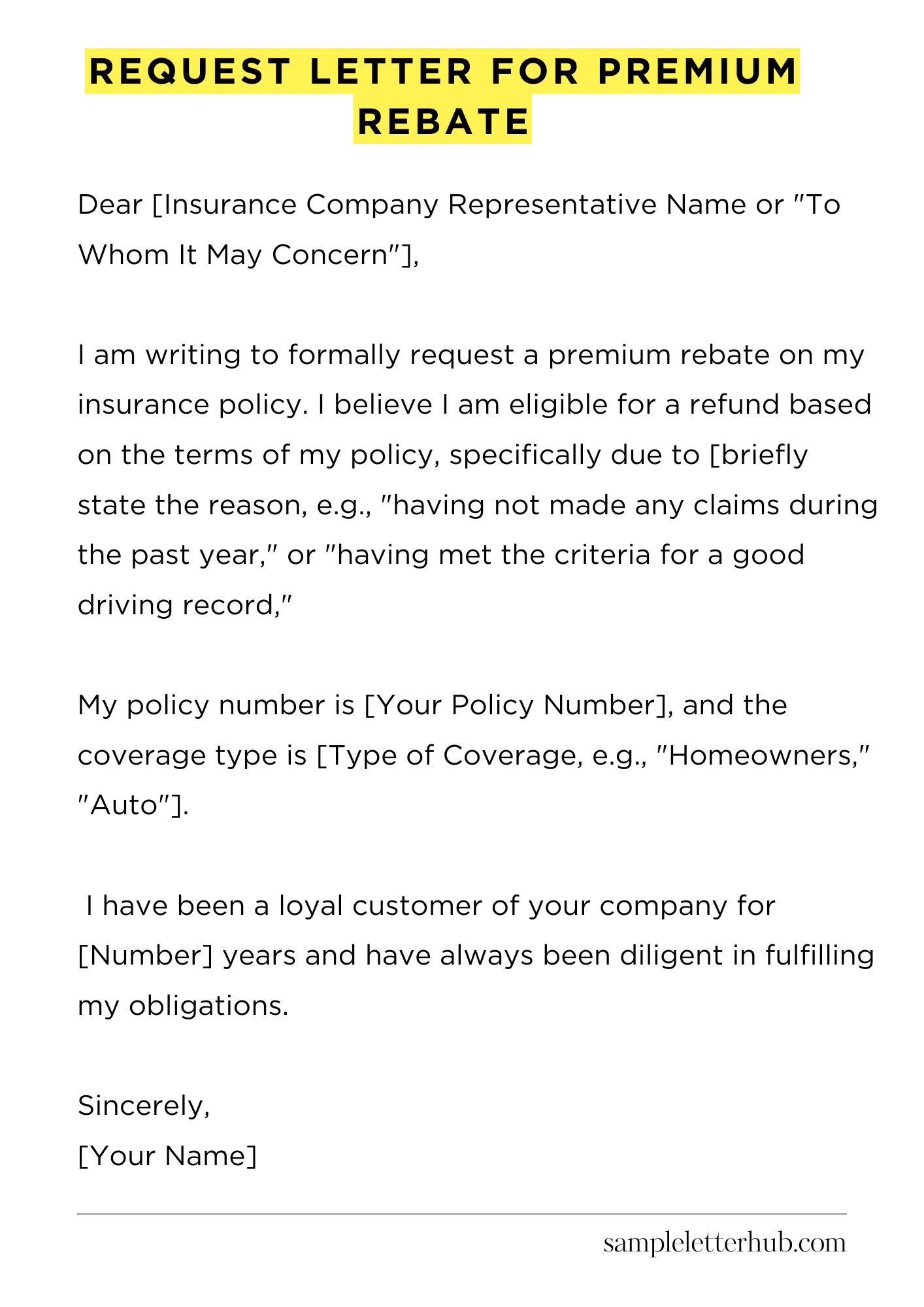
I am writing to formally request a premium rebate on my insurance policy. I believe I am eligible for a refund based on the terms of my policy, specifically due to [briefly state the reason, e.g., “having not made any claims during the past year,” or “having met the criteria for a good driving record,” or “policy cancellation.”]. This has resulted in savings.
My policy number is [Your Policy Number], and the coverage type is [Type of Coverage, e.g., “Homeowners,” “Auto”]. I have been a loyal customer of your company for [Number] years and have always been diligent in fulfilling my obligations.
I have reviewed my policy documentation and the details of my situation align with the rebate clauses outlined within. I have found the coverage to be useful. I would appreciate it if you could review my account and confirm my eligibility for a premium rebate. Please let me know what supporting documentation, if any, is required from my end to facilitate this process.
Could you please also specify the amount of the rebate I am entitled to receive and the anticipated timeframe for the rebate to be processed? Receiving the rebate would be very helpful.
Thank you for your time and attention to this matter. I look forward to your prompt response and a resolution. I have always found your company to be responsive.
Sincerely,
[Your Name]
How to Write Request Letter for Premium Rebate
A premium rebate request letter can be a potent tool in your arsenal, allowing you to reclaim funds and potentially foster a stronger relationship with the insurer. It is vital to articulate your request with precision and clarity. Let’s delineate the crucial steps involved in composing a compelling letter.
1. Understand the Premise: Eligibility Verification
Before you even begin, meticulously review your insurance policy. Scrutinize the fine print. Ascertain whether a premium rebate is permissible under the extant terms and conditions.
Does your policy explicitly stipulate such a provision? Confirm your eligibility by verifying the specific circumstances that trigger a rebate. For instance, have you fulfilled all requirements, such as a claim-free period or achieving certain performance metrics outlined in the policy? Failure to establish eligibility renders your request moot, a purely quixotic endeavor.
2. Constructing the Salutation and Introductory Statement
Begin with a professional salutation. Address the appropriate department or individual; if known, address a specific claims adjuster to foster a more personal touch. State your purpose clearly and concisely in the introductory paragraph.
This is your initial salvo, your first attempt to command the reader’s attention. Indicate that you are requesting a premium rebate and specify the policy details, including the policy number, type, and the period to which the request pertains.
For example, “I am writing to formally request a premium rebate under policy number [Policy Number] for the period of [Start Date] to [End Date] under the terms of the aforementioned policy.”
3. Detailing the Rationale: The Core Argument
This section is the heart of your letter. It is here that you will elucidate the reasons for your request. Provide concrete, well-documented justifications. Refer directly to the policy’s clauses that support your claim.
Did you meet a certain threshold, such as a low claim history? Did you upgrade your security systems? Did you participate in an incentivized program? Quantify the benefits. Offer substantiating evidence; present any necessary documentation, such as claim histories or verification of compliance with security protocols.
Avoid nebulous pronouncements; back up every claim with irrefutable facts. Remember that clear articulation and irrefutable proof will strengthen your argument, making it much more persuasive.
4. Specifying the Desired Outcome and Method of Disbursement
Clearly state the specific rebate amount you are requesting or outline how the amount is calculated if it is not explicitly stated. Be specific. Indicate your preferred method of disbursement.
Do you want it credited back to your bank account? Perhaps you would like it applied to future premiums. Specify the necessary details required for processing the rebate. Include your bank account information, if applicable, or any other pertinent details needed for seamless financial transaction.
Remember, clarity here is paramount. Ambiguity will lead to unnecessary delays or, worse, denial of the request.
5. Adding Supporting Documentation and Evidence
Mention any supporting documentation you are including with the letter. Make a list for easier reference. Include a copy of the insurance policy, if it helps to bolster your argument.
Always include proof of eligibility. You might want to also include additional documents such as claim records or certifications. This will serve to substantiate your claims. Organize your documentation methodically. A well-organized packet reflects professionalism and demonstrates seriousness.
6. Crafting the Closing and Call to Action
In your closing paragraph, reiterate your request and express your gratitude for their consideration. End with a polite but firm call to action. State your expectation for a prompt response.
Provide your contact information, including your phone number and email address, and consider including a deadline for their response. This underscores the seriousness of your request and encourages timely processing. For example, “I kindly request that you process this rebate request within [Number] business days.
I have included all necessary documentation. You can reach me at [Phone Number] or [Email Address] if any clarification is needed. Thank you for your attention to this matter.”
7. Polishing and Perfection: Review, Edit, and Proofread
Before sending, review and edit your letter meticulously. Check for grammar, spelling, and punctuation errors. Ensure that the tone is professional, respectful, and assertive, never demanding.
Re-read the letter from the insurer’s perspective. Does it effectively convey your message? Does the language sound clear? Is the document error-free?
Proofread at least twice, and consider having another pair of eyes review it for objectivity. A polished and error-free letter signifies attention to detail and increases the likelihood of a favorable response, a testament to your professionalism and preparedness.
FAQs about Request Letter for Premium Rebate
What is a premium rebate and why would someone request it?
A premium rebate is a return of a portion of the insurance premium paid by a policyholder. Individuals request premium rebates for several reasons, including: the policy terms changed, the policyholder met certain criteria stipulated by the insurance company (e.g., safe driving discounts, bundling policies).
What information should be included in a request letter for a premium rebate?
A comprehensive request letter should include the policyholder’s full name, policy number, contact information (address, phone number, email), and a clear and concise statement requesting the rebate. It’s crucial to state the specific reason for the request, referencing relevant policy clauses, dates, and amounts.
Supporting documentation, such as copies of previous payment receipts, proof of eligibility for the rebate (e.g., driving record), or any communication with the insurance company regarding the issue, should be attached. The letter should also clearly indicate the preferred method of receiving the rebate (e.g., check, direct deposit).
How should a request letter for a premium rebate be formatted and submitted?
The request letter should be professionally formatted, using a formal business letter style. Begin with your contact information, followed by the date and the insurance company’s contact information. Address the letter to the appropriate department or individual. Use a clear and concise language. Keep the tone polite and businesslike.
Proofread the letter carefully for any errors. The letter can be submitted via mail (certified mail with return receipt requested is recommended for proof of delivery), email (if the insurance company accepts email submissions), or through their online portal, if available. Always retain a copy of the letter and any supporting documentation for your records.
What supporting documents are typically required with a premium rebate request letter?
The required supporting documentation varies depending on the reason for the rebate. Common documents include copies of payment receipts, the original insurance policy or any policy endorsements, and documents to support the reason for the rebate.
For instance, if the rebate is due to a change in coverage, you may need a copy of the revised policy. For safe driving discounts, you may need a copy of your driving record from the DMV.
For overpayment rebates, you might include a copy of the check or payment confirmation. Always verify with your insurance company what specific documentation they require.
What is the typical timeframe for processing a premium rebate request?
The processing time for a premium rebate request can vary between insurance companies. Generally, it may take anywhere from a few weeks to several months.
The time frame depends on factors such as the complexity of the request, the volume of requests the insurance company is currently processing, and the completeness of the information and documentation submitted.
It is important to check the terms and conditions of your policy. It’s also often possible to inquire about the status of the request by contacting the insurance company’s customer service department, quoting the policy number and the date of the request.
Related:
Resignation letter due to rude boss
Resignation letter moving to another state
Resignation letter due to illness of family member
Resignation letter due to study
Resignation letter due to long commute