

Need to understand a company’s rules? Want to see some important paperwork? A request letter for policy statement and documentation is the answer. It is a formal way to ask for specific company policies, procedures, and related documents. Its purpose is to obtain necessary information. This helps you understand your rights, responsibilities, or company practices.
Are you struggling to write a perfect request? We’ve got you covered! This article provides request letter for policy statement and documentation examples. We have created different sample letters. These will help you easily create your own. You can adapt them for your specific needs.
We will share templates to get you started. Need to request policy statements? Need access to vital documentation? Look no further. Our examples offer clear, concise language. Start crafting your request with confidence today.
[Your Name/Your Company Name]
[Your Address]
[Your Phone Number]
[Your Email Address]
[Date]
[Recipient Name/Company Name]
[Recipient Address]
Dear [Recipient Name],
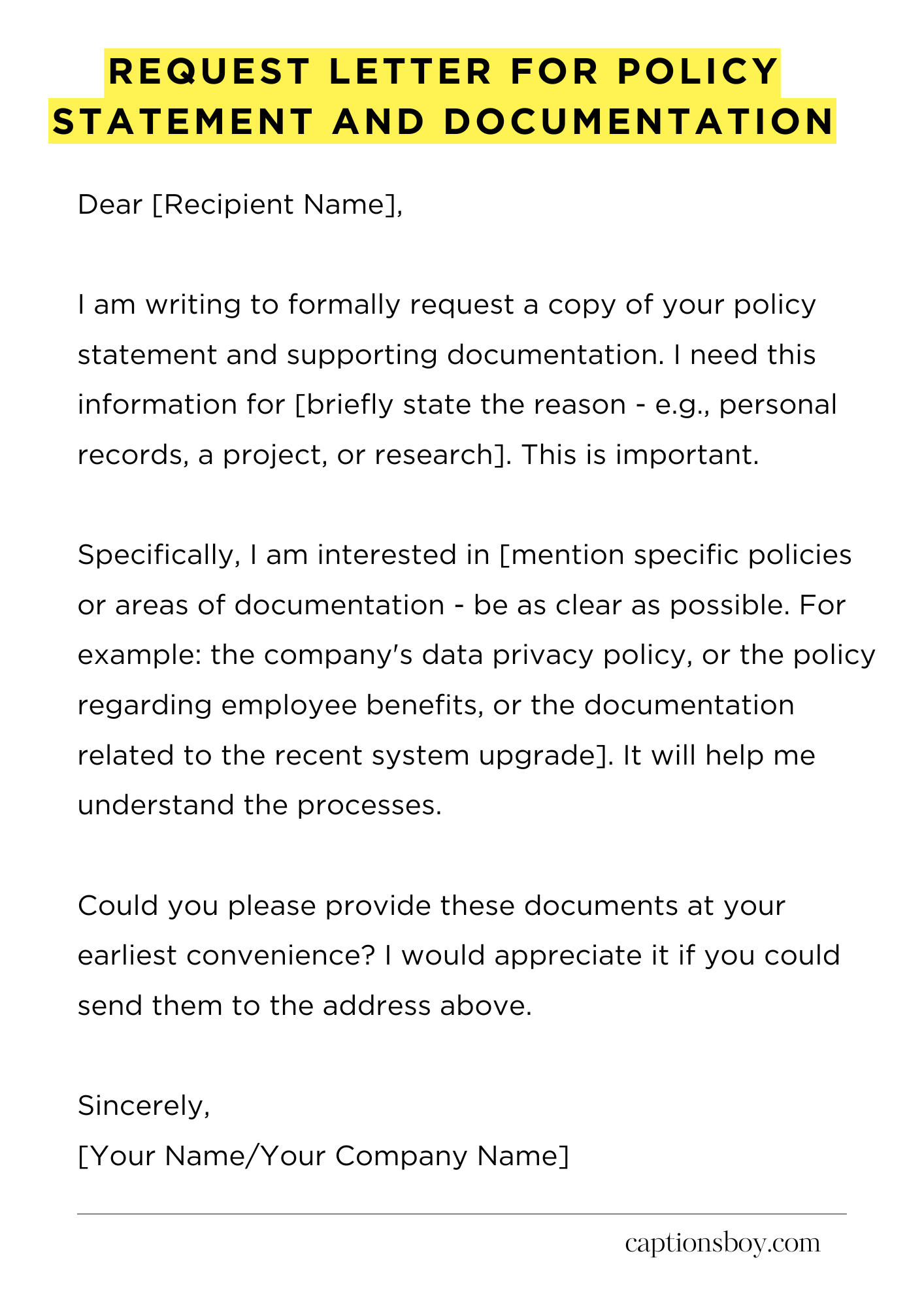
I am writing to formally request a copy of your policy statement and supporting documentation. I need this information for [briefly state the reason – e.g., personal records, a project, or research]. This is important.
Specifically, I am interested in [mention specific policies or areas of documentation – be as clear as possible. For example: the company’s data privacy policy, or the policy regarding employee benefits, or the documentation related to the recent system upgrade]. It will help me understand the processes.
Could you please provide these documents at your earliest convenience? I would appreciate it if you could send them to the address above, or, if possible, electronically to the email address provided. I want to make sure I am following the rules.
If there are any associated fees for accessing these documents, please let me know, and I will be happy to make the necessary arrangements. I need to know everything.
Thank you for your time and attention to this matter. Your prompt response is greatly appreciated. I look forward to hearing from you soon. These documents are very important to me.
Sincerely,
[Your Name/Your Company Name]
How to Write Request Letter for Policy Statement and Documentation
Crafting a letter requesting policy statements and documentation is a crucial skill. It’s often the first step in a process of investigation, seeking information, or ensuring compliance. A well-constructed missive can expedite the process and yield the desired results. Follow these guidelines to achieve the best outcome.
1. Commence with Clarity and Concision
Your opening gambit must immediately state the purpose of your letter. It should be forthright and leave no room for ambiguity. Employ declarative sentences to state your intentions. For example: “I am writing to formally request a copy of your current policy statement regarding…” Avoid extraneous verbiage; every word should serve a purpose. This is a crucial start.
2. Specify the Precise Documentation Needed
Detail the specific documents, policy statements, or information you require. The more granular you are, the better. Listing each item explicitly minimizes the chances of misinterpretation. Use bullet points or numbered lists for increased clarity, making the task less cumbersome for the recipient. Be precise; imprecise language will delay the process. Consider providing reference numbers if available.
3. Justify Your Request, Briefly
While you are not obligated to expound at length, providing a brief justification can be beneficial. Explain the context of your request. Briefly articulate why you need the documents. Are you seeking clarification? Are you conducting research? Be transparent, but remain concise. A short sentence or two is adequate; brevity is the soul of wit.
4. Identify the Relevant Parties and Contact Information
Ensure the letter is addressed to the correct individual or department. Scrutinize your target. Include their full title and contact information, including postal and email addresses. Misdirected correspondence can lead to significant delays. Check your sources. Accuracy at this stage is paramount, a sine qua non for a successful outcome. Always include your own contact details as well.
5. Maintain a Professional Tone and Demeanor
Regardless of your personal feelings, maintain a professional tone throughout the letter. Avoid inflammatory language or accusatory statements. Your tone should be polite, respectful, and objective. Remember, your objective is to receive documentation, not to alienate the recipient. This fosters a more cooperative environment. Even when addressing difficult subjects, remain composed.
6. Stipulate a Realistic Deadline (If Applicable)
If you have a specific deadline, clearly state it in your letter. Providing a timeframe can add a sense of urgency. Be reasonable in your expectations. Allow ample time for processing and response. Be aware of any existing company protocols for document access and compliance. If no deadline exists, you can simply express your anticipation for a prompt response.
7. Execute a Polished and Considerate Closing
Conclude your letter with a polite closing, such as “Thank you for your time and attention to this matter.” Include your full name, title (if applicable), and contact information again. Proofread the entire letter meticulously to eliminate any grammatical errors or typos. Proper spelling and grammar are crucial. Always show gratitude, and ensure a lasting impression of professionalism.
FAQs about Request Letter for Policy Statement and Documentation
What is the primary purpose of a request letter for a policy statement and documentation?
The main objective of this letter is to formally ask an organization or individual to provide detailed information about their existing policies, procedures, and associated documentation. This is often necessary for understanding an organization’s operations, compliance with regulations, or when needing specifics about internal guidelines.
What specific information should be included in the request letter to ensure clarity?
A well-crafted request letter should include the following: a clear subject line, identification of the specific policy statement and documentation requested, the reason for the request, the timeframe for the information, any relevant reference numbers, and the requester’s contact information. Be precise about what you need to avoid ambiguity.
Who typically issues and receives this type of request letter?
These letters are commonly issued by individuals, businesses, government agencies, and legal professionals. The recipients typically include insurance companies, educational institutions, financial institutions, human resources departments, and governmental bodies. The specific sender and recipient depends heavily on the reason for the request.
What are the legal implications or considerations when making such a request?
Legal implications depend on the nature of the request and the sensitivity of the information. Requests related to personal data may be governed by privacy regulations. Ensure compliance with data protection laws, and be mindful of confidentiality and proprietary information. Seek legal advice if the request involves sensitive matters.
What are the typical follow-up actions after sending a request letter for policy statement and documentation?
After sending the letter, follow up within a reasonable timeframe (as specified in your letter) if you don’t receive a response. This may involve a phone call, email, or a subsequent letter. Maintain a record of all communication. If the request is denied or if the response is inadequate, you may need to escalate the matter through different channels, depending on the context.
Related:
Resignation letter due to rude boss
Resignation letter moving to another state
Resignation letter due to illness of family member
Resignation letter due to study
Resignation letter due to long commute