

Need to know what your insurance policy actually covers? That’s where a Request Letter for Policy Coverage Details comes in. It’s a formal way to ask your insurance provider for all the specifics. The goal? To get a clear understanding of your policy coverage for things like claims, limits, and exclusions. This ensures you are fully aware of your insurance plan.
Struggling to write this letter yourself? No worries! We’ve got you covered. We’ll be sharing a collection of sample request letters. They’re all about policy coverage details. We’ll also provide a variety of template examples. These are designed to make it easy for you. You can easily adapt them to fit your specific needs.
Whether you’re dealing with a car insurance issue or a tricky health insurance situation, these samples will guide you. Writing this type of letter just got easier. Get ready to draft your own policy detail request letter with confidence. Let’s get started.
[Your Name/Your Organization’s Name]
[Your Address]
[Your Phone Number]
[Your Email Address]
[Date]
[Insurance Company Name]
[Insurance Company Address]
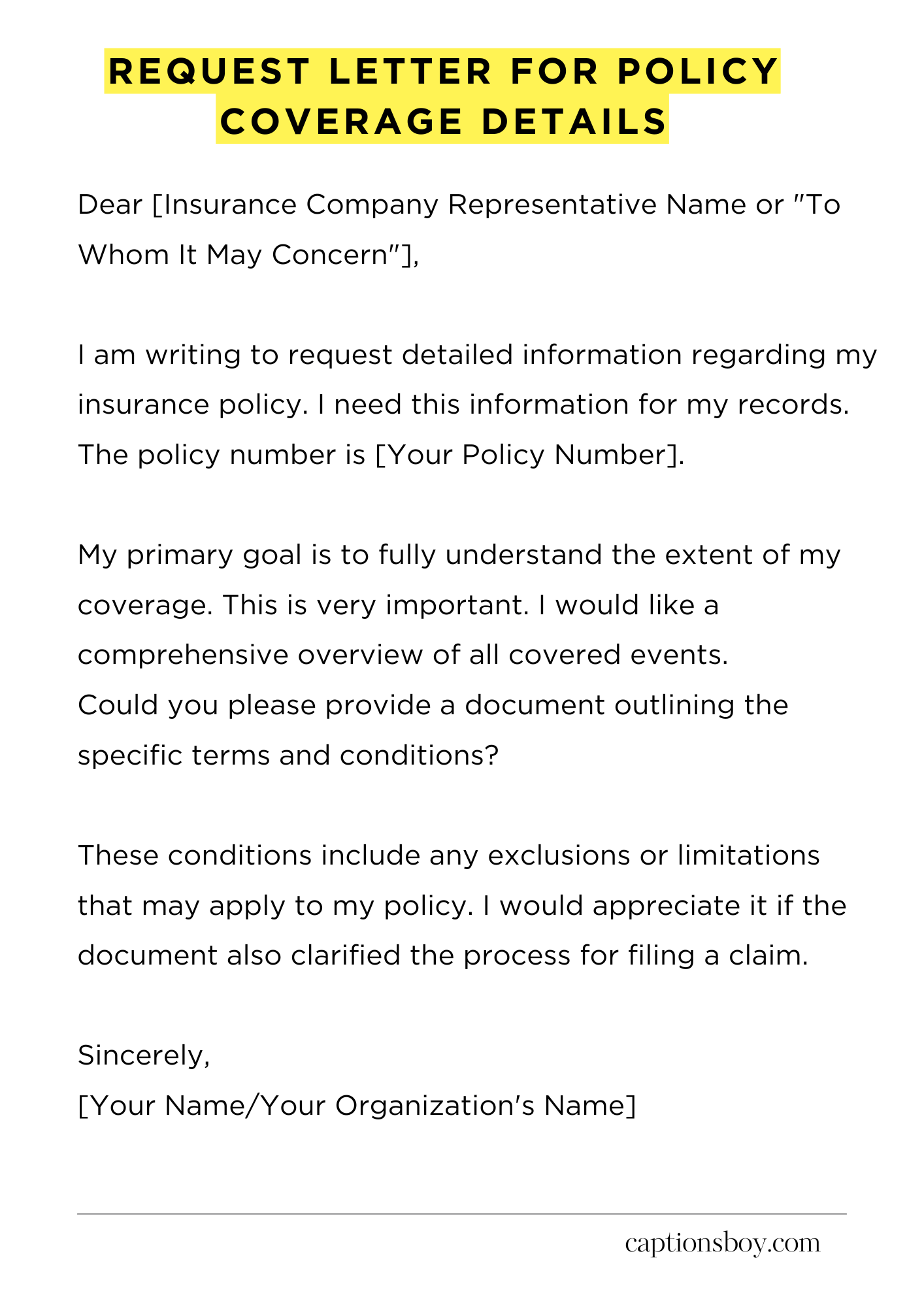
Dear [Insurance Company Representative Name or “To Whom It May Concern”],
I am writing to request detailed information regarding my insurance policy. I need this information for my records. The policy number is [Your Policy Number].
My primary goal is to fully understand the extent of my coverage. This is very important. I would like a comprehensive overview of all covered events.
Could you please provide a document outlining the specific terms and conditions? These conditions include any exclusions or limitations that may apply to my policy. I would appreciate it if the document also clarified the process for filing a claim.
I also have a few specific questions regarding [Mention specific areas of interest, e.g., “coverage for water damage,” “the deductible amount”]. Clear answers here would be most helpful. I am eager to get a full picture.
Please send this information to the address above. Alternatively, you can email it to me at [Your Email Address]. I appreciate your time and attention to this matter. Thank you very much for your assistance.
Sincerely,
[Your Name/Your Organization’s Name]
How to Write Request Letter for Policy Coverage Details
Need to decipher the cryptic language of your insurance policy? You’re in luck! Crafting a well-structured request letter is the first step toward unveiling the specifics of your coverage. A concise, cogent letter can expedite the information gathering process, saving you time and potential headaches. Follow these steps to generate a persuasive and informative request.
1. Identify Your Objectives and Audience
Before you even begin, meticulously define what you need. Are you seeking clarification on a specific clause, or are you hoping to acquire the full panorama of your policy’s stipulations? Pinpoint your precise objectives. Determine to whom this missive should be addressed. The appropriate recipient might vary, depending on the insurance carrier and the nature of your request. Is it a claims adjuster, a customer service representative, or a specific department? Addressing the letter correctly can ensure a swift response.
2. Gather Your Arsenal: Essential Information
Certain details are non-negotiable. First and foremost, you’ll need your policy number. This is the cornerstone of your request; without it, the recipient may struggle to locate your file. Include your full legal name, the name of the insured (if different from yourself), and your contact information – postal address, phone number, and email. Provide any additional details germane to your query. For instance, if you are asking about a claim, include the date and incident details.
3. Crafting the Perfect Proem: The Salutation and Introduction
Start your letter professionally. A formal salutation is expected, such as “Dear [Recipient’s Name]” or “To Whom It May Concern,” if you are unsure of the exact name. The introduction must be clear and direct. State the purpose of your letter succinctly, mentioning that you are requesting details regarding your policy coverage. This initial section sets the tone and provides context for the remainder of your correspondence.
4. Delving into the Details: The Body of Your Request
This is where you articulate your specific requirements. Formulate your questions with the utmost clarity. Be explicit. If you require clarification on a particular section of the policy, quote it directly and then phrase your inquiry in a way that leaves no room for ambiguity. If you are requesting specific documents, such as a copy of your policy schedule or a summary of benefits, clearly state your needs. The body section is the locus of your argument and request.
5. The Final Flourish: Conclusion and Call to Action
Summarize your request in the concluding paragraph. Reiterate the key information and restate your expectation for a response. Include a polite request for a prompt reply. Specify how you prefer to receive the information, whether it is by mail, email, or telephone. End with a professional closing, such as “Sincerely,” or “Respectfully,” followed by your full name and signature (if sending a hard copy). Always reiterate your contact details here.
6. The Art of Proofreading: Polishing Your Prose
Before you hit ‘send,’ meticulously proofread your letter. Scrutinize every word for errors in grammar, punctuation, and spelling. Double-check all the information you provided to guarantee accuracy. Ensure your tone is professional, respectful, and not demanding. It’s often helpful to read the letter aloud to catch any awkward phrasing or unclear statements. A well-edited letter demonstrates attention to detail and reinforces the seriousness of your request.
7. Delivery and Follow-Up: Ensuring a Response
Send your letter through a reliable channel. If possible, consider sending it via certified mail with a return receipt requested. This provides proof that the insurance company received your letter. If sending via email, confirm that you have the correct email address. Keep a copy of the sent letter for your records. If you do not receive a response within a reasonable timeframe (typically two to three weeks), follow up with a polite phone call or a subsequent email, referencing your original request. Persistence, combined with professionalism, generally yields results.
FAQs about Request Letter for Policy Coverage Details
What information should I include in a request letter for policy coverage details?
Your request letter should clearly identify the policy you’re inquiring about. Include the policy number, your name (or the policyholder’s name if you’re not the primary policyholder), and the type of information you need (e.g., specific coverage details, exclusions, limits, effective dates, premium amounts). Be precise about what you need to avoid any delays or misunderstandings. You may also want to include your contact information for the insurer to reach you.
Who should I address my request letter to?
Address the letter to the appropriate department within the insurance company. This is usually the customer service department or the department responsible for policy inquiries. You can often find the correct department and contact information on your insurance policy documents, the insurer’s website, or by calling their customer service line to inquire.
How should I submit my request letter, and what is the turnaround time for a response?
You can usually submit your request letter via mail, email, or through an online portal if your insurer provides one. Check your policy documents or the insurer’s website for the preferred method. Turnaround times vary between insurers, but you can typically expect a response within a few business days to a couple of weeks. If you have a specific deadline, be sure to mention it in your letter.
What if I don’t know the exact policy number? Can I still request the details?
Yes, you can still request the details even if you don’t know the policy number. Include as much identifying information as possible, such as your full name, address, date of birth, and any other relevant details like the date the policy was started. This will help the insurer locate your policy in their records.
What if I am not the policyholder but need information about the policy?
If you are not the policyholder, you will likely need to provide proof of authorization or an official reason for needing the information. For example, if you are a beneficiary, you may need to provide a death certificate. If you are a legal representative, you will need to provide documentation, such as a power of attorney. The insurance company needs to ensure they are providing information to the right person.
Related:
Resignation letter due to rude boss
Resignation letter moving to another state
Resignation letter due to illness of family member
Resignation letter due to study
Resignation letter due to long commute