

Do you need to change your job and your insurance policy needs updating? A “Request Letter for Change of Occupation in Insurance Policy” is a crucial document. Its purpose is to officially inform your insurance provider about your new job. This ensures your insurance coverage accurately reflects your current occupation.
Writing this letter can seem daunting. Don’t worry, we’re here to help! We have crafted various request letter examples for you. These will guide you through the process. Our samples cover different scenarios.
We have letter templates ready. They are easy to use. Adapt them to fit your specific needs. Easily update your occupation details with your insurance company.
[Your Name]
[Your Address]
[Your Phone Number]
[Your Email Address]
[Date]
[Insurance Company Name]
[Insurance Company Address]
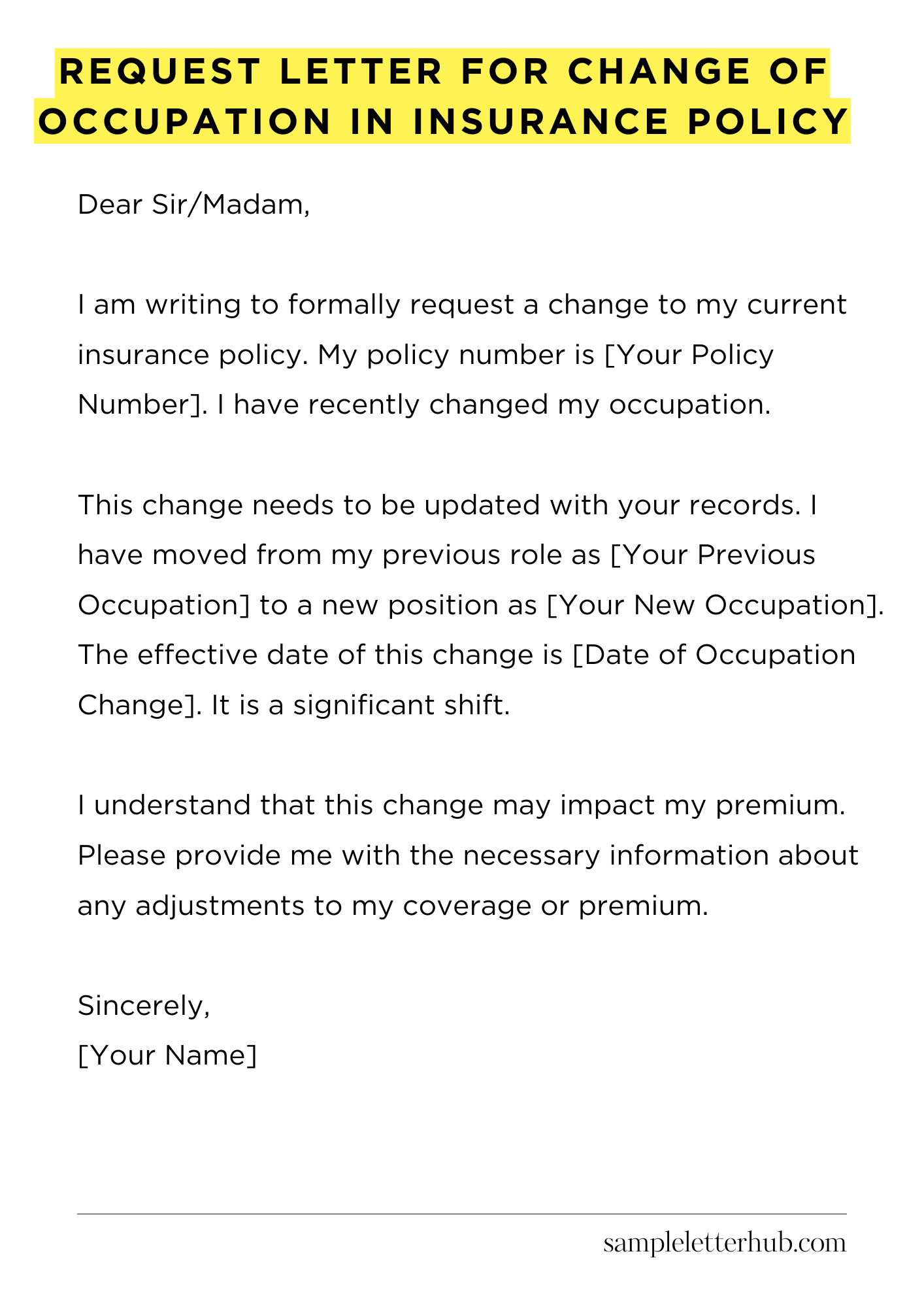
Dear Sir/Madam,
I am writing to formally request a change to my current insurance policy. My policy number is [Your Policy Number]. I have recently changed my occupation.
This change needs to be updated with your records. I have moved from my previous role as [Your Previous Occupation] to a new position as [Your New Occupation]. The effective date of this change is [Date of Occupation Change]. It is a significant shift.
I understand that this change may impact my premium. Please provide me with the necessary information about any adjustments to my coverage or premium. I would appreciate it if you could send me a revised policy document reflecting my new occupation. I need to understand the implications of this change.
I have attached copies of [any supporting documents, if applicable – e.g., employment letter, etc.]. This should help you with the process. Please contact me if you require any further information.
I look forward to hearing from you soon. You can reach me by phone or email. Thank you for your time and assistance with this matter.
Sincerely,
[Your Name]
How to Write Request Letter for Change of Occupation in Insurance Policy
Switching careers? It’s a common aspiration, and often, it necessitates a swift and precise modification to your insurance policy. This is where a well-crafted request letter becomes paramount.
It serves as your official communication, initiating the procedural metamorphosis of your policy to reflect your new vocational reality. The efficacy of your letter directly impacts the expeditiousness of the transition.
1. Commence with Proper Salutation
Your missive should always begin with a formal and courteous salutation. Address the letter to the designated insurance company representative or department responsible for policy modifications.
Verify the correct recipient, and ensure that your salutation mirrors the recipient’s title and rank to maintain professionalism. For instance, “Dear Claims Adjuster,” or “Dear Underwriting Department,” sets the right tone from the outset.
2. Explicitly State Your Purpose
Immediately after the salutation, unequivocally state your objective. Clearly articulate your intent to request a change of occupation within your insurance policy. Avoid vagueness. Be direct and concise.
State the policy number upfront for unambiguous identification. For example, “This letter is to formally request a change of occupation on policy number [Policy Number].”
3. Furnish Comprehensive Personal Details
Include all relevant personal details to facilitate the verification process. This encompasses your full legal name, current residential address, date of birth, and contact information, specifically your phone number and email address.
Such minutiae assures the insurer can readily cross-reference information and prevents any potential discrepancies. The inclusion of this information streamlines processing.
4. Detail Your New Occupation and its Implications
This is arguably the most crucial section. Precisely delineate your new occupation. Provide a detailed description of your new job responsibilities and the industry you are now involved in.
Explain how this new role may or may not impact your risk profile as assessed by the insurance provider. If your occupation presents a higher or lower risk profile, be prepared to outline the rationale. Honesty is absolutely the best policy.
5. Present Supporting Documentation
Anticipate the insurer’s need for supporting documentation. Attach pertinent documents that substantiate your career transition. This may encompass a copy of your new employment contract, a recent pay stub, a professional license, or a letter from your new employer confirming your position.
Ensure you retain copies of all documents for your records. Providing this supplementary material can expedite the approval process.
6. Express Gratitude and Anticipation
Politely express your gratitude for the insurer’s consideration and assistance. Indicate your expectation for a prompt response and a revised policy document that reflects the updated occupational details. Concluding your letter with a professional closing, such as “Sincerely,” or “Respectfully,” followed by your full name and signature, completes the formal requirements.
7. Review and Submit Your Letter
Before dispatching your letter, meticulously review it for any errors in grammar, spelling, or factual inaccuracies. Verify that all essential information is included and accurately presented.
Retain a copy of the finalized letter, along with all supporting documentation, for your personal files. Send the letter via certified mail or another method that provides proof of delivery. This is a critical step in ensuring the secure transmission of your request and documenting the procedure.
FAQs about Request Letter for Change of Occupation in Insurance Policy
Navigating changes to your insurance policy can be complex. Here’s a look at common questions regarding a request letter for a change of occupation:
What is a “Request Letter for Change of Occupation” in an Insurance Policy?
A “Request Letter for Change of Occupation” is a formal document you submit to your insurance provider to inform them about a change in your profession or employment status. This is crucial because your occupation significantly impacts the risk profile associated with your policy, and therefore, your premiums and coverage.
Why is it necessary to submit a request letter when changing jobs?
Insurance companies assess risk based on various factors, including your occupation. Different professions have different levels of risk associated with them. Certain jobs are considered higher risk (e.g., construction workers, offshore workers) than others (e.g., office workers).
Failing to notify your insurer can lead to denial of claims or even policy cancellation if the change of occupation increases the risk profile.
What information should be included in the request letter?
Your request letter should clearly state your name, policy number, and the details of your previous occupation. It should then explicitly state your new occupation, including the name of your new employer and a brief description of your new job duties. It is also recommended to include the date the change of occupation took effect and your contact information.
What happens after I submit the request letter?
Upon receiving your letter, the insurance company will typically review your policy and assess the implications of the occupation change.
They may request additional information, such as further clarification of your job duties. Based on their assessment, they will inform you of any changes to your premium, coverage terms, or policy conditions. This might also include the need to fill out new forms to acknowledge the changes made.
How does a change of occupation affect my insurance premium and coverage?
The impact of your occupation change on your insurance premium and coverage depends on whether your new job is considered higher or lower risk. If your new occupation is deemed higher risk, your premium may increase. If it is lower risk, your premium could potentially decrease. The coverage you have may also be adjusted to reflect your new risk profile.
Related:
Resignation letter due to rude boss
Resignation letter moving to another state
Resignation letter due to illness of family member
Resignation letter due to study
Resignation letter due to long commute