

Need insurance policy information? You might need a “Request for Insurance Policy Information Letter”. This letter formally asks an insurance provider for specific details. Its purpose is to obtain crucial documents. Examples include the insurance policy itself, coverage details, or claim history.
Writing this letter can feel daunting. Don’t worry, we’re here to help! We’ll provide templates and examples today. These samples will guide you. They make crafting your own request letter easy.
Use our template suggestions. They cover many situations. You can adapt them to your specific needs. Get ready to access insurance information quickly! Start writing your Request for Insurance Policy Information Letter today!
[Your Name/Company Name]
[Your Address]
[Your Phone Number]
[Your Email Address]
[Date]
[Insurance Company Name]
[Insurance Company Address]
Dear Sir/Madam,
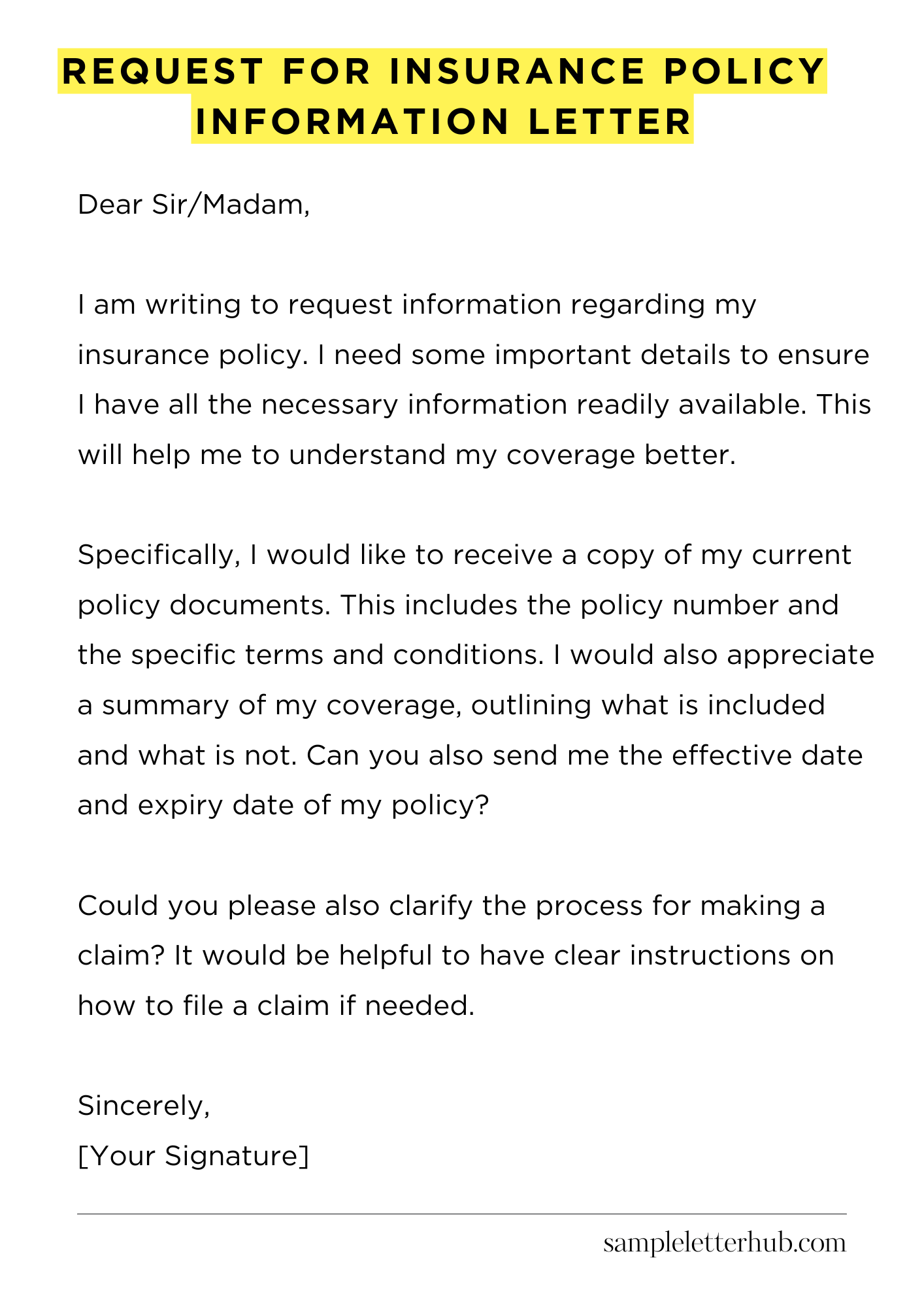
I am writing to request information regarding my insurance policy. I need some important details to ensure I have all the necessary information readily available. This will help me to understand my coverage better.
Specifically, I would like to receive a copy of my current policy documents. This includes the policy number and the specific terms and conditions. I would also appreciate a summary of my coverage, outlining what is included and what is not. Can you also send me the effective date and expiry date of my policy?
Could you please also clarify the process for making a claim? It would be helpful to have clear instructions on how to file a claim if needed. Furthermore, I am interested in understanding the deductible amount applicable to my policy. Obtaining this information is crucial for my records.
I understand that you may need some information from me to locate my policy. My full name is [Your Full Name], and my date of birth is [Your Date of Birth]. Please let me know if you require any further details.
I would be grateful if you could send the requested information to my address listed above. I look forward to receiving this information at your earliest convenience. Thank you for your time and assistance in this matter.
Sincerely,
[Your Signature]
How to Write Request for Insurance Policy Information Letter
Crafting a letter requesting insurance policy information might seem like a straightforward endeavor, but precision is paramount. Ensure your missive traverses the channels efficiently, yielding the desired outcome: the illumination of your insurance particulars. This section lays out the procedural steps for writing a compelling, effective letter.
1. Commence with the Header: Your Point of Contact
The genesis of your letter should feature your contact information. This is where your identity solidifies. Begin by positioning your full name, followed by your street address, city, state, and postal code in the upper left-hand corner. Underneath this, furnish your telephone number and email address.
This ensures the recipient can easily locate you if clarification is required. This is the first step towards establishing clear communication.
2. Date and Recipient’s Address: The Chronological and Corporate Context
Below your contact details, include the current date. Align the date to the left. Subsequently, direct your attention to the recipient’s address.
This typically encompasses the insurance company’s name, the specific department (e.g., “Claims Department”), the street address, city, state, and postal code. Verify the accuracy of this information to avoid bureaucratic hurdles. Accurate targeting is crucial.
3. Salutation: The Initiatory Etiquette
The salutation sets the tone. Use a formal salutation, such as “Dear [Insurance Company Name] Claims Department”. If you know a specific individual’s name within the department, address the letter to them.
For example, “Dear Mr./Ms. [Last Name]”. Avoid generic salutations like “To Whom It May Concern” if possible, as it lacks personalization. It’s a key element of persuasive writing.
4. The Core Body: Articulating the Essence of Your Inquiry
This is the crux of your correspondence. Clearly and concisely state your request for insurance policy information. Specify the types of information needed. For example, do you require a copy of the policy itself?
Or the history of claims paid? Include your policy number (or policy numbers, if applicable), and any other relevant identifying data. These include the names of insured parties. The more details you provide, the easier it will be for the insurance company to fulfill your request. Be very direct with your demands.
5. Supporting Documents: The Evidentiary Arsenal
If you’re attaching any supporting documentation, explicitly mention them in your letter. Examples might include a copy of your driver’s license, a copy of the policy holder’s death certificate, or any previous communication with the insurer. List the attachments at the end of the letter. This provides transparency. This also underscores your seriousness.
6. The Concluding Salutation and Signature: The Formal Closure
End your letter with a professional closing, such as “Sincerely” or “Respectfully”. Leave sufficient space for your signature above your typed name. Sign the letter in ink. Then print the letter with a proper format, and print the letter to a physical form and send it via mail. This establishes the authority and authenticity of the letter. Formalities have their utility!
7. Proofreading and Mailing: The Final Scrutiny
Before submitting, meticulously proofread your letter. Verify spelling, grammar, punctuation, and clarity. Ensure the tone is professional and respectful.
Make a copy of the letter for your records. Then, mail your letter via certified mail with return receipt requested. This provides proof of delivery and ensures you have a record of when the insurance company received your request. This is the last and most important part of the process.
FAQs about Request for Insurance Policy Information Letter
What is a Request for Insurance Policy Information Letter?
A Request for Insurance Policy Information Letter is a formal written communication used to obtain specific details about an insurance policy.
This can include information on coverage, policy limits, effective dates, premium payments, beneficiaries, or any other relevant details needed by the policyholder, a third party (like a lender or lawyer), or a government agency. The letter serves as a written record of the request and the information sought.
Who Typically Sends a Request for Insurance Policy Information Letter?
The policyholder themselves typically initiates this request. However, other parties with a legitimate interest in the policy can also send the letter.
These parties might include: a beneficiary, a legal representative acting on behalf of the policyholder, a lender needing proof of insurance (e.g., for a mortgage), or a court requesting policy details as part of legal proceedings. In specific cases, an authorized representative of the policyholder, like a broker, may send the letter too.
What Information Should I Include in the Letter?
The letter should clearly identify the policyholder and the specific insurance policy (policy number is crucial). It should state precisely what information is needed, such as policy terms, coverage details, or a copy of the policy document. Including the policyholder’s contact information, and any relevant dates (such as when a claim occurred or when coverage started/ended) is recommended.
Be sure to address the letter to the correct insurance company department. It is also wise to specify how you wish to receive the information, such as via mail, email, or fax.
How Do I Find the Correct Address to Send My Request?
The correct address or department to send the request to can typically be found on the insurance company’s website, within policy documents, or by calling the company’s customer service number.
Look for a specific mailing address dedicated to policy inquiries or customer service. If the insurance company operates multiple departments, ensure the letter is directed to the appropriate department handling policy information requests. Confirm this with a phone call.
How Long Does it Take to Receive a Response to a Request for Insurance Policy Information Letter?
The response time varies depending on the insurance company’s processing times and the complexity of the request. However, you should expect a response within a reasonable timeframe, typically within a few business days to a few weeks.
The best practice is to include a timeframe in your letter, such as “Please provide this information within 30 days.” If you haven’t received a response within the expected timeframe, it is advisable to follow up with the insurance company by phone or email, referencing your original request.
Related:
Resignation letter due to rude boss
Resignation letter moving to another state
Resignation letter due to illness of family member
Resignation letter due to study