

Renewing your life insurance policy? Sometimes, you might want to make changes. This is where a “Renewal Request for Life Insurance with Benefit Changes” comes in. It’s how you formally ask your insurance company to update your policy. Maybe you need to adjust your coverage amount. Perhaps you want to add or remove beneficiaries.
Need to create a letter? Writing these requests can seem tricky. Don’t worry, we’ve got you covered. We’ll share samples, templates, and examples to help you. These are crafted for easy life insurance renewal requests. You can find many options to help create your own letter!
We’ve made it simple for everyone. Whether it is adjusting coverage, updating beneficiaries, or changing policy terms and conditions. Our templates will help you. Get ready to simplify your life insurance renewal process!
[Your Name/Insurance Company Letterhead]
[Your Address]
[Your City, Postal Code]
[Date]
[Recipient Name]
[Recipient Address]
[Recipient City, Postal Code]
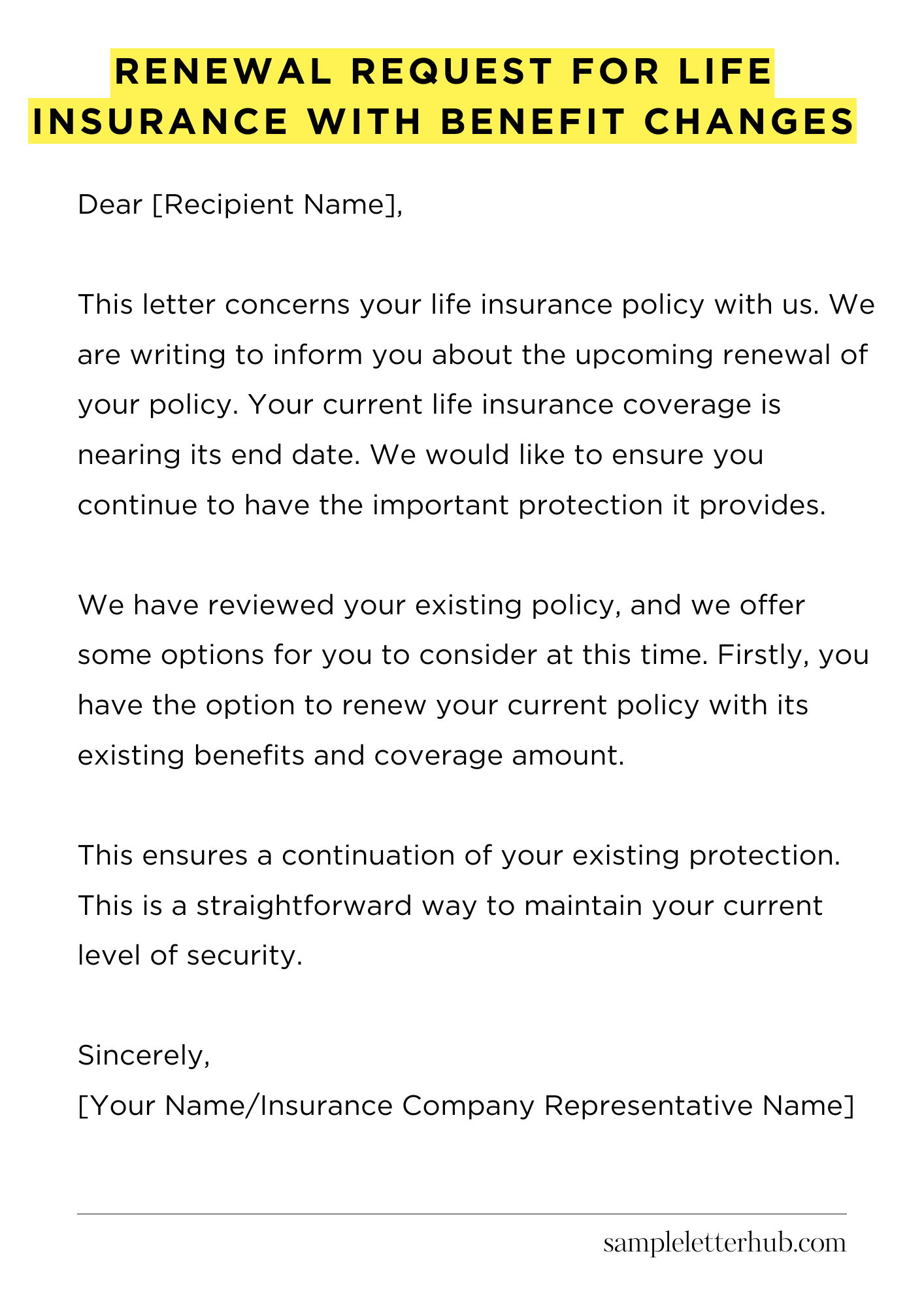
Dear [Recipient Name],
This letter concerns your life insurance policy with us. We are writing to inform you about the upcoming renewal of your policy. Your current life insurance coverage is nearing its end date. We would like to ensure you continue to have the important protection it provides.
We have reviewed your existing policy, and we offer some options for you to consider at this time. Firstly, you have the option to renew your current policy with its existing benefits and coverage amount. This ensures a continuation of your existing protection. This is a straightforward way to maintain your current level of security.
Secondly, we would like to present you with some potential benefit changes. We have designed these changes to better fit your current needs. These changes may involve adjusting the coverage amount.
You might consider increasing your coverage to account for changes in your financial situation, such as a growing family or increased financial obligations. Or, perhaps, you might be interested in decreasing the coverage if your needs have changed.
We also have some other options in terms of policy type. Perhaps, you would like to discuss updating your policy type. We recommend you carefully review all the details provided.
Enclosed with this letter, you will find a summary of your current policy details. The summary also includes the proposed changes for your consideration. Please take some time to read through these documents carefully. The documents clearly outline all the pertinent information regarding your renewal options.
To proceed with the renewal, or to discuss the benefit changes, please contact us at your earliest convenience. You can reach us by calling the number below, or by replying to this letter. Our team of experienced insurance professionals is available to answer any questions. We are here to help you choose the best plan for your needs.
We value your business and appreciate the opportunity to continue serving your life insurance needs. We look forward to hearing from you soon. We are committed to providing you with the peace of mind you deserve.
Sincerely,
[Your Name/Insurance Company Representative Name]
How to Write Renewal Request for Life Insurance with Benefit Changes
Life insurance policies require periodic renewal, which is a crucial juncture to review and revise your coverage. This is especially vital when considering benefit modifications. Constructing a renewal request with benefit changes necessitates meticulousness. Here’s a comprehensive guide to navigate the process effectively.
1. Initiate the Process with Utmost Deliberation
Before putting pen to paper (or fingers to keyboard), engage in a thorough assessment of your existing policy. Scrutinize your current benefit levels, premium payments, and the specific terms and conditions.
Contemplate any life events that might warrant an adjustment, such as a birth, marriage, a change in financial circumstances, or an elevation in your risk profile. This initial phase sets the stage for a well-reasoned and impactful request.
2. Gather Pertinent Policy Documents and Data
Locate your original life insurance policy document. It is indispensable. Also, assemble any subsequent correspondence or amendments you’ve received. This trove of information provides the foundation for your renewal request.
Key details you’ll require include your policy number, the insurer’s contact information, and specific clauses relevant to benefit adjustments. Accuracy here is paramount; it averts any potential for confusion or misinterpretation.
3. Crafting the Formal Salutation and Introductory Statement
Begin your letter with a formal salutation. Employ the appropriate title (Mr., Ms., Dr., etc.) followed by the insurance company representative’s name, if known. If a specific individual isn’t designated, address it to the “Life Insurance Renewal Department.”
In the introductory paragraph, succinctly state your intent. Clarify that you are requesting a renewal of your life insurance policy with specific modifications to the existing benefits. Ensure clarity from the outset.
4. Articulating the Desired Benefit Alterations
This is the core of your communication. Concisely and precisely articulate the benefit changes you are requesting. Whether you aim to increase, decrease, or modify other policy features, be explicit.
Specify the desired new death benefit amount, any alterations to coverage terms (e.g., term length or type of policy), or modifications to beneficiary designations. Support your requests with cogent reasoning. For instance, if you are seeking a higher benefit, explain the rationale, such as an increase in familial obligations or significant debts. Avoid ambiguities.
5. Presenting Supporting Documentation, If Necessary
Depending on the requested benefit adjustments, you might be required to furnish supporting documentation. For example, an increase in coverage might necessitate a new medical examination or additional financial disclosures. If this is the case, enumerate the documents you are including.
Providing these materials upfront streamlines the evaluation process and expedites the renewal timeline. Failing to provide this can stall your request.
6. The Crucial Closing and Sign-Off
In the closing paragraph, reiterate your commitment to renewing the policy with the specified changes. Express your willingness to collaborate with the insurer to finalize the process.
Include your contact information (phone number, email address) to facilitate seamless communication. End the letter with a professional and appropriate closing, such as “Sincerely” or “Respectfully.” Sign the letter and include your printed name.
7. Submission and Follow-up
Before submitting your letter, proofread it diligently. Correct any grammatical errors or typographical mistakes. Make a copy for your records. Send the letter via a method that provides proof of delivery, such as certified mail with return receipt requested, or electronic means, that offer a read receipt.
After submission, anticipate a response from the insurer. If you haven’t received confirmation or a reply within a reasonable timeframe (typically a few weeks), proactively follow up. This ensures your request is being processed efficiently.
FAQs about Renewal Request for Life Insurance with Benefit Changes
What is a life insurance renewal request with benefit changes?
A life insurance renewal request with benefit changes is a formal request to extend your existing life insurance policy beyond its current term, while simultaneously modifying the policy’s coverage, terms, or benefits.
This can involve increasing or decreasing the death benefit amount, altering the type of coverage (e.g., from term to whole life), or adjusting other policy features like premium payments or riders.
How does the renewal process with benefit changes typically work?
The process generally involves the policyholder submitting a renewal request to the insurance company before the policy’s expiration date. This request specifies the desired changes.
The insurer reviews the request, potentially requiring a new medical exam or updated information depending on the nature of the change and the policy’s age. If approved, the insurer will offer a new policy reflecting the changes, including a new premium and any modified terms. The policyholder then has the option to accept or decline the renewal offer.
What factors influence the premium when renewing with benefit changes?
Several factors affect the premium. These include the insured’s age, health (assessed through a medical exam or questionnaire), the desired death benefit amount, the type of coverage selected, and any added riders. Market conditions, inflation, and the insurance company’s pricing strategy also play a role.
Generally, increasing coverage or adding features will lead to a higher premium, while decreasing coverage may result in a lower premium.
What are the advantages of requesting benefit changes during renewal?
Renewing with benefit changes allows policyholders to adapt their coverage to evolving needs. For example, a person might increase coverage to accommodate a growing family or decrease it when financial obligations lessen.
It also enables policyholders to take advantage of new product offerings or riders that might better suit their current circumstances. Staying insured ensures continued financial protection for beneficiaries.
Are there any potential downsides to making changes during the renewal process?
Yes, there are potential downsides. Increasing coverage usually results in higher premiums, potentially impacting affordability. Underwriting might be required again, and if the insured’s health has changed since the initial policy, they may face higher rates or even be denied coverage.
Also, changing from term life to permanent life insurance (like whole life) can be significantly more expensive. It’s crucial to carefully evaluate needs, budget, and health before requesting changes.
Related:
Resignation letter due to rude boss
Resignation letter moving to another state
Resignation letter due to illness of family member
Resignation letter due to study