

A Registrar resignation letter is a formal document. It announces your decision to leave a Registrar position. The letter officially informs your employer. It also specifies your last day of employment.
This article is all about making your life easier. We have gathered some helpful resources. You’ll find templates and examples. Use these as a starting point.
We provide a variety of Registrar resignation letter samples. They cover different scenarios. Customize them to fit your needs. Writing your own letter will be a breeze.
Registrar Resignation Letter
Below is a sample of a Registrar Resignation Letter:
[Your Name]
[Your Address]
[Your Phone Number]
[Your Email Address]
[Date]
[Registrar’s Name]
[Registrar’s Title]
[University Name]
[University Address]
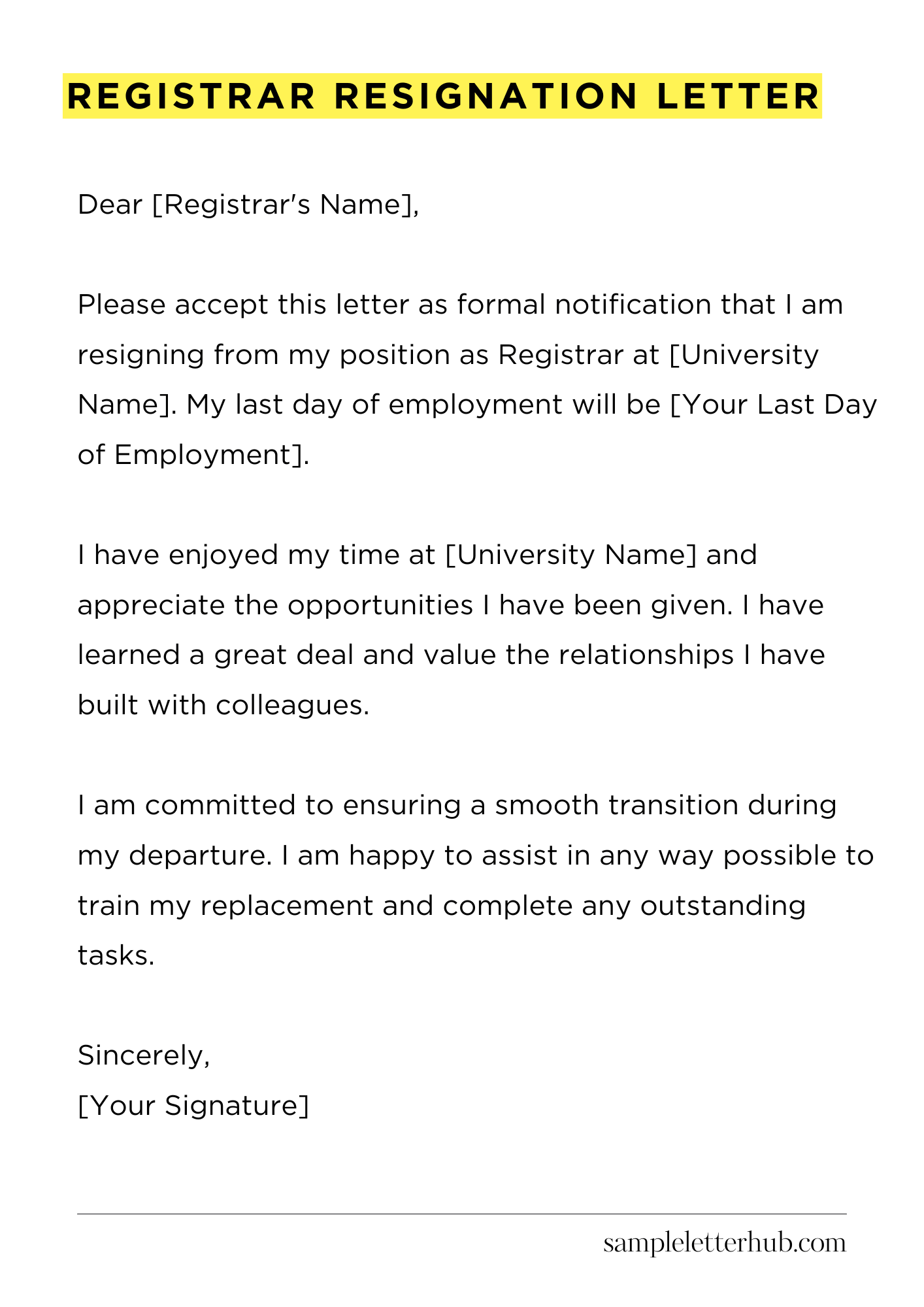
Dear [Registrar’s Name],
Please accept this letter as formal notification that I am resigning from my position as Registrar at [University Name]. My last day of employment will be [Your Last Day of Employment].
I have enjoyed my time at [University Name] and appreciate the opportunities I have been given. I have learned a great deal and value the relationships I have built with colleagues.
I am committed to ensuring a smooth transition during my departure. I am happy to assist in any way possible to train my replacement and complete any outstanding tasks.
Thank you for the opportunity to have served as Registrar. I wish you and the university continued success in the future.
Sincerely,
[Your Signature]
How to Write a Registrar Resignation Letter
Leaving a job is a big decision. When you’re ready to move on from your role as a registrar, a well-crafted resignation letter is crucial. It’s your official farewell. This document sets the tone for your departure and can impact your future professional relationships. Let’s break down how to write a great one.
1. Start with the Basics: The Essential Components
First things first, your letter needs essential information. Keep it concise. Begin with your name, address, and contact details. Then, include the date and the recipient’s information (name, title, and the organization’s address).
Make sure everything is accurate. Next, the formal salutation is vital. Use “Dear [Recipient’s Name],” or if you don’t know the name, “Dear Hiring Manager” is fine.
2. State Your Intentions: The Core Purpose
The most important part? Clearly state your intention to resign. This should be direct and unambiguous. You need to declare your resignation.
For instance, you might say, “Please accept this letter as formal notification that I am resigning from my position as Registrar, effective [Your Last Day of Employment].” Keep it professional. Avoid ambiguity. The reader should immediately understand your purpose.
3. Show Appreciation and a Little Grace
While you might have reasons for leaving, maintaining a positive tone is beneficial. Express gratitude for the opportunity to work there. You can mention specific experiences or skills you’ve gained. Acknowledge any positive aspects of your time at the organization. Even a short acknowledgment can go a long way. This shows professionalism and leaves a good impression.
4. Outline the Logistics: What You Need to Do
Address any transition details. Offer your assistance in the handover process. For example, state something like, “I am committed to ensuring a smooth transition and am happy to assist in training my replacement.” Outline any specific responsibilities you’re willing to handle during your notice period.
This shows your commitment to your employer even as you depart. Mention any unfinished projects or tasks you can help complete.
5. Closing it Out: A Final Touch
End your letter with a professional closing. Use “Sincerely,” or “Respectfully,” followed by your full name. If you’d like, you can include your signature above your typed name.
This is standard practice. Review your letter carefully for any errors in grammar or spelling. A well-written letter reflects positively on you and leaves a lasting professional impression. Sending the letter is just the first step. You also want to consider delivering the letter in person. It’s a nice touch and shows extra respect.
FAQs about Registrar resignation letter
What is the primary purpose of a Registrar resignation letter?
The primary purpose of a Registrar resignation letter is to formally notify the employing institution of the intent to leave the position. It serves as an official communication, initiating the resignation process and providing a documented record of the employee’s decision. It allows the institution to begin planning for the transition and the search for a replacement.
What key elements should be included in a Registrar resignation letter?
A well-crafted Registrar resignation letter should include: a clear statement of resignation, the effective date of the resignation, a brief expression of gratitude for the employment opportunity (optional), a mention of any outstanding responsibilities or handover plans (if applicable), and contact information for future correspondence.
The letter should be professional and concise.
How much notice should a Registrar provide when resigning?
The amount of notice a Registrar should provide is typically determined by their employment contract or company policy. However, a minimum of two to four weeks’ notice is generally considered standard practice. Providing ample notice allows the institution sufficient time to find and train a replacement, ensuring a smooth transition.
Should a Registrar provide a reason for their resignation in the letter?
While not mandatory, a Registrar can choose to briefly state the reason for their resignation. This could be for personal or professional growth, a new job opportunity, or other relevant factors.
However, it’s not essential, and the level of detail provided is at the discretion of the resigning Registrar. The tone should remain professional regardless of the reasons provided.
How should a Registrar handle the submission of their resignation letter?
A Registrar should typically submit their resignation letter to their direct supervisor or the appropriate Human Resources department. It’s often best to provide a hard copy and, for record-keeping purposes, also email a digital copy.
After submitting the letter, it’s advisable to discuss the resignation and transition plans with their supervisor to ensure a smooth handover of responsibilities.
Related:
Resignation letter due to rude boss
Resignation letter moving to another state
Resignation letter due to illness of family member
Resignation letter due to study