

A Regional Vice President resignation letter is a formal document. It announces your departure from the company. It clearly states your intention to resign from your position. This letter is a crucial step in the resignation process.
Need to resign? This article is here to help. We’ll provide you with helpful examples. We’ll share various resignation letter templates. These samples will guide you. They’ll make writing your own letter easier.
Crafting the perfect resignation letter is important. We have different scenarios covered. Whether you’re moving on or retiring, we have templates. We aim to ease the burden of this often tricky task.
Regional Vice President Resignation Letter
Below is a sample of a Regional Vice President Resignation Letter:
[Your Name/Address]
[Your Phone Number]
[Your Email Address]
[Date]
[Recipient Name/Title]
[Company Name]
[Company Address]
Dear [Recipient Name],
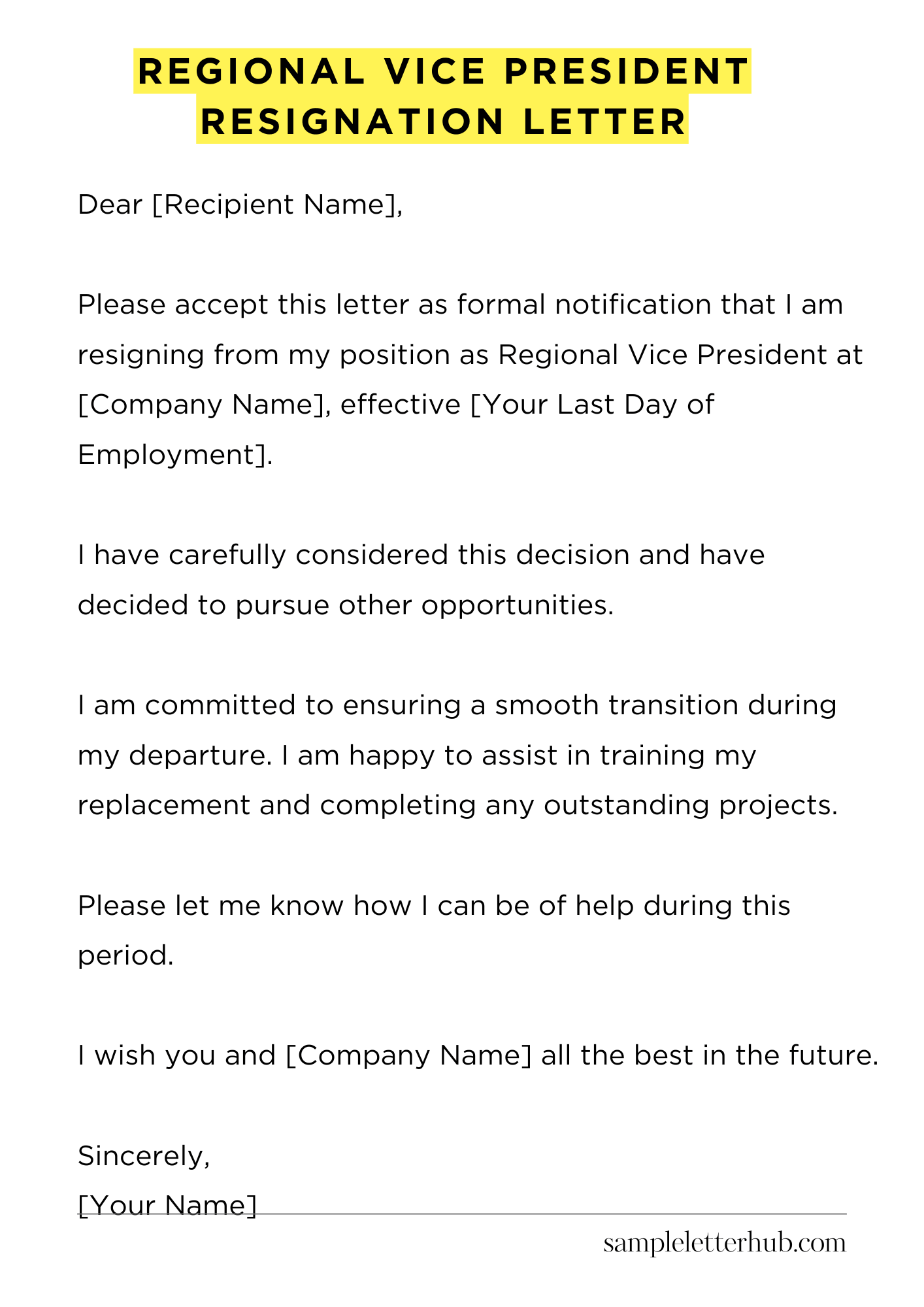
Please accept this letter as formal notification that I am resigning from my position as Regional Vice President at [Company Name], effective [Your Last Day of Employment].
I have carefully considered this decision and have decided to pursue other opportunities.
I am committed to ensuring a smooth transition during my departure. I am happy to assist in training my replacement and completing any outstanding projects. Please let me know how I can be of help during this period.
I want to thank you and the company for the opportunities I have been given during my time here. I have learned a great deal and appreciate the experiences I have gained.
I wish you and [Company Name] all the best in the future.
Sincerely,
[Your Name]
How to Write a Regional Vice President Resignation Letter
Know Your Audience
Before you even begin typing, think about who will be reading your letter. That’s the first step! Are you sending it directly to the CEO, your immediate supervisor, or perhaps the Human Resources department?
Their position dictates the level of formality and the specific details you’ll include. Understanding your audience helps you tailor your message and ensures it’s well-received. Keep it professional. This is a very important communication.
Consider their personalities too. You want to remain professional, even if the work environment wasn’t your favorite place.
Crafting the Opening Paragraph
Start strong! Your opening paragraph should be clear, concise, and state your intention. It must be direct. The main goal is to declare your resignation. Begin with a formal statement of resignation. Include the date you intend to leave the company. This shows you’re serious and respectful of the company’s needs.
For example: “Please accept this letter as formal notification that I am resigning from my position as Regional Vice President, effective [Your Last Day of Employment].” Don’t beat around the bush; get straight to the point.
Highlighting Your Contributions (Briefly)
This is where you can showcase your achievements. It’s not a resume, but acknowledging your accomplishments can be beneficial. List them very briefly. Mention key contributions during your tenure. Did you exceed sales targets? Did you implement a successful new strategy? It’s okay to mention these things, but keep it brief and focused.
This is an opportunity to express gratitude. You can say something like, “During my time at [Company Name], I am proud to have…” Keep it concise.
Addressing the Transition
Offer assistance during the transition phase. This shows professionalism and a commitment to helping the company. Offer your help with a smooth handover. Offer to help with training your replacement. Your goal is to be helpful. This demonstrates that you’re focused on the company, and not yourself.
Include this statement, “I am committed to ensuring a smooth transition during my departure and am available to assist in any way possible to train my replacement.” Being available is a good idea. That says you’re willing to make the transition as easy as possible.
The Closing and Signature
End on a positive note, expressing gratitude for the opportunity and wishing the company well. It’s smart to end on a gracious note. Thank the company for the experience and the opportunities you’ve been given.
For example: “Thank you for the opportunities I’ve been given during my time here. I wish [Company Name] continued success.” Then, sign your letter formally. Always include your typed name below your signature. Use a professional font. A clean, easy-to-read font makes the letter even better. Finally, Proofread! Carefully check for typos and grammatical errors before sending.
FAQs about Regional Vice President resignation letter
How much notice should a Regional Vice President give when resigning?
The standard notice period for a Regional Vice President resignation typically aligns with the employment contract or company policy. However, a notice period of at least four weeks, and ideally one to two months, is generally considered professional.
This timeframe allows for a smooth transition, including the handover of responsibilities, training of a replacement, and completion of ongoing projects. Factors like the seniority of the role, the complexity of the responsibilities, and company culture can influence the specific length of the notice period.
What key elements should be included in a Regional Vice President resignation letter?
A well-crafted resignation letter should include: a clear and concise statement of resignation; the effective date of resignation; a brief statement of gratitude for the opportunity; a professional and courteous tone; and a willingness to assist with the transition.
It can be beneficial to briefly explain the reason for leaving (optional but encouraged), and offer to help train a successor. Ensure that the letter is reviewed for accuracy before submission.
Should I provide a reason for my resignation in the letter, and if so, how detailed should it be?
While not mandatory, providing a reason for resignation can offer context and help maintain a positive relationship with the employer. Keep the reason concise and professional. Avoid negativity or overly detailed explanations, particularly if the reason involves personal conflicts.
A general statement such as “pursuing other opportunities” or “seeking a new career direction” is often sufficient. If departing due to a specific issue, state it factually and avoid accusatory language.
How should a Regional Vice President handle the handover process?
A Regional Vice President should proactively prepare for a smooth handover. This involves compiling a comprehensive list of ongoing projects, key contacts, and critical tasks.
Documenting procedures and creating training materials is essential. Offer to assist in the training of a successor and be available for questions and consultation during the transition period. Maintaining a positive and supportive attitude can greatly facilitate a successful handover.
What are the legal implications of resigning from a Regional Vice President position?
The primary legal considerations relate to the terms of the employment contract, including notice periods, non-compete clauses, and confidentiality agreements. Review the contract carefully to understand any obligations or restrictions. Ensure compliance with all applicable legal requirements.
Seek legal counsel if there are any doubts or concerns regarding the implications of the resignation. Be aware of any potential severance agreements or payouts if they are applicable.
Related:
Resignation letter due to rude boss
Resignation letter moving to another state
Resignation letter due to illness of family member
Resignation letter due to study