

A Recruitment Specialist resignation letter is a formal document. Its purpose is to officially inform an employer of your departure. It outlines your intention to leave your current role. It also specifies your last day of employment.
Thinking of moving on from your recruitment role? This article is here to help. We’ll provide you with various letter samples. These cover different scenarios. You’ll find templates, examples, and straightforward options.
Crafting the perfect resignation letter doesn’t have to be hard. We’ve compiled a collection. Use them to write your own with confidence. Let’s make this process simple and stress-free for you.
Recruitment Specialist Resignation Letter
Below is a sample of a Recruitment Specialist Resignation Letter:
[Your Name]
[Your Address]
[Your Phone Number]
[Your Email Address]
[Date]
[Hiring Manager Name] (If known, otherwise use title)
[Hiring Manager Title]
[Company Name]
[Company Address]
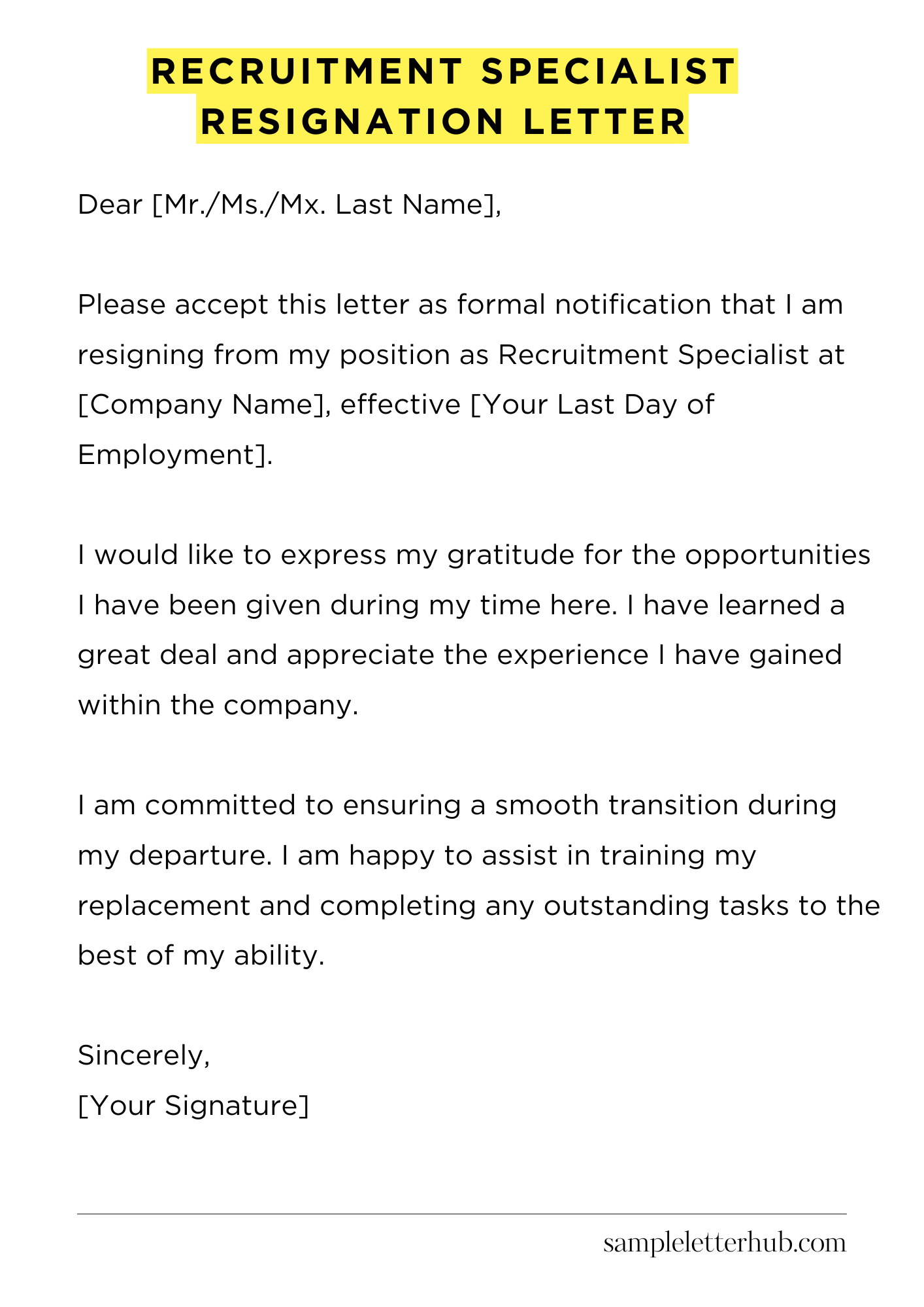
Dear [Mr./Ms./Mx. Last Name],
Please accept this letter as formal notification that I am resigning from my position as Recruitment Specialist at [Company Name], effective [Your Last Day of Employment].
I would like to express my gratitude for the opportunities I have been given during my time here. I have learned a great deal and appreciate the experience I have gained within the company.
I am committed to ensuring a smooth transition during my departure. I am happy to assist in training my replacement and completing any outstanding tasks to the best of my ability.
I wish you and [Company Name] all the best in the future.
Sincerely,
[Your Signature]
How to Write a Recruitment Specialist Resignation Letter
1. Preparation is Key: Before You Start
Resigning from your job is a significant step. You need to prepare meticulously. Before putting pen to paper (or fingers to keyboard!), reflect on your reasons for leaving. Consider the specific points you want to address in your letter. Remember, clarity is crucial in this process.
Think about the tone you want to convey. Will you be thankful for the opportunity? Do you have any constructive criticism to offer? Decide what you feel comfortable sharing. It is very important to consider the company culture before your decide on the tone.
Double-check your employment contract for any required notice periods. Make sure you adhere to them. Failing to do so can sometimes lead to complications. Make sure to gather all the important documents before handing in your letter. Ensure you have the necessary information ready at hand to avoid any last-minute stress.
2. The Essential Elements: What to Include
Your resignation letter needs to be clear and concise. It needs to contain a few key elements. First, start with a formal salutation, addressing the appropriate person by name (e.g., “Dear [Manager’s Name]”). This simple step shows professionalism.
Clearly state your intention to resign. This should be the very first thing that the recipient understands. Mention your last day of employment. This is usually determined by your notice period. This is essential to avoid any confusion.
Express your gratitude for the opportunity to work at the company. Even if you’re not completely thrilled about leaving, a brief expression of thanks can go a long way. This builds a positive relationship. You might also want to briefly mention anything of value you gained from your experience.
3. The Body of Your Letter: Adding Detail
The body of your letter is where you expand on your initial statement. Here, you can optionally provide a brief and professional explanation for your resignation. Keep it brief. There is no need to over-share. Focus on facts rather than emotions.
If you’re willing, offer to assist with the transition process. This includes training a replacement or completing ongoing projects. This demonstrates commitment and goodwill, and increases your chances of getting a good reference.
Avoid negativity. Don’t dwell on complaints or grievances unless they are absolutely crucial and professional. Always keep the tone respectful. This will help maintain a positive impression.
4. Finalizing Your Letter: Proofreading and Formatting
Before submitting, proofread your letter meticulously. Errors can undermine your credibility. Check for grammar, spelling, and punctuation mistakes. Ask a friend or colleague to review it as well for an extra pair of eyes.
Ensure a professional format. Use a standard business letter format with a clear font like Times New Roman or Arial. Keep the letter concise; one page is usually ideal. Always use a professional font.
Include your contact information at the top or bottom of the letter. This includes your phone number and email address. This makes it easier for your employer to reach you. Always remember to use your personal email address.
5. After Submission: What to Expect
Once you submit your letter, be prepared for a response. Your manager may want to discuss your resignation. They might want an exit interview. Be prepared to answer questions professionally. Be prepared to listen too.
Fulfill your notice period diligently. Continue to perform your duties to the best of your ability. Keep your work ethic intact until your last day. This is very important to maintain your professionalism.
Remember that your resignation letter is a formal document. It is a reflection of your professionalism. By following these guidelines, you can ensure a smooth transition and maintain a positive professional reputation. Also, be sure to request a reference letter before you leave. This could be very important in the future.
FAQs about Recruitment Specialist resignation letter
How do I start a resignation letter as a Recruitment Specialist?
When starting your resignation letter, begin with a professional and direct approach. Clearly state your intention to resign from your position as a Recruitment Specialist.
Include the date of your resignation and, if required, the effective date of your departure. Briefly and politely mention your decision, without going into excessive detail. For instance, you could start with: “Please accept this letter as formal notification that I am resigning from my position as Recruitment Specialist at [Company Name], effective [Date].”
What should I include in the body of my resignation letter?
In the body of your letter, express your gratitude for the opportunity to have worked at the company. Mention any specific experiences or achievements you valued.
Keep the tone positive and avoid negative comments about your current role or colleagues. Offer to assist with the transition process, such as training your replacement or completing pending tasks. Conclude by reiterating your thanks and offering well wishes for the future success of the company.
What is the proper format for a Recruitment Specialist resignation letter?
The standard format for a resignation letter is typically business-like. Start with your contact information (name, address, phone number, and email) at the top, followed by the date.
Then, address the letter to your immediate supervisor or the appropriate HR representative. Use a clear and concise font like Arial or Times New Roman, and maintain single spacing within paragraphs and double spacing between them.
The letter should be no longer than one page. Close with a professional closing, such as “Sincerely” or “Best regards,” followed by your signature and your typed name.
Should I provide a reason for my resignation in the letter?
You are not obligated to provide a detailed reason for your resignation in the letter. However, it’s generally acceptable to briefly state that you are pursuing a new opportunity or personal reasons, or even to state, “for personal reasons.” Keep the explanation brief. If you wish to provide more detailed feedback, consider doing so during an exit interview with HR, separate from the letter.
How can I ensure my resignation letter is professional?
To ensure your resignation letter is professional, maintain a positive and respectful tone throughout. Proofread your letter carefully for any grammatical errors or typos. Avoid including any unnecessary personal opinions or complaints. Keep the focus on your departure and offer to support the transition.
Delivering your letter in person is often the most professional approach, but depending on the company policy and circumstances, submitting the letter electronically may also be acceptable. Remember to keep a copy for your records.
Related:
Resignation letter due to rude boss
Resignation letter moving to another state
Resignation letter due to illness of family member
Resignation letter due to study