

A Recruitment Executive resignation letter is a formal document. Its purpose is to officially inform an employer of your intention to leave your job. This letter marks the end of your employment. It is a vital step in the process.
Feeling unsure about crafting this letter? Don’t worry, you are not alone. We’ve got you covered. We’ll provide you with various templates. Examples and samples are also available for your use.
Use our guide to simplify the writing process. You can create your perfect letter. We’ll make it easier than ever before. Let’s get started.
Recruitment Executive Resignation Letter
Below is a sample of a Recruitment Executive Resignation Letter:
[Your Name]
[Your Address]
[Your Phone Number]
[Your Email Address]
[Date]
[Hiring Manager Name] (If known, otherwise use title)
[Hiring Manager Title]
[Company Name]
[Company Address]
Dear [Mr./Ms./Mx. Last Name],
Please accept this letter as formal notification that I am resigning from my position as Recruitment Executive at [Company Name]. My last day of employment will be [Your Last Day of Employment].
I would like to express my gratitude for the opportunities I have been given during my time here. I have learned a great deal and appreciate the experience I have gained.
I am committed to ensuring a smooth transition during my departure. I am happy to assist in training my replacement and completing any outstanding tasks. Please let me know how I can be of assistance during this period.
I wish you and [Company Name] all the best for the future.
Sincerely,
[Your Signature]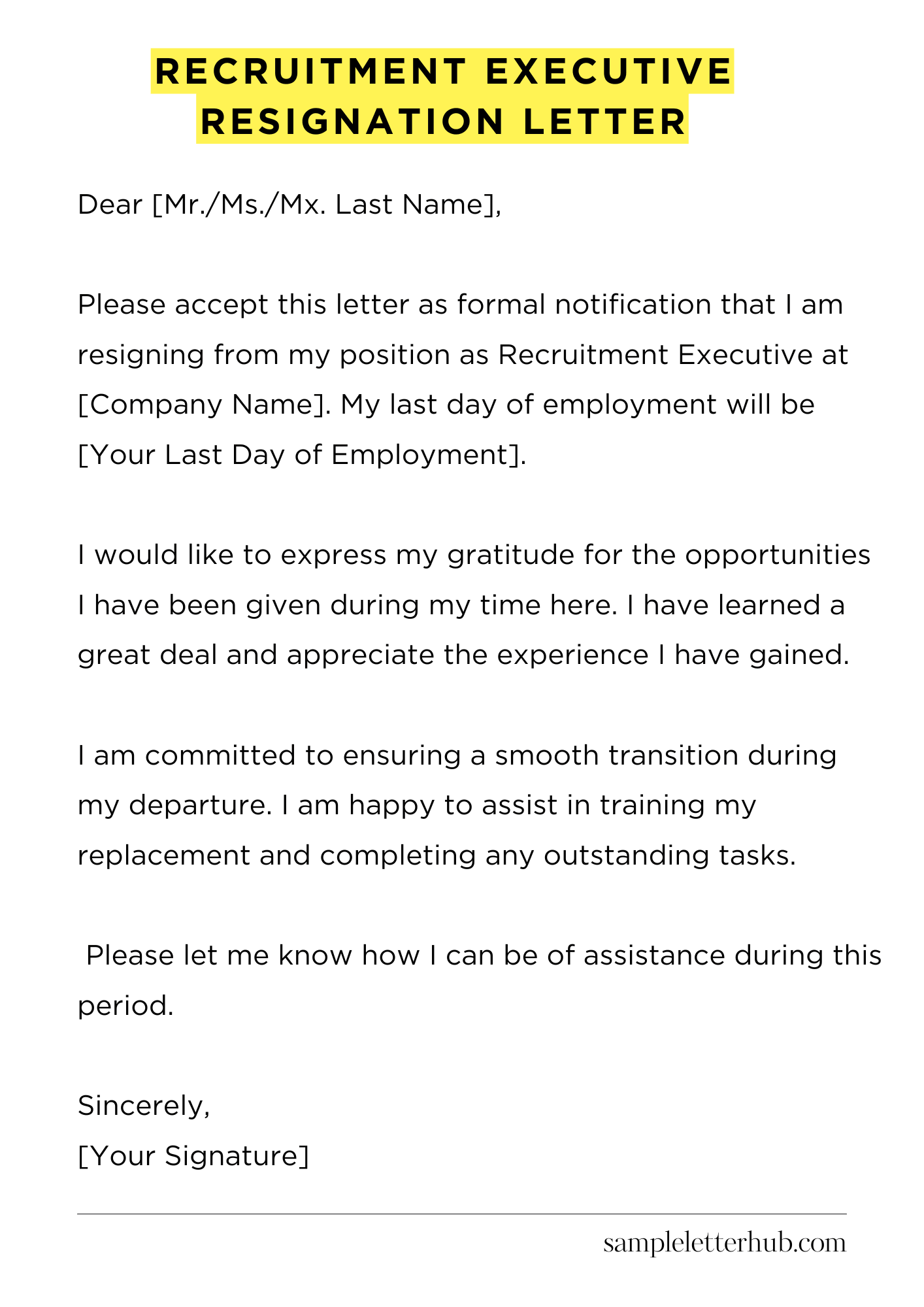
How to Write a Recruitment Executive Resignation Letter
Leaving a job is never easy, especially when you’ve invested time and energy in your role. When you’re a Recruitment Executive, your skills are in demand, and your departure impacts your team.
A well-crafted resignation letter is critical. It’s not just a formality; it’s your final professional statement. Let’s delve into crafting a resignation letter that reflects your professionalism and leaves a positive lasting impression.
1. Start with the Basics: Formatting and Formatting
First things first. You need a polished and professional look. This starts with proper formatting. Ensure your letter is correctly formatted. Use a standard business letter format.
Your contact information goes at the top, typically left-aligned. Include your name, address, phone number, and email address. Next, add the date, followed by your hiring manager’s name and title, and the company’s address.
Keep it clean and easy to read. Use a standard font like Times New Roman or Arial in a readable size (usually 12 points). Single-space the body of the letter and leave a space between paragraphs. A well-formatted letter is a sign of respect and attention to detail.
2. The Core: State Your Intent and State it Clearly
The main purpose of your resignation letter is to officially announce your departure. Be direct. Begin with a clear statement of your intention to resign. For example, “Please accept this letter as formal notification that I am resigning from my position as Recruitment Executive at [Company Name], effective [Your Last Day of Employment].”
This is straightforward and leaves no room for misunderstanding. It’s crucial to specify your last day of employment. This allows your employer to prepare for your departure and initiate the handover process. Avoid ambiguity and keep it concise.
3. Express Gratitude, If Appropriate: The Polite Approach
Now, while you are resigning, keeping it courteous is essential. It’s usually a good idea to express your gratitude for the opportunity. You can say something like, “I am grateful for the opportunities I have been given during my time at [Company Name].” This shows professionalism. It’s also a way to maintain a positive relationship.
Mentioning specific experiences or skills you’ve gained can also be beneficial. It’s the sign of a good professional who knows how to express his mind, whether it’s leaving or staying. Even if you’re not entirely happy, keeping a positive tone is generally wise.
4. Handover: Smooth Transition and Offer of Assistance
Your departure will likely create a void. Help ease the transition. Offer your assistance in the handover process. You might write something like, “I am committed to ensuring a smooth transition during my departure.
I am happy to assist in training my replacement and transferring my knowledge and responsibilities.” Providing assistance is professional and considerate. It shows that you care about your colleagues and the company’s success even after you are gone. Be prepared to provide any documents or information needed.
5. The Close: Professionalism and a Positive Outlook
Your final paragraph is a chance to end on a positive note. Reiterate your gratitude. This reinforces your professionalism. “I wish [Company Name] continued success in the future.”
This closing is standard and shows respect. Sign off with a formal closing, like “Sincerely,” or “Best regards,” followed by your signature and your typed name. Proofread your letter carefully. Ensure there are no errors in grammar or spelling before sending it. Remember, your resignation letter is a reflection of you. Make it count.
FAQs about Recruitment Executive resignation letter
How do I start a resignation letter as a Recruitment Executive?
Begin your resignation letter by clearly stating your intent to resign from your position as a Recruitment Executive. Include the date of your letter and your name. Formally address the letter to your immediate supervisor or the relevant HR department. A concise and direct opening is key.
What essential information must I include in my Recruitment Executive resignation letter?
The most crucial element is the effective date of your resignation, specifying your last day of employment. Briefly mention your role as a Recruitment Executive. Offer a concise reason for your departure if desired, but it is not mandatory. Include your contact information for any necessary follow-up.
Should I express gratitude in my Recruitment Executive resignation letter?
It is generally advisable to express gratitude for the opportunity to work in your position. Acknowledge any positive experiences or professional growth you gained during your tenure. This reflects a professional and respectful demeanor.
What should be avoided in a Recruitment Executive resignation letter?
Avoid negative comments about the company, your colleagues, or your supervisor. Refrain from listing grievances or engaging in personal attacks. Keep the tone professional and positive. It’s also best to avoid providing excessive or unnecessary details about your new role or future plans.
How do I end my Recruitment Executive resignation letter?
Conclude your letter by offering assistance during the transition period, such as helping with handover tasks. Express your best wishes for the company’s future. Include your name, signature (if printed), and contact details again. A polite and professional closing is essential.
Related:
Resignation letter due to rude boss
Resignation letter moving to another state
Resignation letter due to illness of family member
Resignation letter due to study