

A Recruitment Consultant resignation letter is a formal document. It informs your employer of your decision to leave your job. It’s a crucial step in the process of moving on. The purpose is to officially communicate your departure.
Are you a Recruitment Consultant looking to move on? We get it. Sometimes, it’s time for a change. Crafting the perfect resignation letter can feel tricky. Don’t worry, we’re here to help.
We’ve compiled some helpful templates. You’ll find examples and samples. This article will make the letter-writing process smoother. Consider this your guide to a professional and easy exit.
Recruitment Consultant Resignation Letter
Below is a sample of a Recruitment Consultant Resignation Letter:
[Your Name]
[Your Address]
[Your Phone Number]
[Your Email Address]
[Date]
[Recruitment Consultant’s Manager Name]
[Recruitment Agency Name]
[Agency Address]
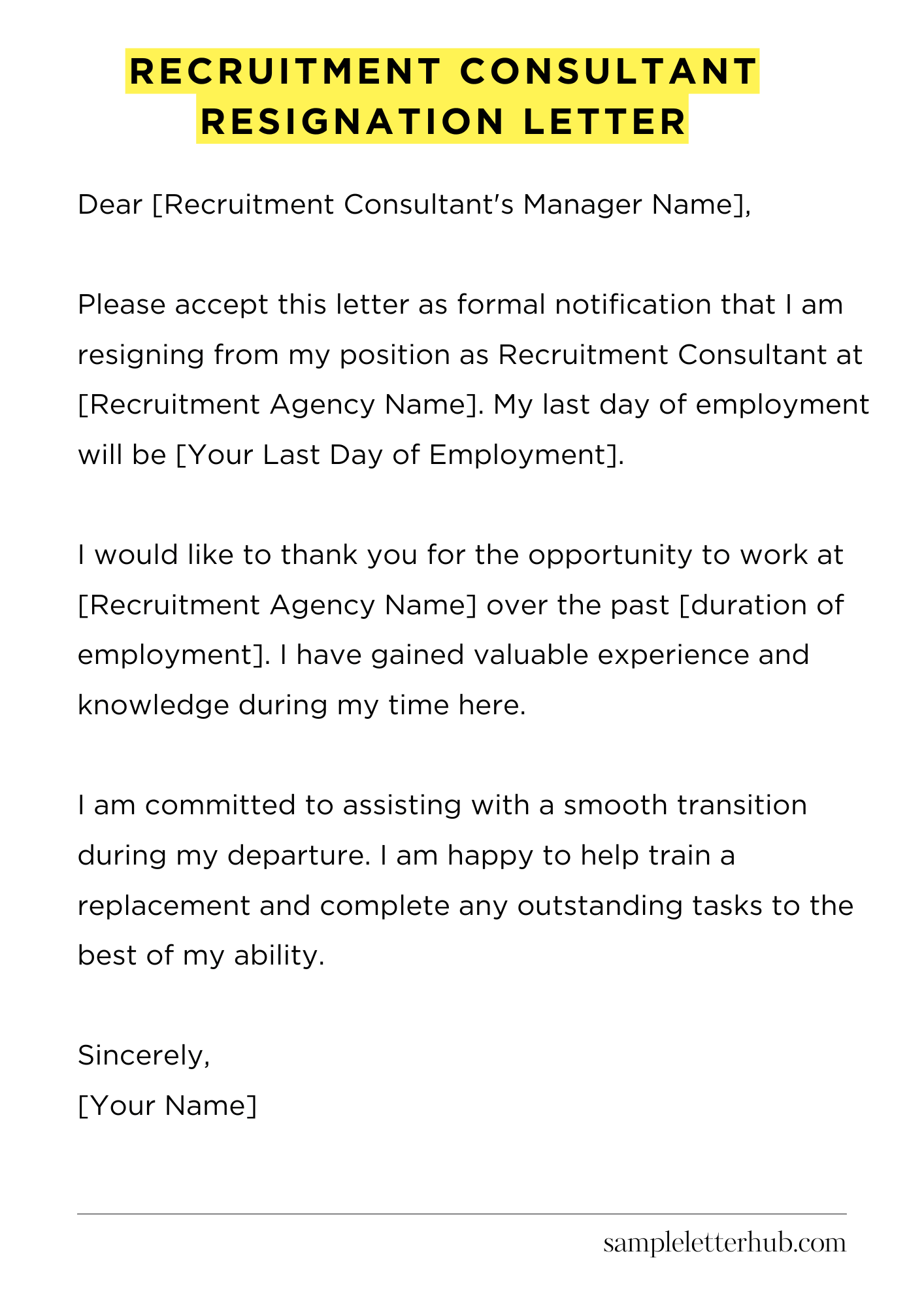
Dear [Recruitment Consultant’s Manager Name],
Please accept this letter as formal notification that I am resigning from my position as Recruitment Consultant at [Recruitment Agency Name]. My last day of employment will be [Your Last Day of Employment].
I would like to thank you for the opportunity to work at [Recruitment Agency Name] over the past [duration of employment]. I have gained valuable experience and knowledge during my time here.
I am committed to assisting with a smooth transition during my departure. I am happy to help train a replacement and complete any outstanding tasks to the best of my ability.
I wish you and the company continued success in the future.
Sincerely,
[Your Name]
How to Write a Recruitment Consultant Resignation Letter
Know Your Audience (and Your Reasons)
Leaving a job is a big decision. Before you even *think* about penning your resignation letter, you need to understand *why* you’re leaving. Are you chasing a bigger salary? A better work-life balance?
A role that ignites your passion? Pinpointing the reasons is crucial. This helps you frame your letter in a way that is clear, concise, and professional. Also, remember who you’re writing to: your direct manager, possibly a senior executive, or maybe even HR. Tailor your tone appropriately. Address them formally. This shows respect, even as you depart.
Crafting the Core: The Essential Elements
Your resignation letter is not the place for lengthy stories or dramatic pronouncements. Stick to the facts. Begin with a clear and direct statement of your intent to resign. Include the specific date of your last day of employment. This is *super* important. Next, briefly, and I mean *briefly*, mention the reason for your departure.
A simple “I have accepted a position that aligns more closely with my long-term career goals” is often sufficient. Avoid negativity. This is not the moment to air grievances, even if you have them.
Expressing Gratitude and Providing Assistance
Even if your experience hasn’t been perfect, acknowledge any positive aspects of your employment. This is where you can show appreciation. Thank your employer for the opportunities you’ve been given. Did you learn valuable skills?
Were there supportive colleagues? Mention those. Furthermore, offer your assistance during the transition period. Offer to help with handover tasks. This includes training a replacement or documenting key processes. This adds professionalism. It leaves a good impression.
Formatting for Success: Making it Readable
Keep your letter concise. Aim for a single page. Use a standard business letter format. This is vital. Include your contact information (name, address, phone number, and email address).
Start with a formal salutation, like “Dear [Manager’s Name]”. Use clear, easy-to-read fonts such as Arial or Times New Roman. Ensure your letter is free of grammatical errors and typos. Proofread! Proofread! Proofread! Errors detract from your credibility.
The Final Touches: What to Avoid and What to Include
Avoid burning bridges. Don’t include any negative comments about your colleagues or the company. Do not divulge confidential information. This can have serious legal consequences.
What should you include? Your signature at the end (if sending a physical copy) and your typed name below. Consider whether you want to offer an exit interview, but it isn’t mandatory. If you are offered one, prepare some answers about your experience at the company. Keep everything positive and professional!
FAQs about Recruitment Consultant resignation letter
How do I write a recruitment consultant resignation letter that’s professional?
To write a professional resignation letter, start by formally stating your intention to resign and your last day of employment. Be direct and concise. Express gratitude for the opportunities you’ve been given, and briefly mention any positive aspects of your experience. Avoid negativity or overly detailed explanations for leaving.
Offer assistance with the transition, such as helping train your replacement or completing outstanding tasks. Finally, end with a polite closing, such as “Sincerely” or “Best regards,” and your full name. Proofread carefully before sending.
What should I include in my recruitment consultant resignation letter?
Your letter should include: your formal intent to resign, the date of your resignation, the date of your last day of employment, a brief expression of gratitude (optional), an offer to assist with the transition (optional), and your closing, and your full name.
Specifics to avoid: do not include the details of why you are leaving, negative comments about the company or colleagues, or promises you can’t keep.
What is the proper format for a recruitment consultant resignation letter?
The format should be a standard business letter format. Include your contact information (name, address, phone, email) at the top or in the letterhead.
Directly below, include the date and the recipient’s information (name, title, company, address). Begin with a formal salutation (e.g., “Dear [Manager’s Name]”), followed by the body of the letter, and conclude with a professional closing (e.g., “Sincerely”) and your full name. It should be single-spaced with a blank line between paragraphs.
How much notice should I give in my recruitment consultant resignation letter?
The standard notice period is typically two to four weeks, but this can vary depending on your employment contract and company policy.
Review your employment agreement to determine the required notice period. When in doubt, a longer notice is generally appreciated. Consider your current role, the complexity of your projects, and the ease of handover when deciding on the appropriate notice period.
Can I provide a reason for leaving in my recruitment consultant resignation letter?
While you don’t have to provide a detailed reason, you can provide a very brief statement if you wish. It is often best to keep the reason brief and neutral.
You could simply state that you are pursuing another opportunity, or that you are looking for a change. Avoid any negative comments about your current employer or colleagues. If you want to provide more specific feedback, consider doing so during an exit interview.
Related:
Resignation letter due to rude boss
Resignation letter moving to another state
Resignation letter due to illness of family member
Resignation letter due to study