

So, you’re ready to move on from your role as a Recruitment Assistant. A resignation letter is your official notice to your employer. It states your intention to leave your job. It’s a key document. It helps ensure a smooth transition.
Writing a resignation letter can feel tricky. Don’t worry, we’re here to help. We’ve got you covered with a variety of examples. You can use them to craft your own perfect letter.
Ready to get started? We will share different templates for your convenience. These samples cover various situations. You will find it easy to adapt them. Let’s make this process simple and stress-free.
Recruitment Assistant Resignation Letter
Below is a sample of a Recruitment Assistant Resignation Letter:
[Your Name]
[Your Address]
[Your Phone Number]
[Your Email Address]
[Date]
[Hiring Manager Name] (If known, otherwise use title)
[Hiring Manager Title]
[Company Name]
[Company Address]
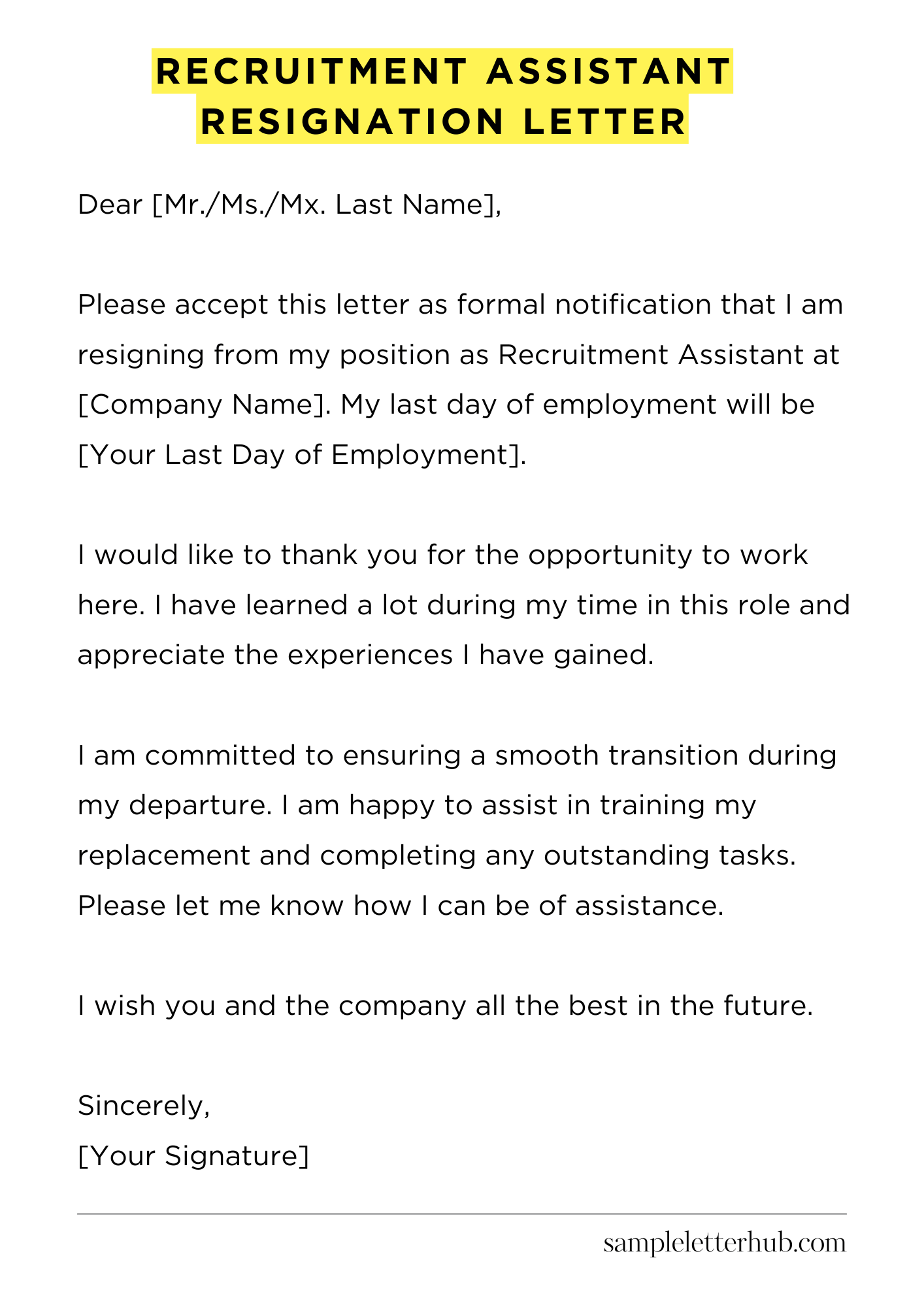
Dear [Mr./Ms./Mx. Last Name],
Please accept this letter as formal notification that I am resigning from my position as Recruitment Assistant at [Company Name]. My last day of employment will be [Your Last Day of Employment].
I would like to thank you for the opportunity to work here. I have learned a lot during my time in this role and appreciate the experiences I have gained.
I am committed to ensuring a smooth transition during my departure. I am happy to assist in training my replacement and completing any outstanding tasks. Please let me know how I can be of assistance.
I wish you and the company all the best in the future.
Sincerely,
[Your Signature]
How to Write Recruitment Assistant Resignation Letter
Leaving a job is a big decision. It can be stressful! If you’re a Recruitment Assistant, and ready to move on, you need a professional resignation letter. This is your official notice. It’s crucial for your career. A well-written letter ensures a smooth transition and maintains a positive relationship with your previous employer. Let’s delve into crafting the perfect letter.
Step 1: The Essential Elements – What You MUST Include
Your resignation letter needs key components. First, there’s the date. Always include it. Then, state your intention to resign. Clearly and directly state you are resigning from your position. Next, specify your last day of employment. This is super important! Also, your job title and the name of the company are vital details.
It keeps everything unambiguous. Finally, express gratitude for the opportunity. This shows professionalism. It can open doors. These are the bare bones that can go a long way.
Step 2: Structuring Your Letter – Keeping it Clear
The structure is important. Begin with a formal salutation. “Dear [Manager’s Name],” is standard. Then, open with your resignation announcement. Keep it concise. Next, briefly express your gratitude. Mention something specific, if possible. For example, “I am grateful for the opportunities for growth I received.”
After that, state your last working day. This clarifies the end date. Conclude with a polite closing. “Sincerely,” or “Respectfully,” are both great options. Finally, type your full name. It makes everything neat. Remember, brevity is a virtue here.
Step 3: Tone and Language – Keeping it Positive
Maintaining a positive tone is crucial. Even if you’re leaving due to negative experiences, avoid negativity. Focus on the positives. Your goal is to leave a good impression. Use professional language. Avoid slang or overly casual terms. Keep your writing clear and concise. This will make it easier to read. Remember, this letter is a reflection of you. It’s your personal brand.
Step 4: Providing a Reason (Optional, But Sometimes Helpful)
You are not usually required to disclose the reason for your departure. However, you may choose to provide a brief explanation. This can be as simple as stating, “I have accepted a new opportunity.”
If you are leaving for a better salary, or for a move, you may choose to include it. Just remember to keep it brief and professional. Avoid lengthy explanations or complaints. Keep the focus on moving forward.
Step 5: Formatting and Proofreading – Attention to Detail
Pay close attention to formatting. Use a standard business letter format. Use a professional font like Times New Roman or Arial. Ensure proper spacing. Before sending, proofread carefully.
Check for any grammar or spelling errors. Errors can undermine your professionalism. Have someone else read it too! A fresh pair of eyes can catch mistakes. This will give you confidence. It’s always the best approach!
FAQs about Recruitment Assistant Resignation Letter
What is the primary purpose of a Recruitment Assistant resignation letter?
The primary purpose of a Recruitment Assistant resignation letter is to formally notify the employer of the employee’s intent to leave their position. It serves as an official record of the resignation, providing crucial details such as the effective date of departure and sometimes a brief reason for leaving, though the latter is not always required.
What key information should be included in a Recruitment Assistant resignation letter?
A well-crafted resignation letter should include the following: the employee’s full name, the date of the letter, the employer’s name and address (or the recipient’s title and department), a clear statement of resignation, the last day of employment (the effective date), a brief and polite expression of gratitude for the opportunity (optional), and the employee’s signature.
How should a Recruitment Assistant address their resignation letter?
The letter should be addressed to the appropriate person, typically the direct supervisor or the Human Resources department. If the specific recipient is unknown, addressing it to the “Human Resources Department” or “Recruiting Manager” is generally acceptable. Always ensure the recipient’s name and title are accurate if known.
Is it necessary to provide a reason for resigning in a Recruitment Assistant resignation letter?
While not strictly required, providing a reason for resignation is often considered a professional courtesy. However, it’s generally best to keep the reason concise and positive. Examples include “to pursue other opportunities,” “for personal reasons,” or “to accept a position with another company.” Avoid overly negative or detailed explanations that could potentially cause conflict.
How much notice should a Recruitment Assistant give when resigning?
The standard notice period is typically two weeks. However, the exact notice period can vary depending on the employment contract, company policy, or any applicable legal requirements. Review the employment contract or company handbook to determine the required notice. Always provide the agreed-upon notice to maintain a professional reputation and ensure a smooth transition.
Related:
Resignation letter due to rude boss
Resignation letter moving to another state
Resignation letter due to illness of family member
Resignation letter due to study