

A Quality Control Technician resignation letter is a formal document. It informs your employer that you’re leaving your job. The letter states your official departure date. It often includes a brief reason for your leaving.
Writing this letter can feel tricky. You want to be professional and polite. Finding the right words matters. We’ve got you covered.
Here, you’ll find ready-to-use templates. Explore various examples and samples. Tailor them to fit your situation. Craft your letter with ease.
Quality Control Technician Resignation Letter
Below is a sample of a Quality Control Technician Resignation Letter:
[Your Name]
[Your Address]
[Your Phone Number]
[Your Email Address]
[Date]
[Employer’s Name]
[Company Name]
[Company Address]
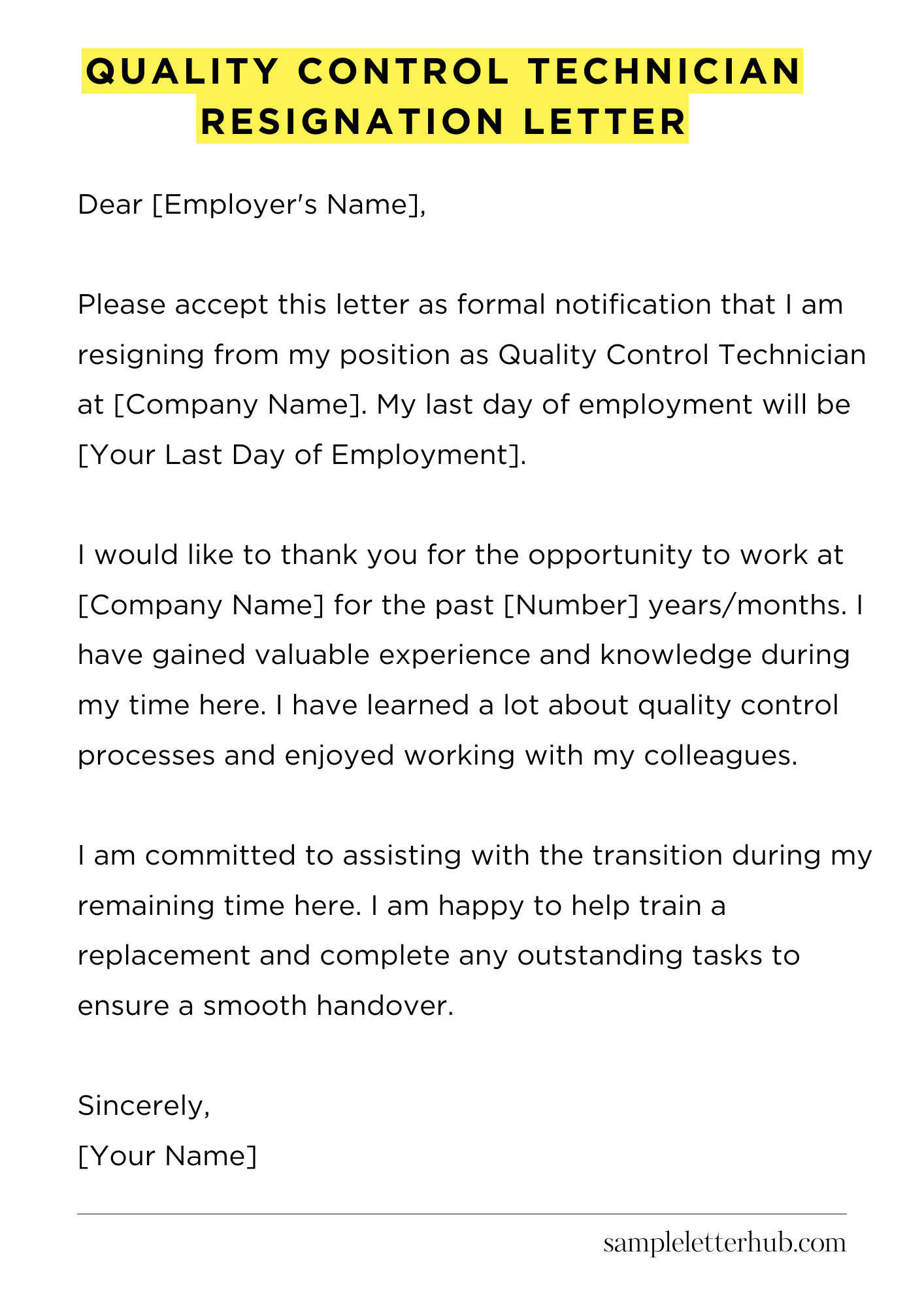
Dear [Employer’s Name],
Please accept this letter as formal notification that I am resigning from my position as Quality Control Technician at [Company Name]. My last day of employment will be [Your Last Day of Employment].
I would like to thank you for the opportunity to work at [Company Name] for the past [Number] years/months. I have gained valuable experience and knowledge during my time here. I have learned a lot about quality control processes and enjoyed working with my colleagues.
I am committed to assisting with the transition during my remaining time here. I am happy to help train a replacement and complete any outstanding tasks to ensure a smooth handover.
I wish you and [Company Name] all the best in the future.
Sincerely,
[Your Name]
How to Write a Quality Control Technician Resignation Letter
1. Why Resign? Planning is Key.
So, you’ve decided to move on from your role as a Quality Control Technician. That’s a big step. Maybe you’ve found a better opportunity, or perhaps the current role just isn’t a good fit anymore.
Whatever the reason, you’ll need to write a resignation letter. Before you even start typing, give some serious thought to your departure. Consider the reasons behind your decision. This helps you write a clear and concise letter.
Think about your end date and ensure it aligns with any company policies regarding notice periods. You don’t want to burn any bridges! Remember, this letter is a formal declaration. Be professional. It’s not a place to vent frustrations. Focus on the facts.
2. Structure: The Anatomy of a Good Resignation Letter.
A well-structured letter is crucial. It’s not complex; in fact, it follows a simple and standard format. Begin with your contact information (name, address, phone number, and email address), and the date.
Next, address the letter to your immediate supervisor or the relevant person in Human Resources. Then, get to the core of the matter! Start with a clear and direct statement of your resignation. State your name and your position. Include the effective date of your last day of employment.
Keep it simple; keep it professional. After the essentials, you can add a brief, positive statement expressing gratitude for the opportunity. This is optional but shows class. It acknowledges the experience you’ve gained during your time there. Proofread your letter meticulously! Grammar and spelling errors reflect poorly on you.
3. Content: What to Actually Write.
The core of your letter is the “meat and potatoes” of your message. Your opening sentence should clearly state your intent: “Please accept this letter as formal notification that I am resigning from my position as Quality Control Technician, effective [Date].”
Next, add a line or two of appreciation. You can say something like, “I am grateful for the opportunities I’ve been given during my time here.” Or, “I appreciate the experience and skills I’ve gained at [Company Name].”
Avoid excessive detail. Keep it short and to the point. No need to delve into specific complaints or negative experiences. While you might want to explain *why* you are leaving, it’s not strictly necessary.
If you choose to, phrase it in a general manner. You can simply state that you are pursuing another opportunity, seeking new challenges, or relocating. A brief statement is fine. At the end, express your willingness to assist in the transition, if appropriate. Offer to train your replacement or help with the handover process.
4. Tone: Keeping It Professional.
Maintaining a professional tone is paramount. You are leaving the company, but you want to leave a positive lasting impression. Avoid negativity or personal attacks.
Even if you’ve had a bad experience, this is not the place to air your grievances. Use a formal and polite tone. Choose your words carefully, showing respect for your former employer and colleagues.
Positive language is your best friend here! Even if you weren’t thrilled with the role, focus on the positive aspects of your experience. A professional tone reflects well on your character. It’s not just a letter; it’s a reflection of your personality and work ethic. Your goal is to depart on good terms.
5. Before You Hit Send: The Final Checklist.
Before you send your resignation letter, make sure everything is perfect. Double-check the date, your name, your position, and the effective date. Does the letter clearly communicate your intention to resign?
Read it aloud. This helps catch any awkward phrasing or grammatical errors. Have someone else read it over too! A fresh pair of eyes can spot mistakes that you might have missed.
Ensure you have all the necessary contact information. Once you’re certain it’s perfect, save a copy for your records. Then, submit the letter according to your company’s policy. Usually, this means delivering it to your supervisor or HR department.
Consider delivering it in person, if possible, to show respect and allow for a quick verbal confirmation. Then, prepare for your transition! Good luck in your future endeavors!
FAQs about Quality Control Technician resignation letter
What is the essential information to include in a Quality Control Technician resignation letter?
A Quality Control Technician resignation letter should include your formal resignation, stating your intention to leave the company and the specific date of your last day of employment.
Briefly mention your role within the company (e.g., “Quality Control Technician”). It’s also customary and professional to express gratitude for the opportunities and experiences gained during your employment, and you can also offer assistance during the transition period. Include your full name and contact information.
How much notice should a Quality Control Technician give when resigning?
The standard notice period for a Quality Control Technician, like most employees, is typically two weeks. However, the exact notice period may be specified in your employment contract or company policy.
Reviewing these documents is crucial to ensure you provide the required notice to avoid any potential issues. If you are uncertain, it is wise to clarify with your Human Resources department.
Should I provide a reason for leaving in my Quality Control Technician resignation letter?
While not mandatory, briefly stating your reason for leaving can be beneficial. It’s generally best to keep the reason concise and positive. Examples include “pursuing new opportunities,” “relocating,” or “seeking career growth.”
Avoid negative comments about the company or colleagues. However, in certain scenarios, like when facing unethical behavior, you may want to seek legal advice and inform your superior about the issues.
What is the appropriate tone for a Quality Control Technician resignation letter?
The tone of your resignation letter should be professional and respectful. Maintain a positive and appreciative attitude, even if you are leaving due to negative experiences. Avoid using overly emotional language, complaints, or criticisms. Keep the language clear, concise, and polite throughout the letter.
How should I handle outstanding projects or responsibilities in my Quality Control Technician resignation letter?
In your resignation letter, you can briefly mention your willingness to assist in a smooth transition. Offer to help train your replacement, complete any ongoing projects, or provide documentation for your responsibilities.
This demonstrates professionalism and a commitment to ensuring the quality of work continues even after your departure. Specifically state that you will cooperate with management and your colleagues to complete a smooth transition.
Related:
Resignation letter due to rude boss
Resignation letter moving to another state
Resignation letter due to illness of family member
Resignation letter due to study