

A Quality Control resignation letter is a formal document. It informs your employer of your decision to leave. The purpose is to officially announce your departure. It also helps maintain a professional relationship.
This article is your guide. We’ll explore Quality Control resignation letter templates. You’ll find examples and samples. These will help you craft your own letter.
Need a letter that gets the job done? We’ve got you covered. Consider this your toolkit. Get ready to write with confidence.
Quality Control Resignation Letter
Below is a sample of a Quality Control Resignation Letter:
[Your Name]
[Your Address]
[Your Phone Number]
[Your Email Address]
[Date]
[Employer’s Name]
[Company Name]
[Company Address]
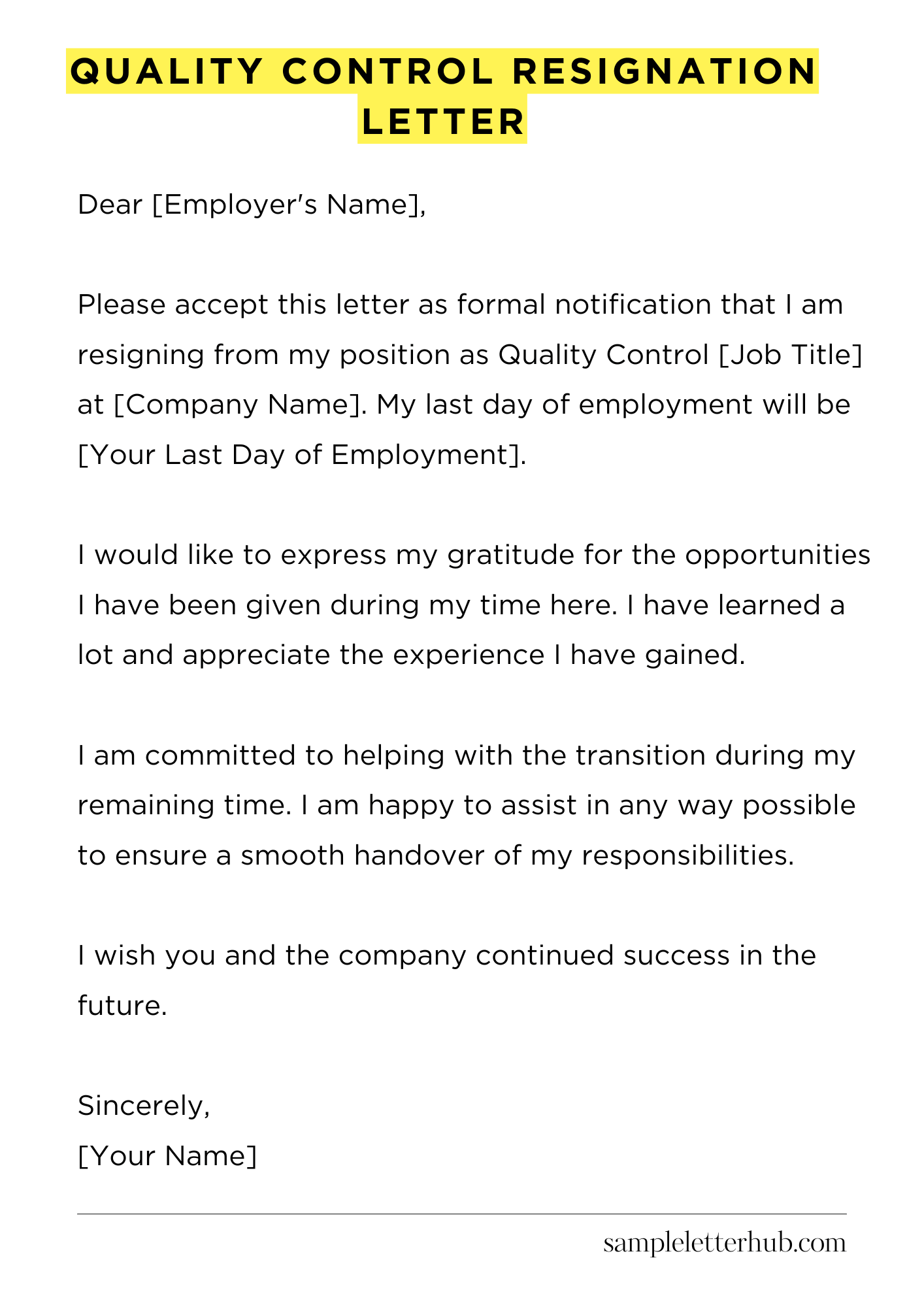
Dear [Employer’s Name],
Please accept this letter as formal notification that I am resigning from my position as Quality Control [Job Title] at [Company Name]. My last day of employment will be [Your Last Day of Employment].
I would like to express my gratitude for the opportunities I have been given during my time here. I have learned a lot and appreciate the experience I have gained.
I am committed to helping with the transition during my remaining time. I am happy to assist in any way possible to ensure a smooth handover of my responsibilities.
I wish you and the company continued success in the future.
Sincerely,
[Your Name]
How to Write a Quality Control Resignation Letter
1. Getting Started: The Basics You Need
Leaving a job is a big decision. You have to inform your employer of your decision in a professional way. First and foremost, you need a resignation letter. This isn’t something to be rushed. Take your time and make sure you do it right.
Before you even begin writing, determine the effective date of your resignation. Check your employment contract or company handbook for any required notice periods.
This notice is crucial, so don’t skip this step. Generally, two weeks’ notice is standard in most professions. Failing to give proper notice can potentially affect your eligibility for unemployment benefits or future employment opportunities.
Now, let’s talk about the format. Your letter should be formal and concise. Always use a professional business letter format: your name, address, and contact information, followed by the date, and then your employer’s information. Keep it clean and easy to read. Clarity is key.
2. Crafting the Core: What to Actually Say
The body of your letter is where you communicate your intentions. Start with a clear and direct statement of your resignation. Begin with a simple sentence stating you are resigning.
Something like, “Please accept this letter as formal notification that I am resigning from my position as Quality Control Inspector, effective [Date].” It’s straightforward and avoids any ambiguity.
Keep your language positive and professional. Avoid negativity, even if you are leaving due to dissatisfaction. You don’t want to burn any bridges. Briefly express your gratitude for the opportunity to have worked there.
You can mention any specific skills or experiences you gained. A simple sentence or two expressing appreciation is enough. For example, “I am grateful for the experience and opportunities I’ve been given during my time here.”
Finally, offer assistance with the transition. Suggest assisting with the transfer of your duties. This shows you’re a responsible employee. Offer to train your replacement or prepare documentation.
It demonstrates respect for the company and your colleagues. This can be as simple as, “I am happy to assist with the transition process to the best of my ability.”
3. The Details Matter: Formatting and Tone
Formatting impacts how your letter is perceived. Keep the font size 12 and use a readable font like Times New Roman or Arial. Use single spacing for the body and double spacing between paragraphs. Ensure proper margins. Accuracy is very important.
The tone of your letter should be professional and respectful. Avoid slang or overly casual language. Maintain a neutral and objective tone, even if you’re feeling frustrated. Proofread your letter meticulously for any grammatical errors or typos. These errors can undermine your credibility. A well-written letter reflects positively on you and your professionalism.
Consider sending a digital copy and a hard copy to your supervisor. Always keep a copy for your records. This ensures you have proof of your resignation and the date you submitted it. It’s a good practice, and you may need it later.
4. Beyond the Basics: What to Leave Out
While you should be professional, there are things to exclude. Don’t go into excessive detail about your reasons for leaving, unless you’ve been asked by HR for an exit interview.
Avoid any negative comments about your colleagues, the company, or your previous role. This isn’t the time for complaints. Criticism will only reflect poorly on you. Keep the focus on the future. Maintain a professional demeanor.
Don’t mention your new job or competing companies. This could cause legal and ethical issues. Confidentiality is key. Keep it simple. You only need to tell them you are leaving, not where you are going.
5. Final Steps: Review, Revise, and Submit
Before submitting, review your letter carefully. Read it aloud to catch any errors you may have missed. Ask a trusted friend or colleague to proofread it. A fresh set of eyes can often catch mistakes. This final check is very important.
Once you are satisfied with the final draft, sign and date the letter. Sign it with a pen if submitting a hard copy. The signature adds a personal touch. Make sure the date is accurate. The date provides a timeline.
Hand the letter to your supervisor or HR representative, and keep a copy for your personal records. Congratulations! You’ve just successfully written a quality control resignation letter. Good luck in your future endeavors!
FAQs about Quality Control Resignation Letter
What information should I include in my Quality Control resignation letter?
Your Quality Control resignation letter should include your formal resignation, the date of your last day of employment (typically two weeks from the date of the letter, or as per your employment contract), a brief and polite statement of your reason for leaving (optional but often included), and your gratitude for the opportunity.
You should also offer to assist with the transition of your duties and include your contact information for any follow-up.
How much notice should I give when resigning from a Quality Control position?
The standard notice period is typically two weeks. However, this can vary based on your employment contract or company policy. Always refer to your contract or employee handbook to confirm the required notice period. Providing more notice, if possible, can be beneficial for a smoother transition.
Should I provide a reason for leaving in my Quality Control resignation letter?
Providing a reason is optional. If you choose to, keep it brief, positive, and professional. Focus on your future career goals or personal reasons rather than any negative aspects of your current role or employer. Common reasons cited include pursuing a new opportunity, career advancement, or personal considerations. Avoid being overly critical.
What tone should I use in my Quality Control resignation letter?
Maintain a professional and polite tone throughout your letter. Express your gratitude for the opportunity to work in Quality Control and avoid any negative or accusatory language. The tone should reflect a respectful and appreciative attitude towards your employer and colleagues, regardless of your reasons for leaving.
Is it necessary to mention specific projects or achievements in my Quality Control resignation letter?
While not mandatory, it is often a good practice to briefly acknowledge your contributions and accomplishments during your time in Quality Control. This can be as simple as mentioning your involvement in specific projects or your role in improving quality processes. Doing so can leave a positive impression and reinforce your value as an employee.
Related:
Resignation letter due to rude boss
Resignation letter moving to another state
Resignation letter due to illness of family member
Resignation letter due to study