

A Public Relations Officer resignation letter is a formal document. Its purpose is to officially inform an employer of your departure. It outlines your intention to leave your role. It also provides a date for your last day of employment.
Are you a PR professional planning your exit? Crafting the perfect resignation letter can be tricky. We’ve got you covered. We’re sharing a range of templates and samples. Use them to create your own professional resignation.
These examples will guide you. Find the right words. Make the process simple and stress-free. Whether you need a brief or detailed letter, we have options. Explore them to ease your transition.
Public Relations Officer Resignation Letter
Below is a sample of a Public Relations Officer Resignation Letter:
[Your Name]
[Your Address]
[Your Phone Number]
[Your Email Address]
[Date]
[Recipient’s Name]
[Recipient’s Title]
[Company Name]
[Company Address]
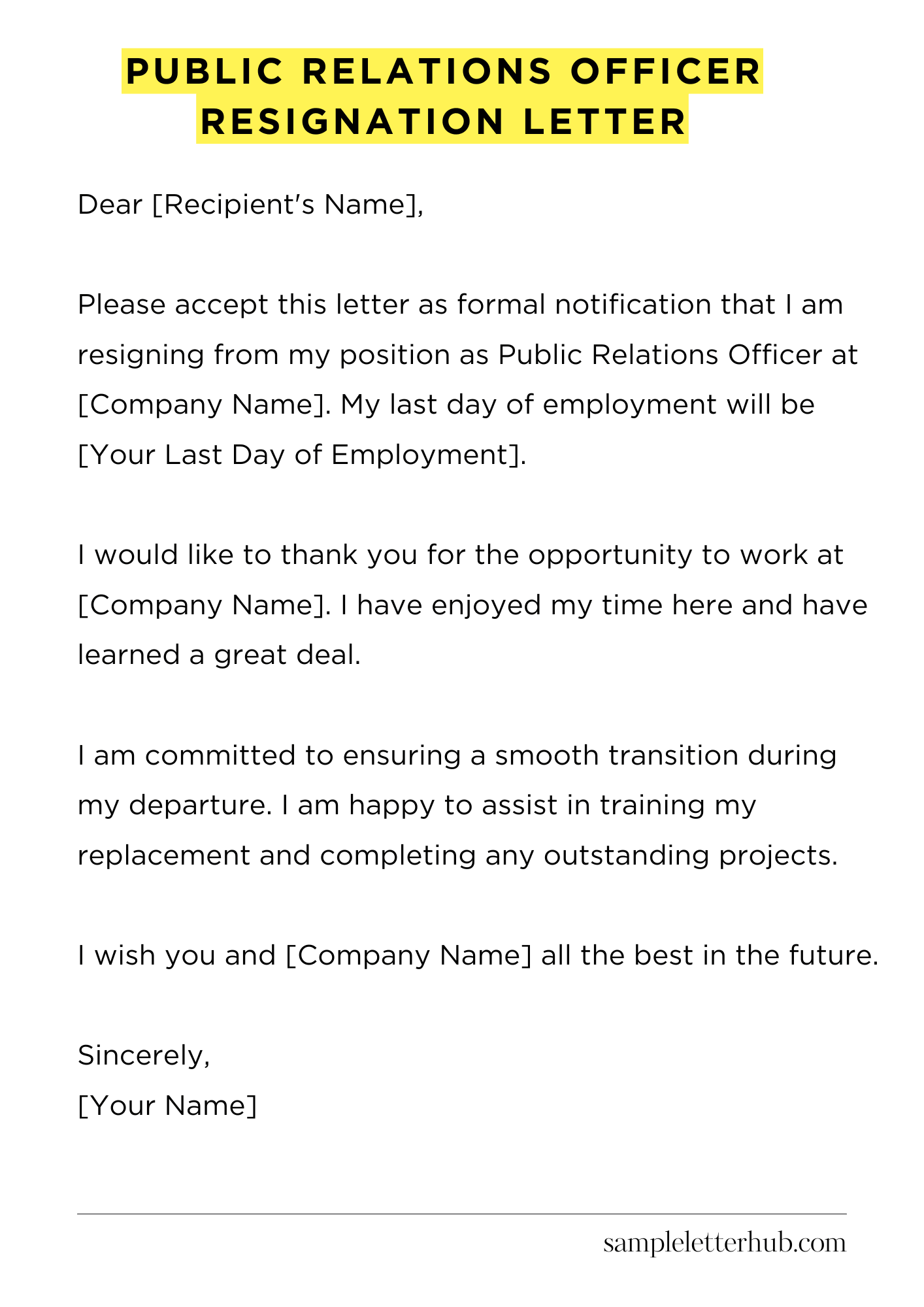
Dear [Recipient’s Name],
Please accept this letter as formal notification that I am resigning from my position as Public Relations Officer at [Company Name]. My last day of employment will be [Your Last Day of Employment].
I would like to thank you for the opportunity to work at [Company Name]. I have enjoyed my time here and have learned a great deal.
I am committed to ensuring a smooth transition during my departure. I am happy to assist in training my replacement and completing any outstanding projects. Please let me know how I can be of assistance during this period.
I wish you and [Company Name] all the best in the future.
Sincerely,
[Your Name]
How to Write a Public Relations Officer Resignation Letter
1. Grasping the Basics: The Premise of Your Departure
Resigning from any position, especially one as crucial as a Public Relations Officer (PRO), demands professionalism. Your resignation letter serves as your formal announcement.
This document is a crucial step towards your departure. It should clearly and concisely state your intention to leave your current role. Remember, the tone you set here matters; it’s a reflection of your character and could affect future opportunities. Think of it as a bridge, ensuring you leave on good terms. You want to make sure the message is clear and easy to understand.
2. Essential Elements: What Your Letter MUST Contain
Every resignation letter needs specific components. Start with a clear and concise statement of your resignation. State your name, the position you’re leaving, and the effective date of your departure. Next, express your gratitude. Acknowledge the opportunities you’ve been given during your time with the company.
Be specific! Mention projects, individuals, or experiences that were particularly meaningful. Keep the tone positive and forward-looking. Briefly, offer to assist with the transition. This shows your commitment to a smooth handover. Finally, include your contact information for any follow-up questions.
3. Crafting the Tone: Striking the Right Balance
Maintaining a positive and professional tone is essential. Avoid negativity or complaints, even if you have legitimate grievances. Focus on the positive aspects of your employment and express your appreciation. Don’t go into excessive detail about your reasons for leaving. Keep it brief and to the point.
The goal is to be respectful and leave a lasting positive impression. This approach will benefit you in the long run.
4. Formatting and Delivery: Polishing Your Presentation
Presentation is key! Use a professional business letter format. Include your contact information at the top. Address the letter to your direct supervisor or the appropriate HR representative. Keep the letter concise; aim for one page, if possible. Proofread meticulously for any errors in grammar and spelling.
Deliver the letter in person, if possible, or through a secure electronic method (e.g., company email). Always keep a copy for your records. Do not miss any of the key elements. You will be glad you did this.
5. After the Letter: Navigating the Transition
Once you’ve submitted your letter, be prepared to answer questions. Be helpful during the transition period. Offer to train your replacement or provide documentation.
Maintain a positive and professional attitude until your last day. This will leave a positive impact on your colleagues and the organization. It will also help you create a positive reputation for your next endeavor. This also opens doors for future networking opportunities.
FAQs about Public Relations Officer resignation letter
What is the primary purpose of a Public Relations Officer resignation letter?
The primary purpose of a Public Relations Officer resignation letter is to formally notify an employer of an employee’s intention to leave their position. It serves as an official record of the resignation, the effective date of departure, and often includes a brief expression of gratitude or acknowledgment of the opportunity.
What key elements should be included in a Public Relations Officer resignation letter?
A well-crafted resignation letter should include: a clear statement of resignation, the date of resignation, the effective date of the resignation, a professional and respectful tone, a brief statement of thanks (optional, but recommended), and any relevant information requested by the employer, such as handover details.
How much notice should a Public Relations Officer give when resigning?
The required notice period depends on the employment contract or company policy. Typically, a Public Relations Officer is expected to give at least two weeks’ notice. However, it can be longer, such as a month or more, for senior roles or if the contract stipulates it. Always check the employment agreement and company guidelines.
Should a Public Relations Officer resignation letter provide a reason for leaving?
Providing a reason for leaving is generally optional. While not required, it’s often courteous to state a brief and professional reason. This could range from seeking new career opportunities, relocation, or personal reasons. It’s not necessary to go into excessive detail, and it’s always best to remain positive and avoid negativity.
How should a Public Relations Officer handle the handover of responsibilities after submitting the resignation letter?
After submitting the resignation letter, the Public Relations Officer should prioritize a smooth handover of responsibilities. This involves collaborating with their supervisor and colleagues to ensure all ongoing projects, campaigns, and communications are adequately transitioned.
This may involve training colleagues, preparing documentation, and meeting deadlines to facilitate a seamless transition.
Related:
Resignation letter due to rude boss
Resignation letter moving to another state
Resignation letter due to illness of family member
Resignation letter due to study