

A Public Information Officer (PIO) resignation letter is a formal document. It announces your departure from the PIO role. The letter officially informs your employer of your intention to resign. It also specifies the effective date of your resignation.
Need to resign from your PIO position? This article is for you. We understand writing a resignation letter can be tricky. We have you covered. Here, you’ll find various templates and examples. These samples will help you craft your own professional resignation letter.
Whether you’re moving on to a new opportunity or pursuing a different path, we have resources. Adapt these templates. Modify them to fit your specific situation. Make the process of leaving your PIO role easier.
Public Information Officer Resignation Letter
Below is a sample of a Public Information Officer Resignation Letter:
[Your Name]
[Your Address]
[Your Phone Number]
[Your Email Address]
[Date]
[Recipient Name]
[Recipient Title]
[Organization Name]
[Organization Address]
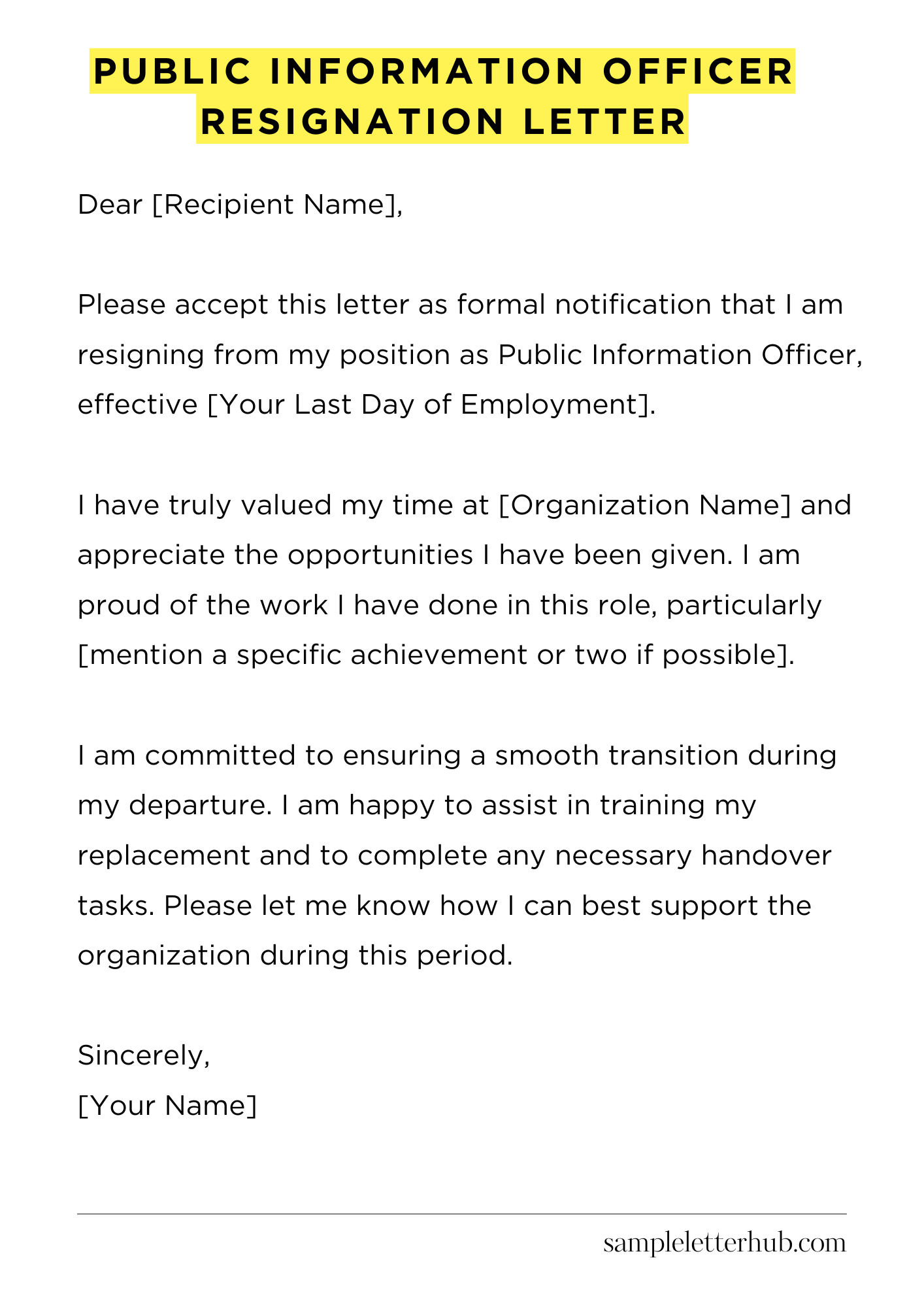
Dear [Recipient Name],
Please accept this letter as formal notification that I am resigning from my position as Public Information Officer, effective [Your Last Day of Employment].
I have truly valued my time at [Organization Name] and appreciate the opportunities I have been given. I am proud of the work I have done in this role, particularly [mention a specific achievement or two if possible].
I am committed to ensuring a smooth transition during my departure. I am happy to assist in training my replacement and to complete any necessary handover tasks. Please let me know how I can best support the organization during this period.
I wish [Organization Name] continued success in the future.
Sincerely,
[Your Name]
How to Write a Public Information Officer Resignation Letter
Understanding the Importance of a Well-Crafted Resignation
Resigning from any position is a significant step. It’s a professional courtesy, but also a crucial way to protect your reputation. A poorly written letter can lead to misunderstandings, damage relationships, and possibly even create legal complications. As a Public Information Officer (PIO), you are constantly communicating; thus, your final communication deserves special attention.
You’re not just ending a job, you’re closing a chapter. The way you handle this closure can affect future opportunities. A good resignation letter will pave the way for a smooth transition, leaving a positive impression, and demonstrating professionalism even in departure.
Essential Elements: What to Include
There are several elements your resignation letter must contain. Firstly, clearly state your intent: “I am writing to inform you of my resignation…” Then, clearly state your position. You want to make sure everyone is crystal clear. Next, include your last day of employment. This is arguably the most important information.
Beyond the basics, expressing gratitude is highly recommended. A simple “Thank you for the opportunity…” acknowledges the experience. You should be professional to leave a great impression. It goes a long way. If you can, briefly mention a positive experience or two, such as learning new skills, or successful projects.
Structuring Your Letter: A Practical Guide
The structure of your letter is important for clarity. Keep it concise; aim for one page, if possible. Start with your name, address, and the date. Next, include the recipient’s information (name, title, and address). Open with a clear and direct statement of your resignation.
The body should contain your key points: your last day, thanks, and, optionally, a brief note about the transition. Conclude with a professional closing, such as “Sincerely,” or “Respectfully,” followed by your typed name. Your signature goes above your typed name.
Proofread your letter several times for typos and grammatical errors.
Addressing Potential Considerations: Specifics for a PIO
As a PIO, you handle sensitive information and public communication. Your resignation letter may need to address some additional considerations. Specifically, you may need to offer assistance with the transition. State you are willing to help train your replacement, complete ongoing projects, or provide information to ensure a smooth hand-off.
You’ll need to think about ongoing projects and communications. This might involve setting up a handover plan. Remember to be concise and professional while showing your knowledge of the job. Even as you leave, you are still a role model.
Final Steps and Follow-Up: Leaving a Positive Legacy
After you’ve completed your letter, make sure you keep a copy. Deliver the letter to the appropriate person, likely your supervisor or HR representative. Consider sending it via both physical mail and email to ensure it is received promptly. If possible, deliver the letter in person.
After submitting your letter, be prepared to discuss your departure. Remain professional and cooperative during your remaining time. This will leave a positive impact. After all, a positive exit is the best way to open the door to your future.
FAQs about Public Information Officer Resignation Letter
What is the primary purpose of a Public Information Officer (PIO) resignation letter?
The primary purpose of a PIO resignation letter is to formally notify the employer of the intent to leave the position. It serves as an official record of the resignation, the effective date, and, in many cases, provides a reason for leaving and any final comments or requests.
What key elements should be included in a PIO resignation letter?
Essential elements include a clear statement of resignation, the specific job title (Public Information Officer), the effective date of resignation, and a professional closing. It is often advisable to briefly state the reason for leaving (though not always required) and to express gratitude for the opportunity to have worked in the role.
Contact information and relevant details about the return of company property should also be considered.
Should I include a reason for resigning in my PIO resignation letter?
While not strictly mandatory, including a reason for resigning can be beneficial. It allows for transparency and helps maintain a professional relationship with the employer.
Reasons can range from seeking new career opportunities, personal matters, to dissatisfaction with the current role. The reason can be general, such as “to pursue other opportunities,” or more specific, depending on the individual’s comfort level and the circumstances.
How much notice should I give when resigning as a PIO?
The amount of notice required typically depends on the employment contract or company policy. However, a general standard is to provide at least two weeks’ notice. Some senior roles may require more notice. It’s crucial to review the employment agreement or consult with HR to determine the correct notice period.
What is the proper format for a PIO resignation letter?
A professional business letter format is recommended. This includes your contact information (name, address, phone number, email) at the top, followed by the date, the recipient’s information (name, title, company address), a formal salutation (e.g., “Dear [Manager’s Name]”).
Related:
Resignation letter due to rude boss
Resignation letter moving to another state
Resignation letter due to illness of family member
Resignation letter due to study