

Dealing with property damage? You need to file a property damage claim. A Property Damage Claim Documents Submission Letter formally notifies your insurance company. This letter includes all supporting documents. Its purpose? To officially start your claim process.
Writing this letter can feel tricky. Don’t worry! We’ve got you covered. We’ll share several property damage claim letter templates. These templates are examples. They will guide you. You can easily adapt them.
Need a letter for a car accident or home damage? Our sample letters simplify the process. They’ll help you craft a clear, concise claim. Get ready to easily submit your property damage claim documents!
[Your Name/Company Name]
[Your Address]
[Your Phone Number]
[Your Email Address]
[Date]
[Insurance Company Name]
[Insurance Company Address]
Subject: Property Damage Claim – [Your Policy Number]
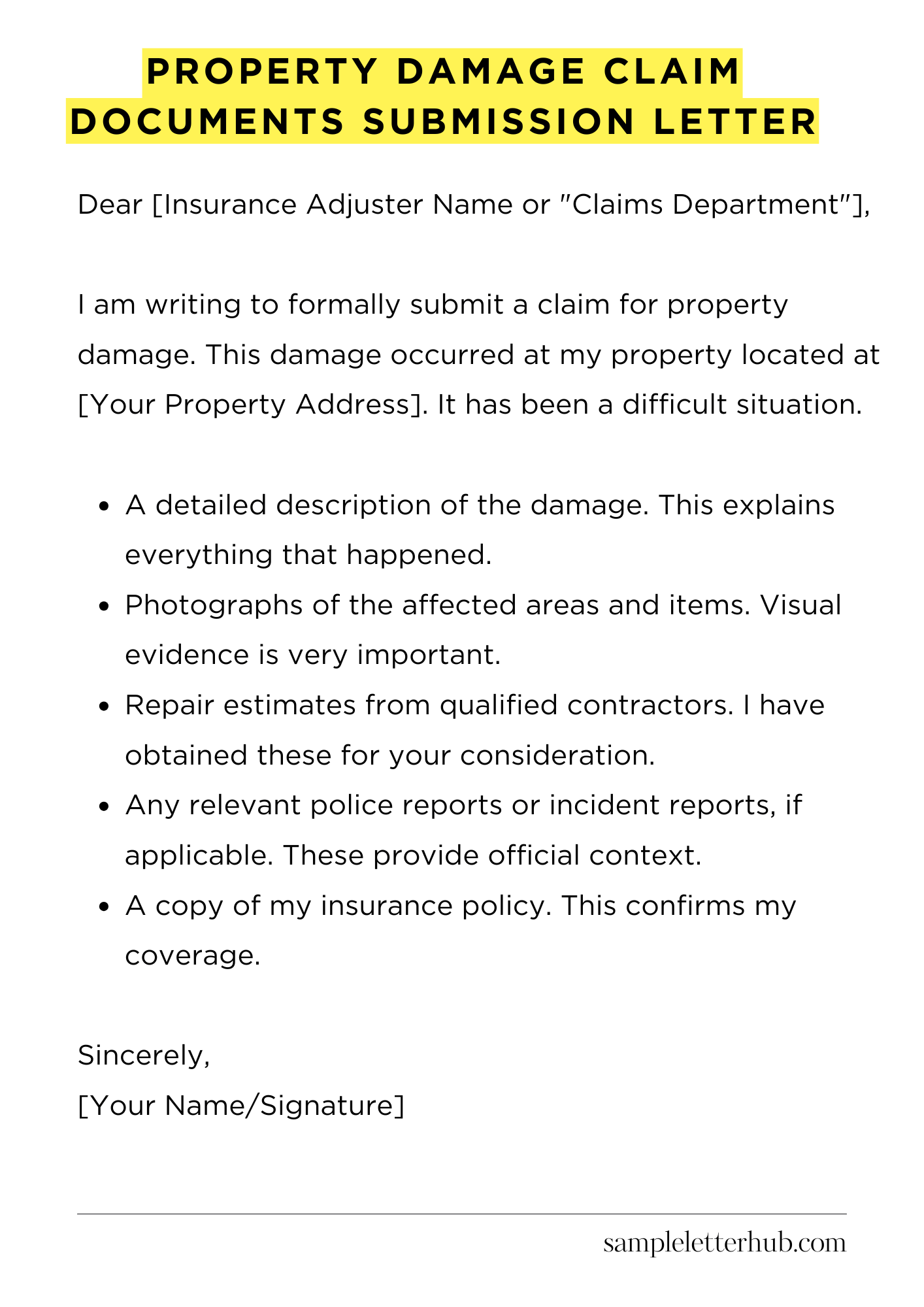
Dear [Insurance Adjuster Name or “Claims Department”],
I am writing to formally submit a claim for property damage. This damage occurred at my property located at [Your Property Address]. It has been a difficult situation.
I am including the following documents to support my claim. These are crucial for a thorough review.
- A detailed description of the damage. This explains everything that happened.
- Photographs of the affected areas and items. Visual evidence is very important.
- Repair estimates from qualified contractors. I have obtained these for your consideration.
- Any relevant police reports or incident reports, if applicable. These provide official context.
- A copy of my insurance policy. This confirms my coverage.
I believe these documents provide a clear picture of the damage and associated costs. Please review them carefully.
I would appreciate it if you could confirm receipt of this claim and the attached documentation within [Number] business days. I will be available to answer any questions you may have. I am ready to help.
Thank you for your time and attention to this matter. I eagerly await your response.
Sincerely,
[Your Name/Signature]
How to Write Property Damage Claim Documents Submission Letter
Filing a property damage claim can be a taxing affair. One of the most critical aspects is the submission letter. It’s not just a formality; it’s your official introduction, the cornerstone of your claim.
A well-crafted letter can significantly influence the claims process. Let’s delve into the nuances of composing a potent submission letter.
1. Identify the Addressee and Establish Correspondence: The Foundation
Begin by meticulously identifying the correct addressee. This necessitates ascertaining the precise name of the claims adjuster or the department handling property damage claims.
Avoid generic salutations like “To Whom It May Concern.” Instead, investigate and find the specific individual or department.
Your letter should commence with a professional salutation such as “Dear Mr./Ms. [Last Name]” or “Dear Claims Department.” This seemingly minor detail demonstrates professionalism and attention to detail, setting a favorable tone from the outset.
2. The Opening Salvo: Clearly State Your Intent
Your opening paragraph should serve as a crystallised declaration of purpose. State unequivocally that you are submitting a claim for property damage. Include the policy number and the date of the incident.
Be succinct and direct. For example: “This letter serves as formal notification that I am submitting a claim under policy number [Policy Number] for property damage that occurred on [Date of Incident].” This immediate clarity prevents ambiguity and provides the necessary context for the reader.
3. Recapitulation of Events: The Narrative Unfolds
Provide a concise but comprehensive account of the events leading to the damage. This section should detail what happened, when it happened, and where it happened.
Maintain an objective tone, refraining from emotive language. Stick to the facts. Include specific details like the type of damage and its apparent cause.
For example: “On the morning of October 26, 2023, a severe storm caused significant damage to the roof of my property located at [Property Address]. Specifically, [describe the damage, e.g., several shingles were dislodged, resulting in water damage to the attic].” Brevity and accuracy are paramount.
4. Documented Substantiation: The Supporting Arsenal
This is where you marshal your supporting evidence. Clearly list all the documents you are including with your submission letter. This could encompass photographs, repair estimates, police reports (if applicable), and any other supporting documentation. State each document precisely.
For example: “Enclosed with this letter are the following documents: 1) Photographs of the damaged roof, 2) Two repair estimates from licensed contractors, and 3) A copy of the police report filed on the day of the incident.” Include a numbered list for clarity. Make sure to keep copies of every single document you submit for your personal records.
5. Demarcation of Damages and Demand for Reparation
This is where you specify the damages claimed and, if possible, the approximate cost of repairs. Review the included estimates and determine the total damages.
If you’re unsure, state that an exact figure is forthcoming after a thorough assessment. Formulate a polite but firm request for the insurer to assess the damage and provide the appropriate compensation.
Example: “Based on the enclosed estimates, the estimated cost of repairs is $5,000. I request that you promptly review this claim and arrange for the necessary compensation to restore my property to its pre-damage condition.” Clarity in your monetary demands is of the utmost importance.
6. Contact Information and Correspondence Cadence
Provide all relevant contact information: your full name, mailing address, phone number, and email address. This ensures that the claims adjuster can easily reach you for any clarification or further information. Include a statement that you are available to answer any questions or provide additional documentation if needed.
“I am readily available to address any inquiries and can be reached at [Phone Number] or [Email Address]. Please do not hesitate to contact me.” Make sure to state how you will prefer to be contacted. This preemptive approach facilitates efficient communication.
7. The Parting Salvo: Professional Closure
Conclude your letter with a professional closing. Use “Sincerely,” “Respectfully,” or a similar professional salutation. Sign your name above your typed name. If submitting a physical copy, consider using blue or black ink.
Proofread your letter meticulously for any typographical errors or grammatical inconsistencies before submission. A polished and error-free letter reflects your diligence and respect for the claims process.
Your final paragraph should reaffirm your commitment to resolving this matter promptly, while also expressing your gratitude for the adjuster’s time and attention.
FAQs about Property Damage Claim Documents Submission Letter
What documents are typically required when submitting a property damage claim?
The required documents can vary depending on the insurance policy and the nature of the damage. However, common documents include a completed claim form, a detailed description of the damage, photographs or videos of the damage, repair estimates from licensed contractors, proof of ownership.
How should I format my property damage claim documents submission letter?
Your letter should be clear, concise, and professional. It should include your name, address, policy number, and the date. Begin by referencing the insurance policy and the date of the incident.
Clearly list all the documents being submitted, ensuring each is easily identifiable. Briefly describe the damage and its cause. Include a request for the claim to be processed and state your contact information for any follow-up questions. Always keep a copy of the letter and all attached documents for your records.
What is the best way to submit my property damage claim documents?
Submitting documents can be done through several channels, including email, postal mail, or online portals provided by your insurance company.
The best method depends on the insurer’s specific instructions. When submitting via email, save each document as a separate PDF file. If mailing, use certified mail with return receipt requested to provide proof of delivery.
For online submissions, follow the platform’s guidelines. Always retain proof of submission, such as email confirmation or the postal receipt.
How long does it typically take for an insurance company to process a property damage claim?
The processing time varies depending on the complexity of the claim, the insurer’s policies, and the completeness of the documentation submitted. Generally, the insurance company is expected to acknowledge receipt of your claim within a few days.
The investigation process, which includes assessing the damage, determining coverage, and potentially hiring an adjuster, can take several weeks or longer, especially for complex claims involving significant damage or disputes. After the investigation is complete, the insurer will make a coverage decision and communicate the outcome to you.
What should I do if my property damage claim is denied?
If your claim is denied, you should first obtain a written explanation from the insurance company outlining the reasons for the denial. Carefully review this explanation and the terms of your insurance policy to understand the basis for the decision.
You have the right to appeal the denial, typically by submitting additional information or evidence. The appeal process and deadlines are typically outlined in the denial letter. Consider seeking legal advice from an attorney, especially if you believe the denial is unjustified or involves significant financial losses.
Related:
Resignation letter due to rude boss
Resignation letter moving to another state
Resignation letter due to illness of family member
Resignation letter due to study