

A “Project Management Consultant Resignation Letter” is a formal document. It is written by a project management consultant. The purpose is to officially inform their employer of their decision to leave. This letter outlines the consultant’s last day of employment. It may also include thanks and farewell wishes.
So, you’re ready to move on? Writing a resignation letter can be tough. Don’t worry! We’ve got your back. We have gathered templates and examples. These samples will help you. They will guide you through the process.
This article provides helpful examples. You can use them to craft your own letter. Need a formal tone? Got it. Want to express gratitude? We’ve got that too. The goal is to make your departure as smooth as possible.
Project Management Consultant Resignation Letter
Below is a sample of a Project Management Consultant Resignation Letter:
[Your Name]
[Your Address]
[Your Phone Number]
[Your Email Address]
[Date]
[Recipient’s Name]
[Recipient’s Title]
[Company Name]
[Company Address]
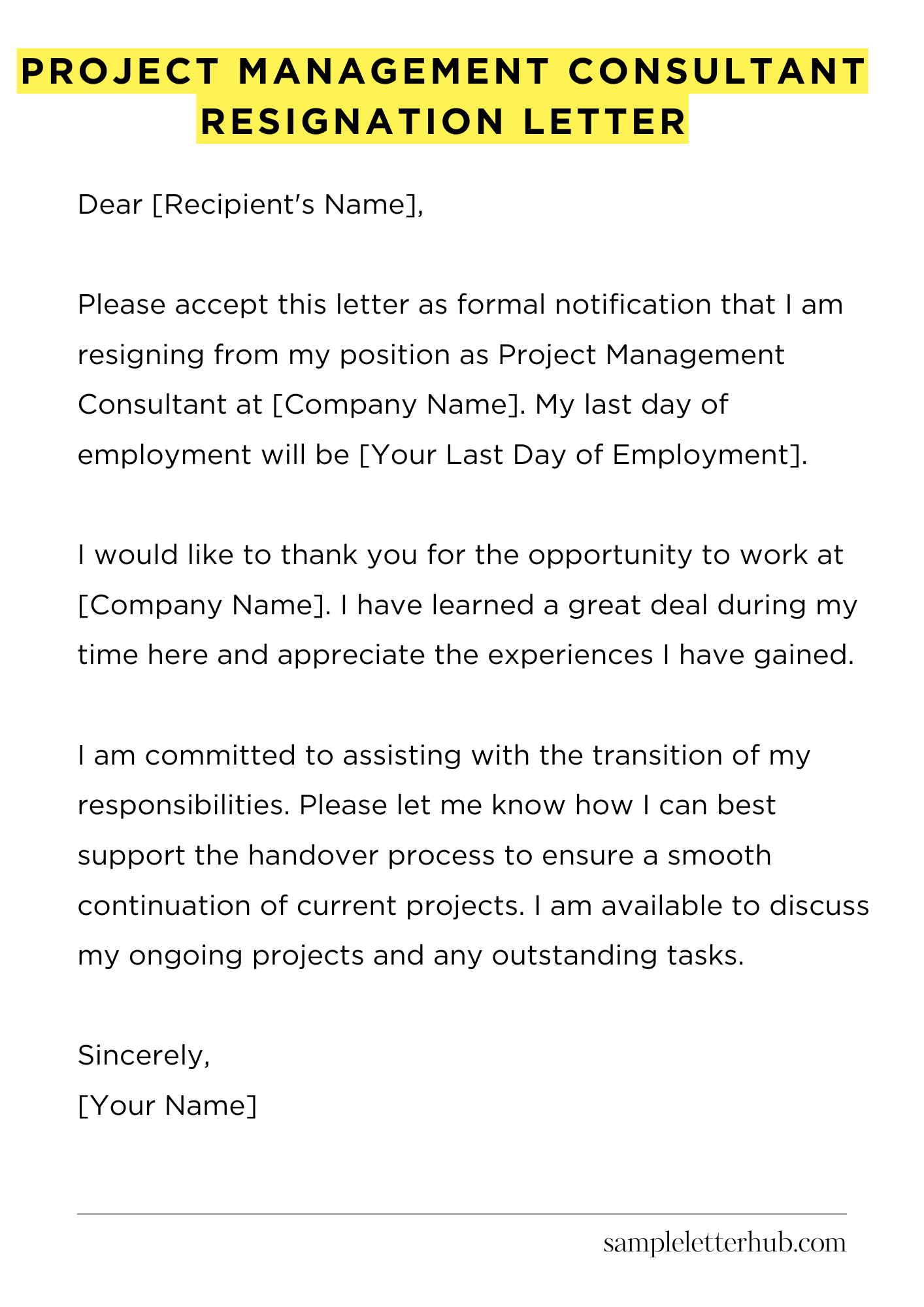
Dear [Recipient’s Name],
Please accept this letter as formal notification that I am resigning from my position as Project Management Consultant at [Company Name]. My last day of employment will be [Your Last Day of Employment].
I would like to thank you for the opportunity to work at [Company Name]. I have learned a great deal during my time here and appreciate the experiences I have gained.
I am committed to assisting with the transition of my responsibilities. Please let me know how I can best support the handover process to ensure a smooth continuation of current projects. I am available to discuss my ongoing projects and any outstanding tasks.
I wish you and the company all the best in the future.
Sincerely,
[Your Name]
How to Write a Project Management Consultant Resignation Letter
Resigning from your role as a Project Management Consultant is a significant professional step. It’s crucial to handle this transition with grace and professionalism. Your resignation letter is the first impression you make. It helps pave the way for a smooth departure. Here’s how to craft a resignation letter that reflects well on you.
1. Start with Clarity and Purpose
Begin your letter with a clear and concise statement of your intention. State explicitly that you are resigning from your position. Avoid ambiguity. The date of your last day of employment should also be very clear. This is vital information that prevents any misunderstandings. Keep it direct and to the point; it serves as the foundation of your letter.
For example: “Please accept this letter as formal notification that I am resigning from my position as Project Management Consultant at [Company Name], effective [Your Last Day of Employment].”
2. Express Gratitude (and Keep it Professional!)
Demonstrating appreciation for your time at the company is important. Thank your employer for the opportunity. Mention any specific experiences or learning opportunities that you valued.
This is a common courtesy and helps maintain a positive relationship. Avoid being overly effusive or insincere; genuine appreciation goes a long way. This shows you’re leaving on good terms.
An example of expressing gratitude could be: “I am grateful for the opportunities I have been given during my time here, particularly [mention a specific project or skill gained]. I appreciate the experience.”
3. Provide Necessary Information and Offer Assistance
Include details about your willingness to assist with the transition. Offer to help train a replacement or complete any ongoing tasks. This highlights your commitment to the company.
Be specific about what you can do to ease the handover process. This shows your professionalism and responsibility. Offer to help in a practical and specific manner, such as: “I am happy to assist in the transition process. I am available to help train my replacement and complete [specific tasks] before my departure.”
4. Keep it Brief and Positive
While expressing gratitude is important, keep your letter concise and to the point. Avoid lengthy explanations or negative comments about your reasons for leaving. Your resignation letter is not the place for grievances. Maintain a positive and professional tone throughout the letter.
Focus on the future and your intention to leave gracefully. Always review your letter before sending. Proofread for any errors in grammar and spelling. Make a good impression; it will impact your future.
5. Finalize with a Professional Closing
End your letter with a professional closing. Use a formal closing, such as “Sincerely,” or “Respectfully,” followed by your name and contact information. Your contact information can include your phone number and email address, especially if you have a personal email account and not your work email account.
This allows your employer to contact you if needed. Remember to print a hard copy of your letter and keep a copy for your records.
FAQs about Project Management Consultant Resignation Letter
What is the essential information to include in a Project Management Consultant resignation letter?
A well-crafted resignation letter for a Project Management Consultant should include: your formal announcement of resignation, the effective date of your departure, a concise statement of gratitude for the opportunity, any necessary handover information or offers of assistance during the transition period, and your contact information for any post-employment communication.
It’s also professional to briefly mention the reason for your resignation, if you choose to do so.
How far in advance should a Project Management Consultant submit their resignation letter?
The standard practice is to provide at least two weeks’ notice, but this can vary depending on your employment contract or the requirements of your specific company.
Always refer to your employment agreement or company policy for the stipulated notice period. In some cases, for senior roles, a longer notice period (e.g., one month) might be expected. Giving ample notice demonstrates professionalism and allows for a smoother transition.
What tone and language are most appropriate for a Project Management Consultant resignation letter?
Maintain a professional and respectful tone. Use clear and concise language. Express gratitude for the opportunities you’ve been given, even if your reasons for leaving are due to other things. Avoid negative comments about the company or colleagues. Keep the focus on your departure and the handover process.
Should a Project Management Consultant offer assistance with the transition process in their resignation letter?
Offering assistance with the transition process is highly recommended. This demonstrates your professionalism and commitment to the company even after your departure. You could offer to train a replacement, document project information, or be available for consultations during a specific period after your last day.
This helps to ensure continuity and makes a positive lasting impression.
Is it necessary to state the reason for leaving in a Project Management Consultant resignation letter?
While not mandatory, briefly stating the reason for leaving is acceptable. It is entirely up to you. Reasons such as “pursuing other opportunities,” “relocating,” or “accepting a different role” are generally acceptable.
Avoid providing overly detailed or negative explanations. If you choose not to provide a reason, that’s also perfectly acceptable. The main purpose is to formally communicate your departure and show your professionalism.
Related:
Resignation letter due to rude boss
Resignation letter moving to another state
Resignation letter due to illness of family member
Resignation letter due to study