

A Project Lead resignation letter is a formal document. It announces your departure from a project lead role. The letter informs your employer of your decision. It also outlines your last day of employment.
Are you stepping down as a Project Lead? Writing a resignation letter can be tricky. We’ve got you covered. We’ll share various templates and examples. These samples will help you craft your own letter.
Need a quick and easy solution? Look no further. Our provided templates will act as your guide. They will allow you to create a professional resignation letter.
Project Lead Resignation Letter
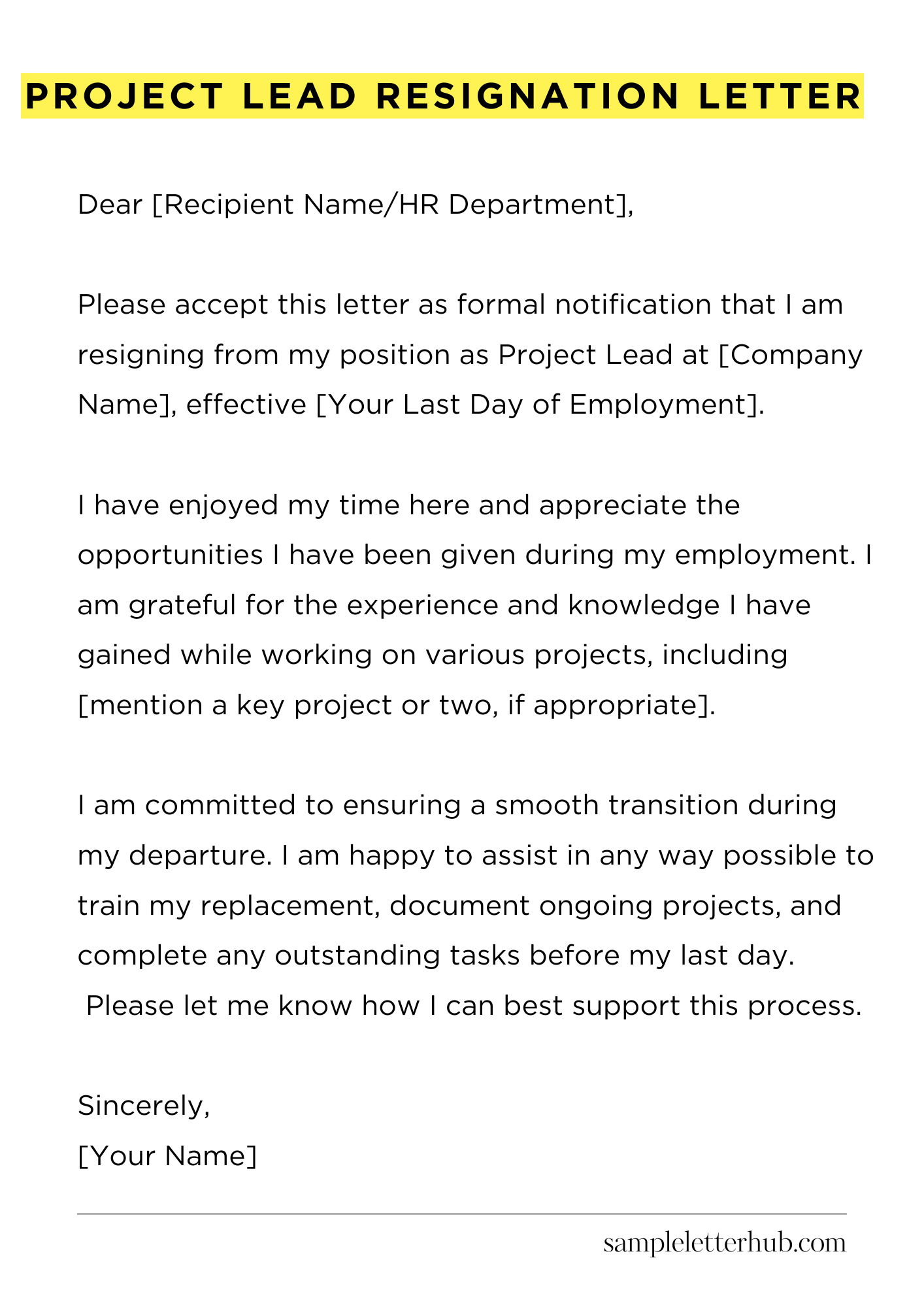
Below is a sample of a Project Lead Resignation Letter:
[Your Name/Company Letterhead – if applicable]
[Your Address]
[Your Phone Number]
[Your Email Address]
[Date]
[Recipient Name/HR Department]
[Recipient Title]
[Company Name]
[Company Address]
Dear [Recipient Name/HR Department],
Please accept this letter as formal notification that I am resigning from my position as Project Lead at [Company Name], effective [Your Last Day of Employment].
I have enjoyed my time here and appreciate the opportunities I have been given during my employment. I am grateful for the experience and knowledge I have gained while working on various projects, including [mention a key project or two, if appropriate].
I am committed to ensuring a smooth transition during my departure. I am happy to assist in any way possible to train my replacement, document ongoing projects, and complete any outstanding tasks before my last day. Please let me know how I can best support this process.
Thank you for the support and opportunities I have received. I wish you and the company continued success in the future.
Sincerely,
[Your Name]
How to Write Project Lead Resignation Letter
Leaving a project lead role requires more than just a simple goodbye. It involves a thoughtful and professional resignation letter. This document is your formal announcement, a critical step in a smooth transition. Done right, it leaves a positive impression, protecting your professional reputation and easing the handover process. But where do you begin? Let’s break it down.
1. Start with the Essentials: The Basics
Your letter should begin with the fundamentals: your name, contact information, the date, and the recipient’s name and title. The most crucial part comes next. Clearly state your intention to resign from your position as Project Lead. Specify your last day of employment. This is not the place for ambiguity.
Be clear and direct. For example, “This letter is to formally notify you of my resignation from the position of Project Lead, effective [Your Last Day of Employment].” Remember, you’re setting the foundation, the official notification of your departure.
2. Express Gratitude: Showing Appreciation
Now, build a bridge of gratitude. Acknowledge your time in the role and express appreciation. This is where you can showcase your positive experience and foster goodwill. You might say, “I am grateful for the opportunities I’ve had during my time as Project Lead. I have learned and grown immensely.”
This simple act demonstrates professionalism and respect for the company and your colleagues. It helps end on a positive note. Remember, burning bridges serves no one.
3. Provide Context: Reasons (Briefly) and the Transition
Keep this part concise. Briefly state your reason for leaving, if you are comfortable. No need for exhaustive explanations. If you have been offered a new opportunity, it’s appropriate to mention this. For example, “I have accepted a new position that I will be starting on [Start Date].”
More importantly, outline your commitment to the transition. Offer assistance in the handover process. This demonstrates your dedication to the project’s success even after your departure.
You could say, “I am committed to ensuring a smooth transition. I am happy to assist in any way possible to help find and train my replacement. I am available to help with documentation or knowledge transfer.” This is key to showing you’re a team player, even in leaving.
4. Formalities: The Sign-Off and Essentials
Your closing should be professional. Offer your best wishes for the future of the project and the company. Use a formal closing, such as “Sincerely” or “Best Regards.”
After that, sign your name and print your name below the signature. This is a must. Include your contact information. This ensures continued communication if needed. This step confirms the letter’s authenticity and ensures you have a record of it. Always keep a copy for your personal records.
5. Review and Refine: Proofreading and Polishing
Proofreading is critical. Before sending, read your letter carefully for any errors in grammar or spelling. Ensure your tone is professional, positive, and considerate.
Have a trusted friend or colleague review it for a fresh perspective. A final check can catch any overlooked mistakes and ensure your message is communicated clearly and effectively. This step is a small investment that makes a big impact. Remember, your resignation letter is a reflection of your professionalism and a final impression. Make it count!
FAQs about Project Lead Resignation Letter
What information should I include in my project lead resignation letter?
Your resignation letter should include your formal resignation, the date of your last day of employment (typically two weeks from the date of the letter), a brief and professional statement of your reason for leaving (optional but often included), and a thank you to the company for the opportunity.
You should also offer assistance with the transition of your projects and responsibilities. Avoid overly emotional language or negative comments about the company or your colleagues.
How much notice should I give when resigning as a Project Lead?
The standard notice period for a project lead is usually two weeks, but it’s always best to consult your employment contract or company policy.
Some companies, particularly for senior roles, might require a longer notice period. Providing ample notice allows for a smoother transition, minimizes disruption to ongoing projects, and maintains a positive relationship with your employer.
Should I explain my reason for leaving in my resignation letter?
It’s generally a good practice to briefly state your reason for leaving, but you are not obligated to go into extensive detail. A simple statement such as “for a new opportunity” or “to pursue other interests” is usually sufficient. Avoid negative comments or complaints. If you have any constructive feedback, consider saving it for an exit interview if the company offers one.
How should I handle the transition of my projects and responsibilities?
Offer to assist with the transition of your projects. This may involve preparing documentation, training your replacement (if applicable), and providing a handover plan.
Be proactive in communicating with your team and stakeholders about the change and your departure date. Ensure all important information and documentation are accessible to the relevant parties, and be prepared to answer questions during your remaining time.
Can I use a template for my project lead resignation letter?
Yes, using a template can be a good starting point. Many templates are available online. However, always customize the template to fit your specific situation and the specifics of your role and the company. Ensure that the letter is tailored to your individual situation and reflects your professionalism.
Related:
Resignation letter due to rude boss
Resignation letter moving to another state
Resignation letter due to illness of family member
Resignation letter due to study