

A “Production Scheduler resignation letter” is a formal notice. It informs an employer about an employee’s decision. The employee is leaving their Production Scheduler position. The letter’s main purpose is to communicate the resignation clearly. It establishes the final date of employment.
Are you a Production Scheduler looking to move on? You’ve come to the right place. We understand crafting these letters can be tricky. We’ll share helpful templates and examples. This will ease the writing process.
Think of it as your toolkit. We’ve got different scenarios covered. Whether you have a new job or are just moving on, we have a sample. Simplify your writing today!
Production Scheduler Resignation Letter
Below is a sample of a Production Scheduler Resignation Letter:
[Your Name]
[Your Address]
[Your Phone Number]
[Your Email Address]
[Date]
[Employer’s Name]
[Employer’s Title]
[Company Name]
[Company Address]
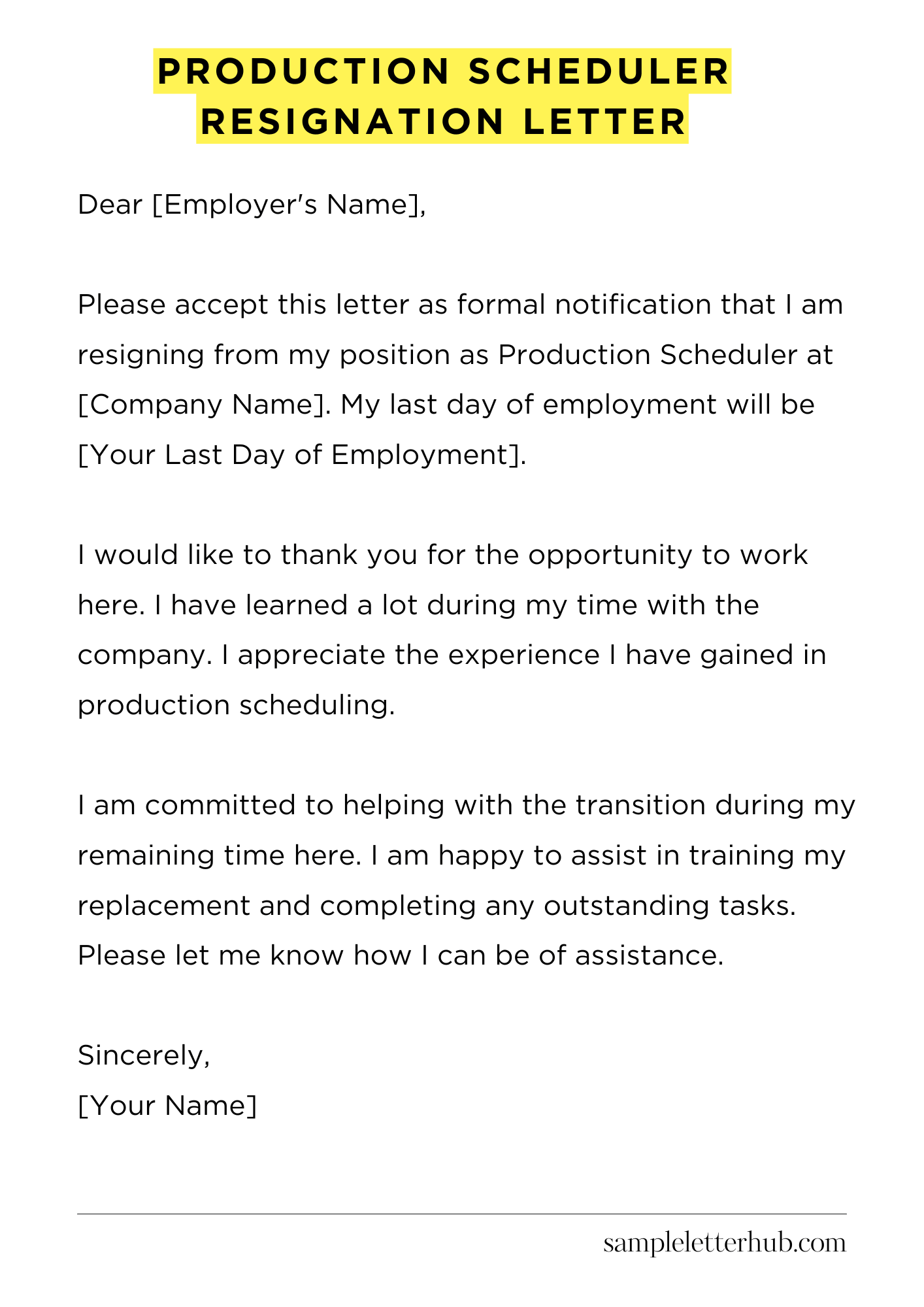
Dear [Employer’s Name],
Please accept this letter as formal notification that I am resigning from my position as Production Scheduler at [Company Name]. My last day of employment will be [Your Last Day of Employment].
I would like to thank you for the opportunity to work here. I have learned a lot during my time with the company. I appreciate the experience I have gained in production scheduling.
I am committed to helping with the transition during my remaining time here. I am happy to assist in training my replacement and completing any outstanding tasks. Please let me know how I can be of assistance.
I wish you and [Company Name] all the best in the future.
Sincerely,
[Your Name]
How to Write a Production Scheduler Resignation Letter
So, you’re moving on! Congratulations on your next chapter. Leaving a job, especially a role as crucial as Production Scheduler, requires a well-crafted resignation letter.
This isn’t just about saying goodbye; it’s about maintaining professionalism and ensuring a smooth transition for everyone involved. Getting this right is key. Here’s how to craft a resignation letter that is clear, concise, and professional, specifically tailored for a Production Scheduler.
1. Start with the Basics: Your Intent and the Date
Your resignation letter needs to begin with a clear statement. State unequivocally that you are resigning from your position. Include the date of your last day of employment. This is the foundation upon which everything else is built. It eliminates any ambiguity and sets the tone for a formal communication.
Think of it like this: “Please accept this letter as formal notification that I am resigning from my position as Production Scheduler, effective [Your Last Day of Employment].” Remember to use a professional and respectful tone throughout the letter.
2. Show Gratitude and Acknowledge Your Time
Acknowledging your time with the company is extremely important. It’s polite, and it leaves a positive lasting impression. Express your gratitude for the opportunity to have worked there. Mentioning anything positive you gained from your experience will make you stand out. Reflecting on your time shows you’re not just leaving; you value your time spent there.
For instance, consider something like: “I am grateful for the opportunity to have worked as a Production Scheduler at [Company Name] for the past [Number] years/months. I have gained valuable experience in [Mention specific skills or areas].” A simple “Thank you” can go a long way.
3. Provide a Reason (Optional, But Sometimes Helpful)
You are not always required to give a specific reason for leaving. However, in some situations, providing a brief, neutral explanation can be beneficial. Are you pursuing a new career opportunity? Moving to a different location? Keep it simple and focus on the future. The aim is to avoid drama and maintain a professional stance.
Good examples would be, “I am pursuing a new opportunity,” or, “I have accepted a position that will allow me to [mention growth plans]”. Refrain from negative comments about your previous employer or your co-workers.
4. Offer Assistance with the Transition and Key Handover
As a Production Scheduler, your expertise is valuable. Offer assistance during the transition period. This shows consideration for your colleagues and underscores your professionalism. It also makes your departure easier for those who remain. Mention your willingness to help train your replacement, document procedures, or assist with any ongoing projects.
For example: “I am committed to ensuring a smooth handover of my responsibilities and am happy to assist in training my replacement. I will also be available to help with any projects until my last day.” This will leave a positive impact.
5. End Professionally and Express Good Wishes
Always conclude your letter with a professional closing and your contact information. Reiterate your gratitude. This reinforces the positive note and reinforces the professional tone you want to project. Provide your contact information, such as your personal email address. This makes it easy for your employer to contact you if necessary.
For example: “I wish the company continued success in the future. Thank you again for the opportunity. Please feel free to contact me at [Your Email Address] or [Your Phone Number] if needed. Sincerely, [Your Name].” Proofread your letter carefully before sending it.
FAQs about Production Scheduler Resignation Letter
Understanding the nuances of crafting a Production Scheduler resignation letter is crucial for a smooth transition. Here are some of the most common questions and their corresponding answers to guide you.
What key information should be included in a Production Scheduler resignation letter?
Your Production Scheduler resignation letter should clearly state your intention to resign, the effective date of your resignation, and a brief expression of gratitude for the opportunity. It’s also beneficial to acknowledge any projects or tasks you are currently involved in and offer assistance during the handover period.
Consider including a concise, professional explanation for your departure if you are comfortable doing so, but this is not mandatory.
What is the appropriate format for a Production Scheduler resignation letter?
The standard format for a resignation letter is a formal business letter. Begin with your contact information and the date, followed by the recipient’s information (usually your manager’s name and title). Use a professional salutation (e.g., “Dear [Manager’s Name]”), state your resignation, effective date, and express your appreciation.
Keep the language concise and professional. Conclude with a closing (e.g., “Sincerely”) and your typed name.
How much notice should a Production Scheduler give when resigning?
The standard notice period for professional positions like Production Scheduler is typically two weeks. However, this can vary based on your employment contract, company policy, or local labor laws.
Review your employment agreement or consult with your HR department to determine the required notice period. Providing more notice is often appreciated and can help maintain positive relationships.
Should I provide a reason for my resignation in the Production Scheduler letter?
You are not obligated to provide a specific reason for your resignation. However, if you choose to include one, keep it brief, positive, and professional. Avoid negativity or personal grievances.
Examples of acceptable reasons might include pursuing another opportunity, relocating, or seeking career advancement. If you are comfortable, a simple “to pursue other opportunities” or “to focus on personal commitments” is often sufficient.
How can I ensure a smooth handover when resigning as a Production Scheduler?
To ensure a smooth handover, offer to assist in training your replacement and completing any urgent tasks. Document your current projects, processes, and relevant information that your successor might need.
Be responsive to questions during your notice period. A detailed handover can help maintain the workflow for the company and leave a positive impression on your former employer.
Related:
Resignation letter due to rude boss
Resignation letter moving to another state
Resignation letter due to illness of family member
Resignation letter due to study