

A Production Manager resignation letter is a formal document. It informs your employer of your intention to leave. This letter initiates the official departure process. It’s a crucial step in ending your employment professionally.
Crafting the perfect resignation can be tricky. Don’t worry, we’ve got you covered. We’ll show you useful templates for your letter. You’ll find different examples. These samples are designed for various situations.
Our goal is to make it easy for you. Whether you need a simple or detailed letter, we help. Use our provided samples as a starting point. Make your resignation process smooth and stress-free.
Production Manager Resignation Letter
Below is a sample of a Production Manager Resignation Letter:
[Your Name]
[Your Address]
[Your Phone Number]
[Your Email Address]
[Date]
[Production Manager’s Name]
[Company Name]
[Company Address]
Dear [Production Manager’s Name],
Please accept this letter as formal notification that I am resigning from my position as Production Manager at [Company Name]. My last day of employment will be [Date – usually two weeks from the date of the letter].
I would like to thank you for the opportunity to work at [Company Name]. I have learned a great deal during my time here.
I am committed to ensuring a smooth transition during my departure. I am happy to assist in training my replacement and completing any outstanding tasks. Please let me know how I can be of assistance during this period.
I wish you and [Company Name] all the best in the future.
Sincerely,
[Your Name]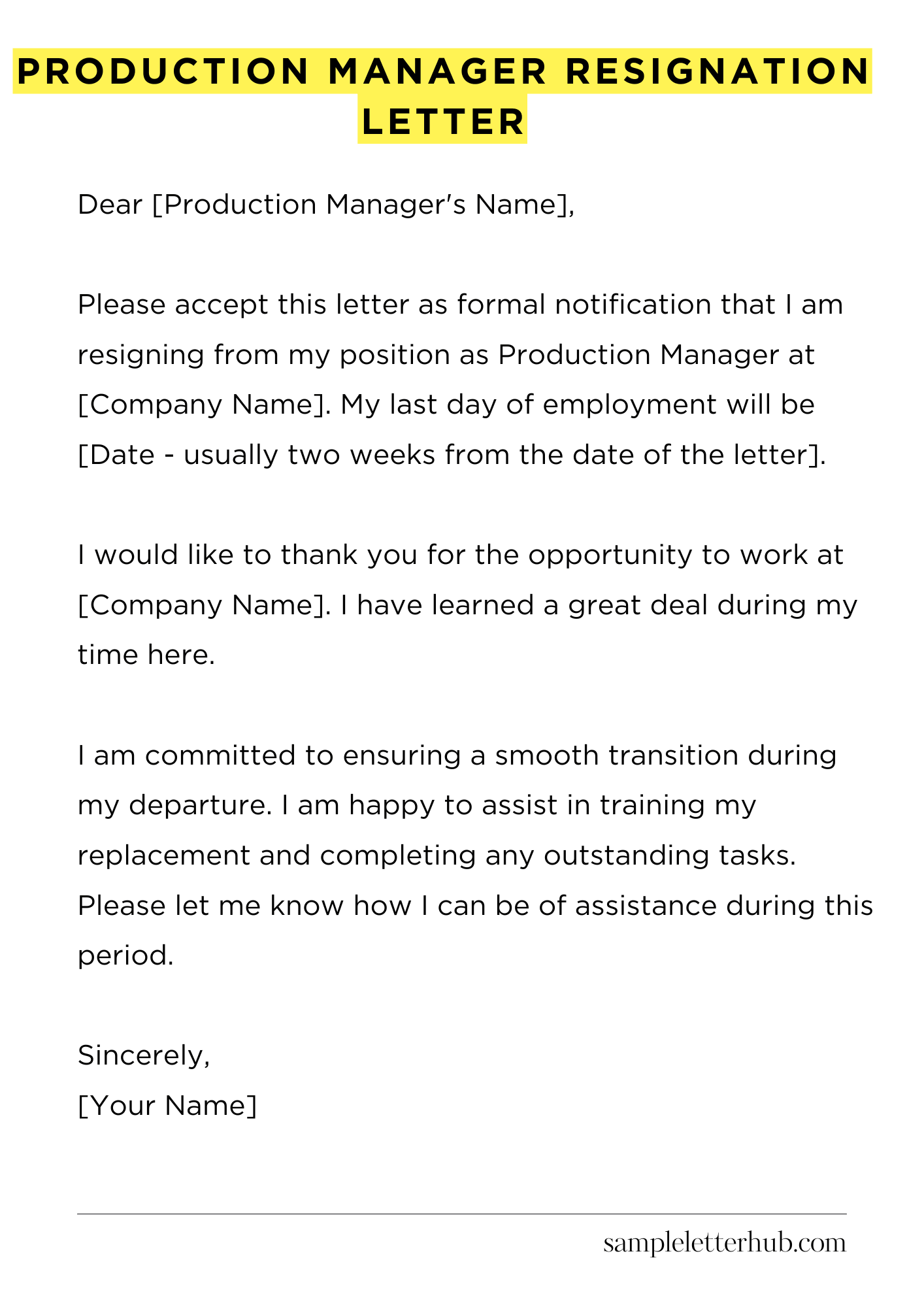
How to Write a Production Manager Resignation Letter
Resigning from a job is a big step. It’s important to do it right, especially when you’re a Production Manager. You need to leave on good terms and ensure a smooth transition. This guide will help you craft a professional and effective resignation letter.
1. Preparation is Key: Before You Start Writing
Before putting pen to paper (or fingers to keyboard), take some time to prepare. First, review your employment contract. Check the terms regarding resignation, including the required notice period.
This is essential to avoid any legal issues. Next, consider your reasons for leaving. Keep them professional and concise. Don’t go into excessive detail about any negative experiences. Focus on the positive – perhaps a new opportunity or a career change.
Think about your replacement. Have you identified someone internally who could step in? Or, will the company need to recruit? Consider your relationship with your supervisor. Understanding this will help you choose the right tone for your letter.
2. The Anatomy of a Solid Resignation Letter
Your letter should be clear, concise, and professional. It should be easily understood. It should also be well-formatted.
Here’s a breakdown:
- Heading: Your full name, address, phone number, and email address. The date should follow.
- Recipient’s Information: The name and title of your supervisor or HR representative, the company name, and the company address.
- Salutation: Use a formal greeting, such as “Dear Mr./Ms. [Last Name]”.
- First Paragraph: State your intention to resign and your last day of employment. Be direct and unambiguous.
- Second Paragraph: Briefly express gratitude for the opportunity. Mention any positive experiences or skills gained.
- Third Paragraph (Optional): Offer to assist with the transition. This is a very helpful gesture.
- Closing: Use a professional closing, such as “Sincerely” or “Best Regards,” followed by your typed name.
- Signature: Sign the letter in blue or black ink if you’re submitting a hard copy.
3. Crafting the Content: What to Say and How to Say It
Now, let’s look at the actual wording. Be mindful of your tone; it should be polite and respectful. Start with a straightforward statement.
For example:
“Please accept this letter as formal notification that I am resigning from my position as Production Manager at [Company Name], effective [Your Last Day of Employment].”
Next, express gratitude, such as: “I am grateful for the opportunities I have been given during my time here.” Or “I would like to thank you for the support and guidance I have received.” Keep it brief. Don’t overdo it. If you want, mention one or two positive things about your experience.
Offering assistance is also important, it should be like this: “I am happy to assist with the transition process to ensure a smooth handover of my responsibilities.”
4. Formatting and Delivery: Making a Good Impression
Formatting matters. Use a professional font like Times New Roman, Arial, or Calibri, and use a font size of 11 or 12 points. Make sure you use a clean and uncluttered layout. Proofread your letter carefully for any errors in grammar or spelling. Getting a second pair of eyes to check it is always a good idea.
Now, to the important part: Delivery. If the company allows it, submit the letter both electronically (e.g., as a PDF) and as a printed hard copy. Always adhere to the company’s established procedures for submitting resignations. This ensures it gets to the right person. If you are comfortable, you may also want to schedule a meeting with your supervisor to discuss your resignation in person.
5. After the Letter: What to Expect and How to Proceed
Once you’ve submitted your letter, your supervisor or HR will likely acknowledge receipt. They may want to schedule an exit interview with you. Prepare for this interview by reviewing your employment, your responsibilities, and any potential issues that may arise. Be prepared to answer questions about your reasons for leaving and to provide feedback.
Be professional and remain courteous throughout the remainder of your employment. This is how you end your professional relationship on a positive note. Remember to collect all your personal belongings and return any company property before your last day. This is very important.
This also means you need to be prepared to receive your final paycheck. Good luck with your future endeavors!
FAQs about Production Manager resignation letter
How do I start a Production Manager resignation letter?
Begin your resignation letter with a formal salutation, such as “Dear [Manager’s Name]”. Clearly state your intention to resign from the position of Production Manager. Include the effective date of your resignation, which is the last day you will be employed. This sets a professional tone and provides the necessary clarity for your employer.
What key information must I include in a Production Manager resignation letter?
The core elements of your resignation letter should encompass: a clear statement of resignation and the effective date; a concise reason for leaving (optional, but can be brief); a brief expression of gratitude for the opportunity; and any assistance you are willing to provide during the transition period, such as training a replacement. Include any pending projects or tasks for handover.
Should I provide a reason for resigning in my Production Manager resignation letter?
While not mandatory, providing a reason is often courteous. Keep the reason brief and professional. Examples include “pursuing a new opportunity,” “seeking a better work-life balance,” or “relocating.” Avoid negative comments about your current employer or colleagues. If you’re comfortable, you can share a general reason that still maintains professionalism.
How should I end my Production Manager resignation letter?
Conclude your letter with a professional closing, such as “Sincerely” or “Best regards.” Following the closing, type your full name and sign the letter. Offering your assistance with the transition, such as training a replacement or answering questions, is a sign of professionalism. Including your contact information for potential future communication is also a common courtesy.
What is the recommended format for submitting a Production Manager resignation letter?
The recommended format is a formal business letter. Use a standard business letter format with a professional font like Times New Roman or Arial, and a font size of 12. Submit the letter in a timely manner according to company policy, often via email as a PDF attachment. Ensure your letter is free of grammatical errors and typos before submitting it to ensure professionalism.
Related:
Resignation letter due to rude boss
Resignation letter moving to another state
Resignation letter due to illness of family member
Resignation letter due to study