

A “Product Support Specialist resignation letter” is a formal document. It informs your employer that you’re leaving your job. The purpose is to officially end your employment. It’s a key step in the process of moving on.
Thinking about writing this letter can be tough. Don’t worry. We’ve got you covered. We’re sharing different letter samples. You can use these examples as a starting point.
These samples are designed to make it simple. Adapt them to fit your situation. Craft your letter with confidence and ease.
Product Support Specialist Resignation Letter
Below is a sample of a Product Support Specialist Resignation Letter:
[Your Name]
[Your Address]
[Your Phone Number]
[Your Email Address]
[Date]
[Hiring Manager Name] (If known, otherwise use title)
[Hiring Manager Title]
[Company Name]
[Company Address]
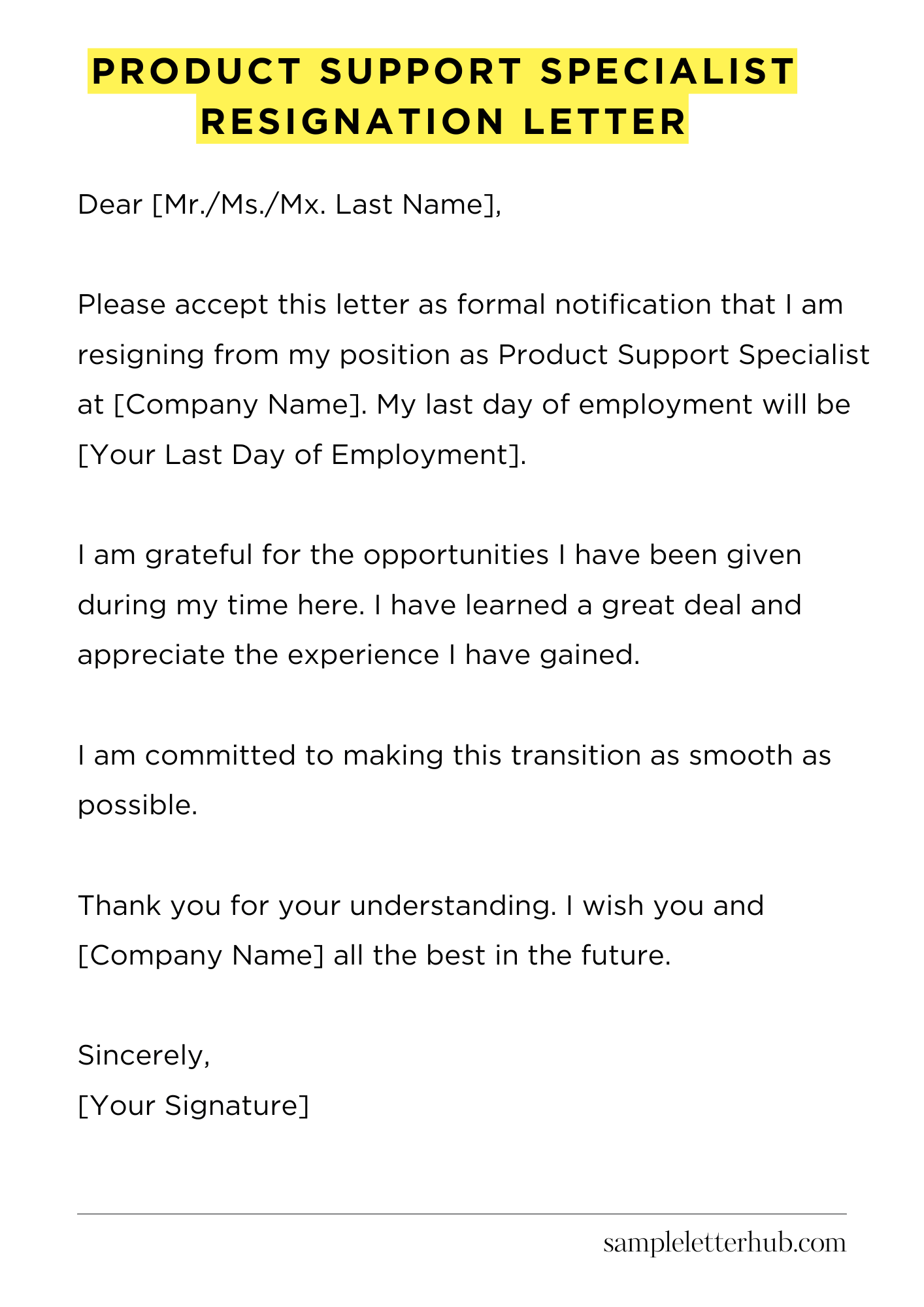
Dear [Mr./Ms./Mx. Last Name],
Please accept this letter as formal notification that I am resigning from my position as Product Support Specialist at [Company Name]. My last day of employment will be [Your Last Day of Employment].
I am grateful for the opportunities I have been given during my time here. I have learned a great deal and appreciate the experience I have gained.
I am committed to making this transition as smooth as possible. I am happy to assist in training my replacement and completing any outstanding tasks to ensure a seamless handover.
Thank you for your understanding. I wish you and [Company Name] all the best in the future.
Sincerely,
[Your Signature]
How to Write Product Support Specialist Resignation Letter
So, you’re moving on from your role as a Product Support Specialist. Congratulations! Whether you’ve landed a new opportunity, are pursuing further education, or just need a change of scenery, it’s time to craft your resignation letter.
It’s important to remember that this letter is more than just a formality. It’s a professional document that reflects your attitude and professionalism. You want to leave a good impression, as you never know when your paths might cross again!
1. Get the Basics Right: Formatting and Key Information
First things first, let’s talk about formatting. Keep it clean and simple. Use a standard business letter format. Your letter should be typed, not handwritten. Start with your contact information, followed by the date, and then the recipient’s information (your manager’s name, title, and the company address).
In the body of your letter, the core information is vital. Clearly state your intention to resign. Specify your last day of employment. This is crucial! Be precise.
Make sure it aligns with your company’s policy regarding notice periods. Generally, two weeks’ notice is standard. Double-check your employee handbook to confirm the required notice period. Then, briefly and professionally state your reason for leaving.
2. Keep it Concise: What to Include and What to Leave Out
Brevity is key. Get to the point! Resist the urge to write a long, drawn-out explanation. A simple sentence or two about your reason for leaving is sufficient. Avoid negativity. Don’t use this letter to air grievances or complaints about the company, your colleagues, or your experiences.
This letter is not the place for that. Focus on the positive. A simple “Thank you for the opportunity” can go a long way. Do, however, include any information about the transfer of responsibilities.
Keep the tone professional. Always. Never use slang or informal language. Proofread, proofread, and proofread again! Check for any typos or grammatical errors. A poorly written letter can damage your reputation. It can create an unprofessional impression, and that’s the last thing you want. Make sure it is impeccable.
3. Express Gratitude: Showing Appreciation for the Opportunity
Acknowledging the opportunity is a must. Expressing gratitude is always appreciated. Thank your employer for the experience you’ve gained and the opportunities you’ve been given.
Briefly mention any positive aspects of your time in the role. Perhaps you enjoyed working with a particular team, learning a specific skill, or contributing to a project. A sentence or two showing appreciation can create a positive and lasting impression.
It’s also a good idea to offer to assist with the transition. Offer your help during your remaining time to train a replacement or complete ongoing tasks. You might include a sentence like, “I am happy to assist in any way possible during the transition period.” Doing so shows your commitment and professionalism. This demonstrates that you care about a smooth handover.
4. Offer Assistance: Ensuring a Smooth Transition
Helping with the transition reflects well on you. Offering to help train your replacement is always a thoughtful gesture. Provide clear instructions about your open tasks. Write a handover document.
This document should include information on all current projects, ongoing issues, and contact information for clients or key stakeholders. Offer to be available for a limited time after your departure to answer questions.
This will show you’re dedicated and that you take the handover process seriously. It’s also a great way to ensure a seamless workflow for your colleagues. Consider offering to create documentation or a guide for common tasks. This gesture will make the transition smoother. It will also show your employer that you’re leaving with their best interests at heart.
5. Review and Submit: Polishing Your Letter for Success
Before sending it, proofread thoroughly! Check for grammar, spelling, and punctuation errors. It’s also wise to have a colleague or friend read it over for a fresh perspective. Ask them to look for clarity, professionalism, and tone. Make sure the date and other key information are correct.
Finally, choose the delivery method appropriate for your company. Typically, this is through your manager. Follow your company’s protocol for submitting your letter of resignation.
After sending your letter, follow up with your manager to confirm they have received it. Stay positive and professional until your last day. Remember, your resignation letter is a crucial step in maintaining a positive professional relationship. Good luck with your future endeavors!
FAQs about Product Support Specialist resignation letter
1. What is the standard format for a Product Support Specialist resignation letter?
The standard format typically includes a clear and concise opening stating your intention to resign, the effective date of your resignation, a brief expression of gratitude for the opportunity, a willingness to assist with the transition (if applicable), and a professional closing. It should be business-appropriate and free of any negativity.
2. What should I include in my Product Support Specialist resignation letter?
You should include the date, your name and contact information (though this may already be present in the header/footer), the recipient’s name and title, a clear statement of resignation, the last day of employment, a brief thank you for the experience, and an offer to assist with the handover of your responsibilities. Avoid including negative feedback or personal grievances.
3. How do I determine the appropriate effective date for my resignation?
Consider your employment contract, which may specify a notice period. Research company policy on resignations. Provide the required notice, typically two weeks but may vary. Factor in any pending projects or critical tasks you’re responsible for, and ensure a smooth handover period to minimize disruption to the team.
4. Should I provide a reason for resigning in my Product Support Specialist resignation letter?
You are generally not obligated to state the exact reason for your resignation. You may choose to briefly mention that you are pursuing a new opportunity or simply state that you are resigning to seek other opportunities. Keep the reason neutral and brief. If you have any positive things to say about the company, feel free to include them as well.
5. How should I deliver my Product Support Specialist resignation letter?
It’s generally best to deliver the letter in person to your manager. If that’s not possible, send it via email. Keep a copy for your records. Ensure your letter is delivered on the agreed date and time as per company policies.
Related:
Resignation letter due to rude boss
Resignation letter moving to another state
Resignation letter due to illness of family member
Resignation letter due to study