

So, you’re a Process Manager, and it’s time to move on. A “Process Manager resignation letter” is a formal document. It lets your employer know you’re leaving. It states your last day of employment. It’s an important step in ending your job professionally.
Need to write your own letter? No worries. We’ve got you covered. We’ll explore different templates. We will share several examples. These samples will help guide your writing.
Creating your resignation letter just became simpler. Our examples will save you time. They offer a strong starting point. Find the perfect words to say goodbye.
Process Manager Resignation Letter
Below is a sample of a Process Manager Resignation Letter:
[Your Name]
[Your Address]
[Your Phone Number]
[Your Email Address]
[Date]
[Recipient Name] (If known, otherwise use title)
[Recipient Title]
[Company Name]
[Company Address]
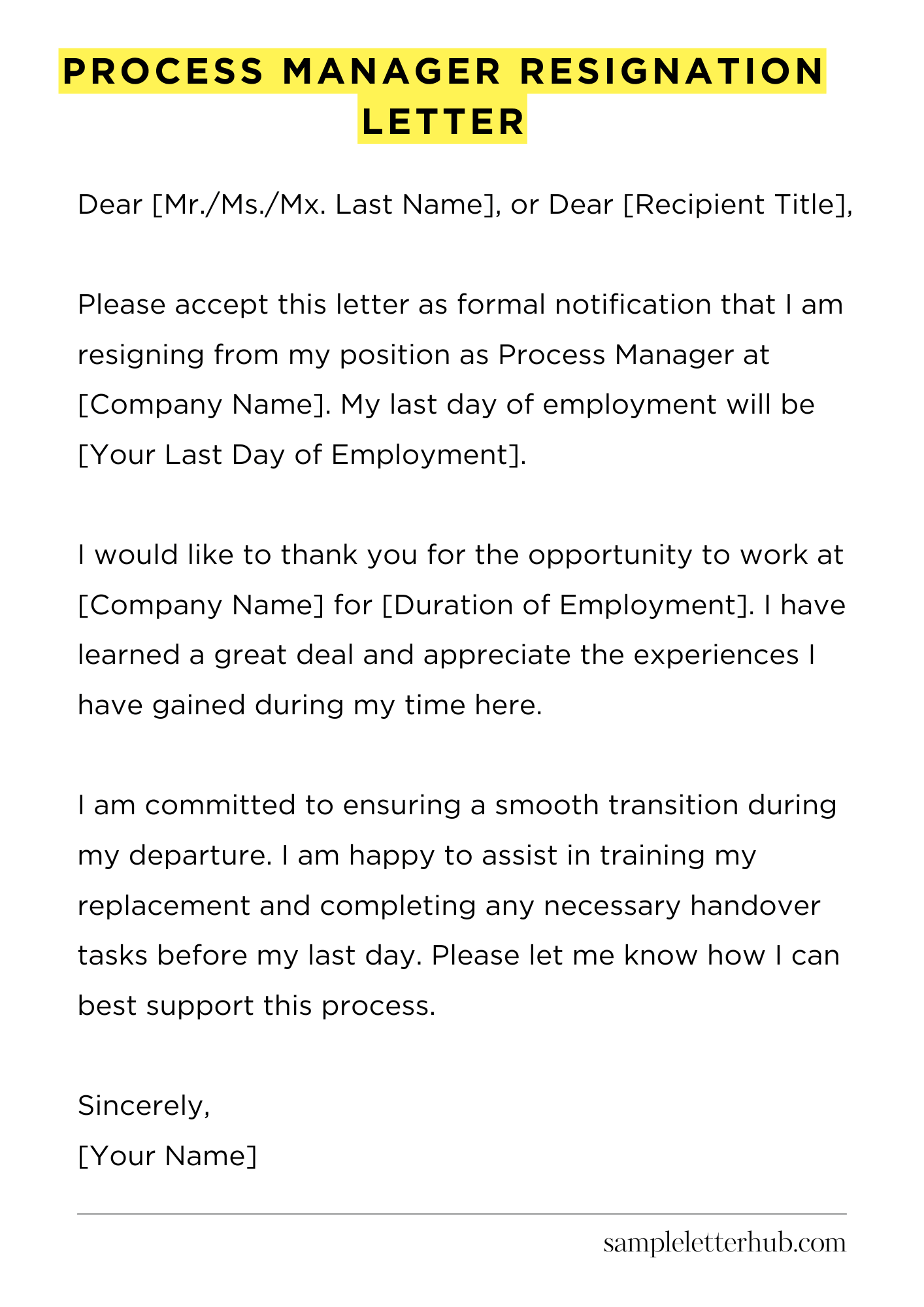
Dear [Mr./Ms./Mx. Last Name], or Dear [Recipient Title],
Please accept this letter as formal notification that I am resigning from my position as Process Manager at [Company Name]. My last day of employment will be [Your Last Day of Employment].
I would like to thank you for the opportunity to work at [Company Name] for [Duration of Employment]. I have learned a great deal and appreciate the experiences I have gained during my time here.
I am committed to ensuring a smooth transition during my departure. I am happy to assist in training my replacement and completing any necessary handover tasks before my last day. Please let me know how I can best support this process.
I wish [Company Name] continued success in the future.
Sincerely,
[Your Name]
How to Write: Process Manager Resignation Letter
Understanding the Importance of a Resignation Letter
Leaving a job is a big deal. It requires careful planning and execution. A well-crafted resignation letter is more than just a formality; it’s a vital step in ensuring a smooth transition and maintaining a positive professional relationship. Think about it: your letter is a lasting record.
It reflects on your professionalism and leaves a final impression on your employer. It also sets the stage for a potentially positive future relationship, which could be beneficial down the line.
You want to leave on good terms, right? A poorly written letter can burn bridges, something you definitely want to avoid. Therefore, understanding its importance is paramount to getting it right.
Essential Elements: What to Include
So, what exactly goes into this important document? There are a few key elements you absolutely must incorporate. First, and foremost, is the clear and concise statement of your intention to resign. This should be direct and unambiguous. Also, you need the effective date of your resignation.
Make sure this date aligns with your employment contract or any company policies. Then, express your gratitude. Acknowledge the opportunities you’ve been given during your time with the company. Finally, if you wish, briefly offer to assist with the transition.
Don’t overcomplicate it. Clarity is the most important thing.
Structuring Your Letter: The Right Format
The structure of your letter should follow a standard business letter format. Start with your contact information, the date, and the recipient’s contact information. Next, address your manager or the appropriate HR representative. The body of the letter should be broken down into clear paragraphs.
Use a professional tone. Keep each section concise, to the point, and easy to read. Proofread everything. Always.
A well-structured letter is easy to navigate.
Crafting the Right Tone: Professionalism and Politeness
Tone is critical. You are parting ways, but the aim is always to leave a positive lasting impression. Maintain a professional tone throughout. This is not the time to air grievances. Keep it polite, even if you weren’t happy in the role. Express gratitude for the opportunities you’ve been given, even if your experience wasn’t perfect.
Be respectful of your manager and the company. Remember, this letter is a reflection of your character. It’s what you want to be remembered by, so make sure it’s good!
Avoid negativity; focus on the positive.
Post-Submission: What Happens Next?
Once you’ve submitted your resignation letter, your part isn’t entirely over. Be prepared for a response, which might include an acceptance, a request for a meeting, or questions about your departure.
Offer to help with the transition. This includes training a replacement or sharing your knowledge. Follow up promptly to any requests. Doing so will make the whole process easier.
Your actions during this transition reflect well on you, further enhancing your professionalism.
FAQs about Process Manager Resignation Letter
What is the typical format for a Process Manager resignation letter?
A Process Manager resignation letter typically follows a formal business letter format. This includes your contact information, the date, the recipient’s contact information (your manager or HR), a formal salutation (e.g., “Dear [Manager’s Name]”), a clear statement of resignation (including your last day of employment), a brief explanation (optional).
What key information should be included in a Process Manager resignation letter?
The core elements to include are: a clear statement of your intent to resign, your last day of employment (typically adhering to company policy, often two weeks’ notice), and your name.
Optional inclusions are a brief reason for leaving (e.g., career advancement, personal reasons – keep it concise), an expression of gratitude for the opportunity, and an offer to assist with the transition. It’s important to avoid negativity or overly personal details.
What should be the tone of a Process Manager resignation letter?
The tone should be professional and respectful. Maintain a positive or neutral outlook, even if you’re leaving due to negative experiences. Expressing gratitude for the opportunity and acknowledging the team’s contributions can leave a positive lasting impression. Avoid using aggressive, accusatory, or overly emotional language.
Do I need to explain the reason for my resignation in the letter?
No, you are not obligated to provide a detailed explanation. However, a brief, neutral reason can be included if you wish. Examples include “for personal reasons,” “to pursue a new opportunity,” or “to focus on other interests.” If you prefer to keep the reason private, you can simply state your resignation without explanation. The key is to keep it brief and professional.
How should I handle the transition of my responsibilities as a Process Manager after submitting my resignation letter?
Offer to assist in the transition. This may include preparing documentation (e.g., standard operating procedures, project status updates), training a replacement, or answering questions from colleagues. Work collaboratively with your manager to identify the tasks that need to be completed before your departure.
Provide clear and concise handover notes or instructions. Your cooperation can leave a positive impression and facilitate a smooth transition.
Related:
Resignation letter due to rude boss
Resignation letter moving to another state
Resignation letter due to illness of family member
Resignation letter due to study