

A “Process Engineer resignation letter” is a formal document. It is written by a Process Engineer. The purpose is to officially announce their departure from a company. It informs the employer of the engineer’s intent to leave. It usually states the last day of employment.
Are you a Process Engineer looking to move on? Writing a resignation letter can feel tricky. We’ve got you covered. We’ll share several templates and examples. These are designed to help you craft your own letter.
Need a simple template? Looking for something more specific? We have a variety of samples. You can adapt them to your situation. Make the process of leaving your job easier.
Process Engineer Resignation Letter
Below is a sample of a Process Engineer Resignation Letter:
[Your Name]
[Your Address]
[Your Phone Number]
[Your Email Address]
[Date]
[Hiring Manager Name] (If known, otherwise use title)
[Hiring Manager Title]
[Company Name]
[Company Address]
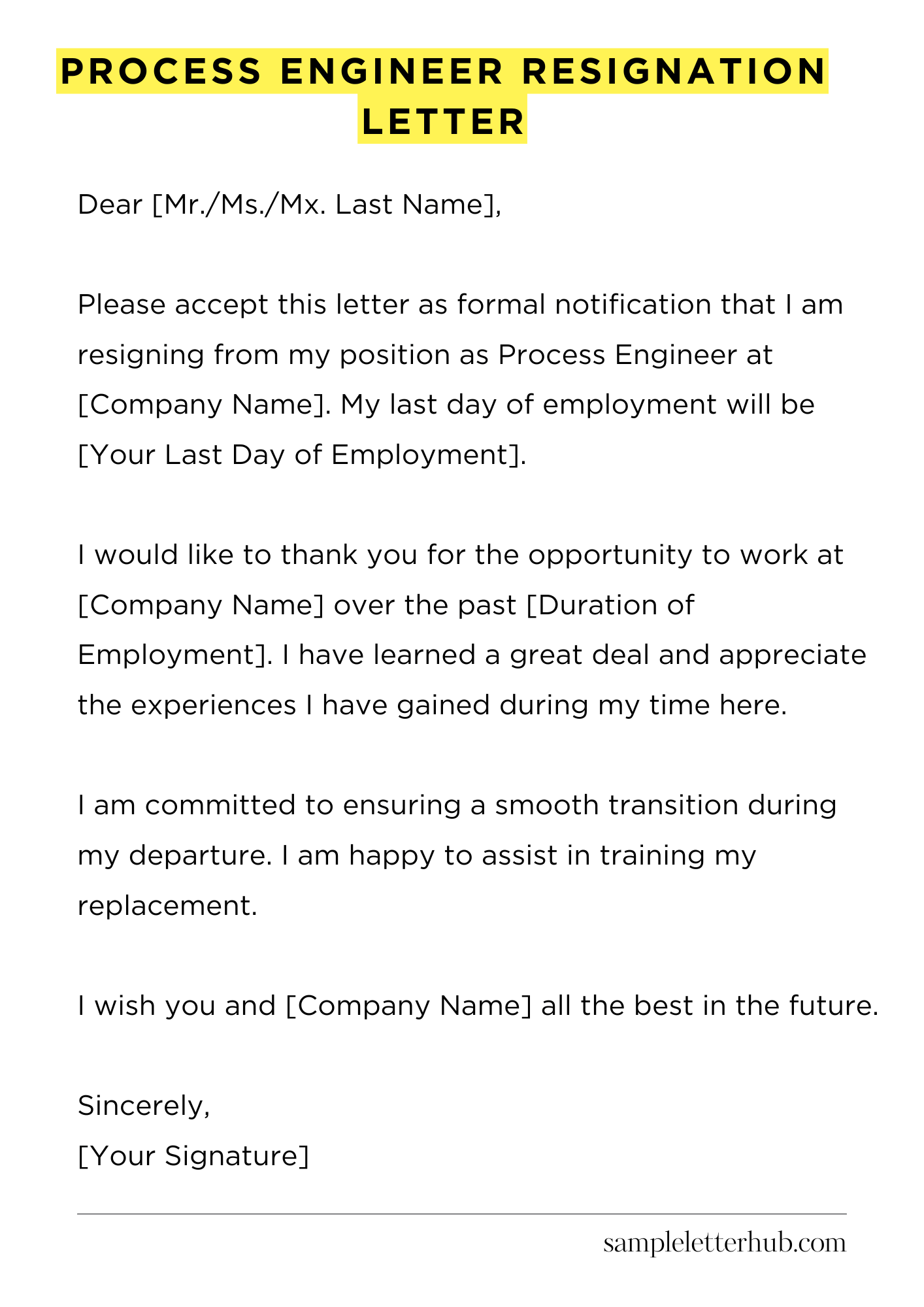
Dear [Mr./Ms./Mx. Last Name],
Please accept this letter as formal notification that I am resigning from my position as Process Engineer at [Company Name]. My last day of employment will be [Your Last Day of Employment].
I would like to thank you for the opportunity to work at [Company Name] over the past [Duration of Employment]. I have learned a great deal and appreciate the experiences I have gained during my time here.
I am committed to ensuring a smooth transition during my departure. I am happy to assist in training my replacement and completing any outstanding projects to the best of my ability before my last day.
I wish you and [Company Name] all the best in the future.
Sincerely,
[Your Signature]
How to Write a Process Engineer Resignation Letter
So, you’re a Process Engineer, and it’s time to move on to greener pastures. Congratulations on taking the next step in your career! But before you jet off to your exciting new opportunity, there’s one crucial step: crafting a professional and effective resignation letter. This document is more important than you think.
It’s your official goodbye, a formal record, and a reflection of your professionalism. Let’s break down how to do it right.
Step 1: Get the Basics Right
First things first: the format. Keep it concise. Start with your name, address, and contact information. Then, add the date. Next, address your letter to your immediate supervisor or the appropriate HR representative, using their correct title.
This shows respect and attention to detail. The body of the letter needs a clear and direct statement of your intent to resign. State your role and the effective date of your resignation. Be specific; this avoids any misunderstandings down the line. Finally, remember a professional closing, such as “Sincerely” or “Best regards,” followed by your typed name.
Step 2: State Your Resignation Clearly
The core of your letter should be unambiguous. Avoid beating around the bush. Use direct and professional language. Instead of something vague, try: “Please accept this letter as formal notification that I am resigning from my position as Process Engineer at [Company Name], effective [Date].”
That is easy to understand. Keep it simple! Resist the urge to include a long list of grievances, unless required by HR. Stick to the facts and maintain a professional tone throughout. This letter is meant to be a professional document.
Step 3: Show Gratitude (Optional, but Recommended)
While not mandatory, expressing gratitude can leave a positive lasting impression. Consider adding a brief sentence or two acknowledging your experience and thanking the company for the opportunities you’ve been given.
For example, “I would like to thank you for the opportunities I’ve had during my time at [Company Name].” This shows maturity and professionalism. Even if you’re leaving due to negative circumstances, finding a way to express appreciation, however small, can be beneficial in the long run. This is a small gesture that can really go a long way.
Step 4: Offer Assistance with the Transition
Demonstrate your commitment to a smooth handover. Offer your assistance in training your replacement or completing any pending projects. A sentence like, “I am committed to ensuring a smooth transition and am available to assist in training my replacement during my remaining time,” goes a long way.
This reflects positively on your work ethic. It also shows you are a team player. Being helpful in the transition phase can often make your departure less stressful for everyone involved. You can also mention completing any pending tasks.
Step 5: Proofread and Finalize
Before hitting send, proofread! Proofreading is absolutely crucial. Check for any grammatical errors, typos, and formatting issues. A poorly written letter can undermine all your efforts.
Make sure the date and your effective date of resignation are correct. Double-check the recipient’s name and title. Consider having a friend or colleague read it over as a fresh pair of eyes can often catch mistakes you might miss.
Once you’re completely satisfied, print a copy for your records, and submit your letter according to your company’s policies (usually via email or hard copy). Good luck with your new adventure!
FAQs about Process Engineer resignation letter
How do I start my Process Engineer resignation letter?
Begin your letter with a clear and concise statement of your intent to resign. Include your name, the date, and the specific date your resignation will be effective. Directly state your position as a Process Engineer. Keep the opening professional and to the point.
What key information should be included in a Process Engineer resignation letter?
Your resignation letter should include:
- A formal statement of your resignation.
- The date of your last day of employment.
- A brief expression of gratitude for the opportunity.
- (Optional) a short, positive statement about your experience.
- Your signature.
Avoid negative comments or unnecessary details.
Should I provide a reason for leaving in my Process Engineer resignation letter?
You are not obligated to provide a reason for your departure. However, if you choose to, keep it brief and professional. You can simply state that you are pursuing another opportunity or that it’s time for a career change.
Avoid going into excessive detail or criticizing your employer. If you are leaving due to something negative, consider stating it if the company may want to improve those aspects.
What is the appropriate tone for a Process Engineer resignation letter?
Maintain a professional and respectful tone throughout the letter. Express gratitude for the opportunities you’ve been given, even if your experience hasn’t been entirely positive. Avoid negativity, sarcasm, or any language that could damage your professional reputation. Keep the tone formal, polite, and appreciative.
How should I handle the handover of responsibilities in my resignation letter?
In your resignation letter, you don’t necessarily need to detail the handover process. However, you can offer to assist with the transition.
State your willingness to help train your replacement or complete any necessary tasks before your departure. Provide your contact information, if you are comfortable with it, in case your former employer needs to reach you after your last day.
Related:
Resignation letter due to rude boss
Resignation letter moving to another state
Resignation letter due to illness of family member
Resignation letter due to study