

A private investigator resignation letter is a formal document. It informs an employer of your intention to leave your job. The letter is your official notice. It marks the end of your employment.
Crafting the perfect resignation can be tricky. You want to leave on good terms. You want to make a professional statement. We’ve got you covered.
Here, you’ll find a variety of sample letters. They cater to different situations. Choose the one that best suits your needs. Adapt and personalize it for your unique situation.
Private Investigator Resignation Letter
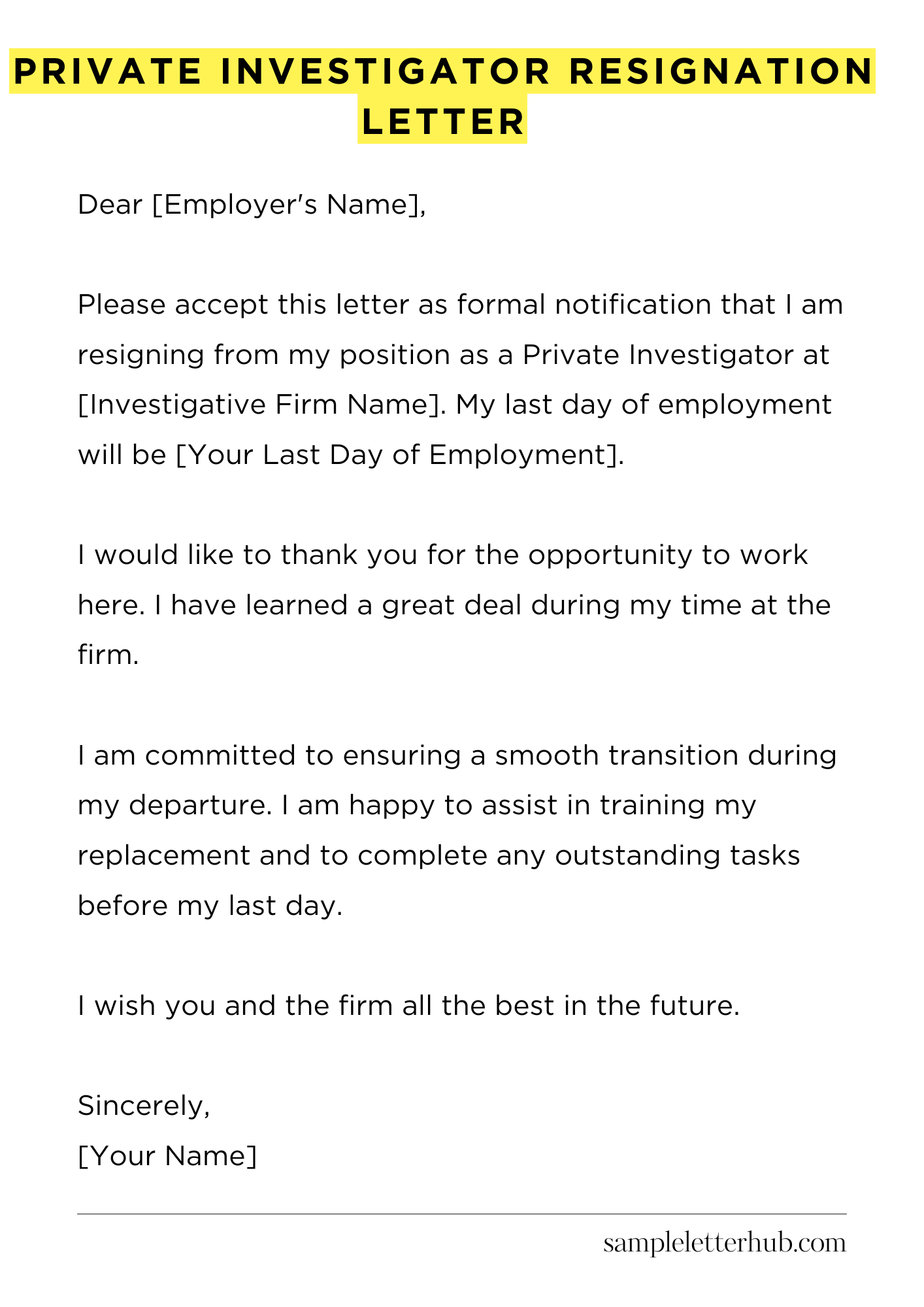
Below is a sample of a Private Investigator Resignation Letter:
[Your Name]
[Your Address]
[Your Phone Number]
[Your Email Address]
[Date]
[Employer’s Name]
[Investigative Firm Name]
[Firm Address]
Dear [Employer’s Name],
Please accept this letter as formal notification that I am resigning from my position as a Private Investigator at [Investigative Firm Name]. My last day of employment will be [Your Last Day of Employment].
I would like to thank you for the opportunity to work here. I have learned a great deal during my time at the firm, and I appreciate the experiences and knowledge I have gained.
I am committed to ensuring a smooth transition during my departure. I am happy to assist in training my replacement and to complete any outstanding tasks before my last day.
I wish you and the firm all the best in the future.
Sincerely,
[Your Name]
How to Write a Private Investigator Resignation Letter
1. Grasping the Basics: Why It Matters
Leaving a job, especially in a field like private investigation, necessitates a professional approach. Your resignation letter isn’t just a formality; it’s a crucial document. It officially communicates your departure to your employer.
Moreover, it serves as a record of your employment. A well-crafted resignation letter can protect your future professional endeavors. It helps ensure a smooth transition for both you and your employer. A poorly written one?
Well, it could leave a lasting negative impression. Think of it as your final case file – you want to leave a good impression, right?
2. Essential Elements: What to Include
There are key ingredients to a successful resignation letter. First, you need to state your intention clearly. Always begin by explicitly stating you are resigning from your position. Second, pinpoint the effective date of your resignation. Be precise. This date officially marks your last day of employment. Third, express gratitude for the opportunity.
Briefly mention what you’ve learned or gained from the experience. Fourth, keep it concise. Avoid unnecessary details or grievances. Finally, consider offering to assist with the transition. This shows professionalism.
Offer to train a replacement or complete specific tasks before you leave. These simple steps make a big difference.
3. Formatting Your Letter: Structure is Key
The layout matters too. Use a standard business letter format. Include your contact information (name, address, phone number, and email). The employer’s information should follow (name, title, company address).
Next, the date. Then, start with a professional salutation (Dear Mr./Ms. [Last Name]). Use clear, concise paragraphs. Keep the tone respectful and polite throughout. You’re aiming for a professional conclusion. Close with a formal closing (“Sincerely” or “Best regards”). End with your full name. It’s a standard and effective method.
4. Crafting the Content: Saying Goodbye the Right Way
Let’s get down to the wording. Start with a straightforward statement of your resignation. For instance, “Please accept this letter as formal notification that I am resigning from my position as a Private Investigator, effective [Date].”
Show your appreciation for the experience you gained. For example, “I am grateful for the opportunities I’ve had during my time here.” If you’re willing to help during the transition, state that clearly, too.
For instance, “I am happy to assist with the handover of my duties to ensure a smooth transition.” Keep it positive and focused on the future. Remember to proofread carefully for any errors before you send it.
5. Examples and Templates: Putting it All Together
Need some examples? Here’s a basic template. Modify it to your specific situation:
[Your Name]
[Your Address]
[Your Phone Number]
[Your Email Address]
[Date]
[Employer’s Name]
[Employer’s Title]
[Company Name]
[Company Address]
Dear [Mr./Ms. Last Name],
Please accept this letter as formal notification that I am resigning from my position as Private Investigator, effective [Date].
I am grateful for the experience and opportunities I’ve received during my time at [Company Name]. I wish you and the company continued success in the future.
I am available to assist with the handover of my duties to ensure a smooth transition.
Sincerely,
[Your Name]
This template provides a foundation. You can customize it to suit your needs. Remember to always tailor it to reflect your personal circumstances.
FAQs about Private Investigator resignation letter
How do I format a private investigator resignation letter?
A private investigator’s resignation letter should adhere to standard business letter format. Include your contact information (name, address, phone number) at the top, followed by the date.
Address the letter to your direct supervisor or the appropriate person within the company. In the body of the letter, clearly state your intent to resign, your last day of employment, and offer a brief expression of gratitude. Keep the tone professional and concise.
What information should be included in a private investigator resignation letter?
The core information includes: a clear statement of resignation (e.g., “I am writing to resign from my position as Private Investigator”), the effective date of your resignation (your last day of employment), and a brief, professional expression of gratitude or appreciation for your time at the company. You may also offer to assist with the transition of your cases or responsibilities, if appropriate.
Should I provide a reason for resigning in my private investigator resignation letter?
While you are not obligated to provide a specific reason for your resignation, it’s a matter of personal choice and professionalism. You can simply state that you are pursuing other opportunities.
If you feel comfortable and it’s relevant, you could offer a general reason, such as a career change or personal circumstances, but keep it brief. Avoid negative or overly detailed explanations.
Is it necessary to hand in a resignation letter as a private investigator?
Yes, submitting a formal resignation letter is standard professional practice. It serves as a written record of your intent to leave your position and helps clarify the terms of your departure. It provides a documented timeline and protects both you and your employer. In the field of investigation, a written record is particularly important.
How can I ensure my private investigator resignation letter maintains professionalism?
Maintain professionalism by using a formal business letter format, avoiding negative language, and proofreading carefully for any grammatical errors. Express gratitude for your experience and avoid burning any bridges.
Deliver the letter in person, if possible, and adhere to any company policies regarding resignation procedures. Focus on the positive aspects of your employment and future goals.
Related:
Resignation letter due to rude boss
Resignation letter moving to another state
Resignation letter due to illness of family member
Resignation letter due to study