

Ever been charged too much for your insurance? A premium refund request letter due to overbilling is your tool. It’s how you formally ask your insurance company to return the extra money you paid. The goal is simple: Get your money back if you were wrongly charged.
We get it. Writing these letters can be tricky. That’s why we’re here. We’ll give you a helping hand. Prepare yourself! We’ve got samples, templates, and examples. This article is your guide to crafting the perfect premium refund request letter.
This article simplifies the process. We break down the letter writing process. We offer ready-to-use letter samples. We make it easy for you to get the overbilling refund you deserve. Let’s get started and reclaim your money!
[Your Name]
[Your Address]
[Your Phone Number]
[Your Email Address]
[Date]
[Name of Company]
[Company Address]
Subject: Refund Request Due to Overbilling – Account Number [Your Account Number]
Dear [Name of Billing Department/Customer Service],
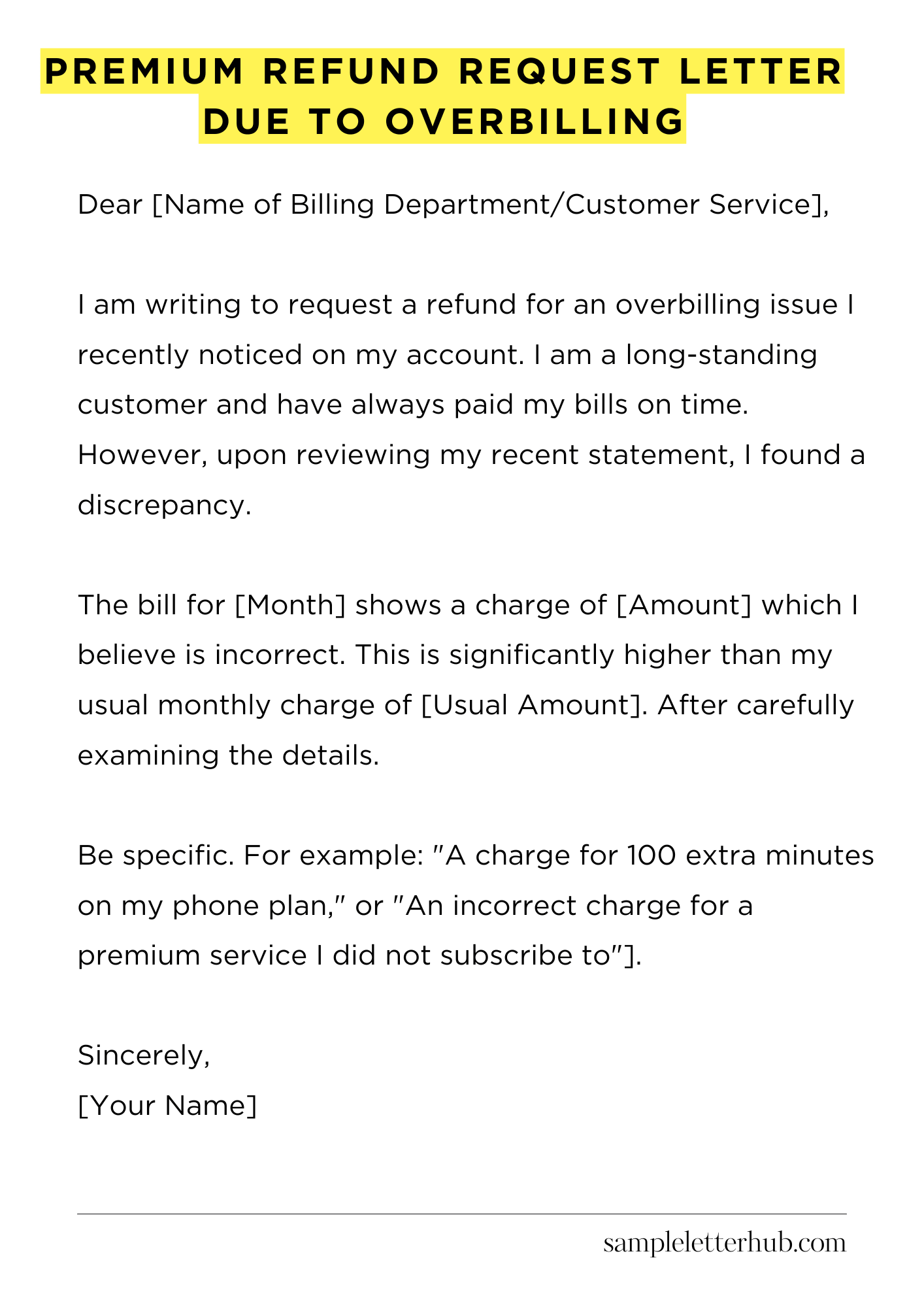
I am writing to request a refund for an overbilling issue I recently noticed on my account. I am a long-standing customer and have always paid my bills on time. However, upon reviewing my recent statement, I found a discrepancy.
The bill for [Month] shows a charge of [Amount] which I believe is incorrect. This is significantly higher than my usual monthly charge of [Usual Amount]. After carefully examining the details, I have identified the following specific item as the source of the overbilling: [Clearly describe the item, service, or charge that is incorrect.
Be specific. For example: “A charge for 100 extra minutes on my phone plan,” or “An incorrect charge for a premium service I did not subscribe to”].
I have attached a copy of my bill, highlighting the specific charge in question, as well as any other supporting documentation that can help to clarify my claim. I think this will help you understand the issue. I believe that I am entitled to a refund for the overcharged amount.
To further support my claim, here are a few other reasons why this charge seems incorrect: [Provide 1-2 brief, additional supporting pieces of information.
For example: “I have records showing my usage did not exceed my included minutes”, or “I never authorized the purchase of the service listed on the bill”]. These points should help illustrate the unfair billing issue.
I would appreciate it if you would investigate this matter promptly and process the appropriate refund. I trust that this can be resolved quickly. Please let me know what steps you will take to rectify this overbilling issue.
Please issue the refund to [How you want to receive the refund – e.g., my original payment method, a check mailed to my address]. I look forward to your prompt response and confirmation of the refund. Please let me know if you need any additional information from me.
Thank you for your time and attention to this matter.
Sincerely,
[Your Name]
How to Write Premium Refund Request Letter Due to Overbilling
Navigating the financial labyrinth of overbilling can be a vexing experience. However, a well-crafted refund request letter can be your stalwart ally in reclaiming unjustly charged funds. Here’s a compendium on composing a cogent letter that effectively argues your case.
1. Commence with a Formal Salutation and Identification
Begin your missive with a formal salutation. Employ “Dear [Name of Billing Department/Company],” or a similarly professional greeting. Immediately after, clearly state your identity and account details. Include your full name, account number, address, and any other pertinent identifying information. Precision in identification minimizes the potential for misinterpretation.
2. Detail the Discrepancy: Articulate the Overbilling Incident
This is where the crux of your argument resides. Be meticulous in describing the overbilling incident. Specify the dates of the disputed charges, the exact amounts, and a concise explanation of why you believe they are erroneous. Refer to specific bills, invoices, or statements, using their reference numbers.
Provide compelling evidence to substantiate your claims. Attach copies of supporting documentation like receipts or prior statements demonstrating the correct charges, thereby fortifying your position.
3. Stipulate the Desired Remedy: The Refund Directive
Explicitly state what you are seeking. Request a full refund of the overbilled amount. Be unambiguous in your demand. Indicate the precise sum you believe is owed to you.
Specify your preferred method of refund, whether via check, credit to your account, or another acceptable mechanism. The clarity of this request is crucial in setting expectations.
4. Fortify with Supporting Documentation: Exhibit A – Your Evidence
Include all supporting documentation that validates your claims. As mentioned, this may include copies of receipts, previous billing statements, contract terms, or any other material that supports your argument. Label each document clearly (e.g., “Exhibit A: Receipt from [Date]”).
Organize these attachments in a logical sequence to assist in efficient review by the recipient. The more proof you provide, the better. Consider utilizing a comprehensive approach.
5. Maintain a Professional Demeanor: The Art of Civil Discourse
Throughout the letter, maintain a professional and respectful tone. Avoid accusatory language or personal attacks. Even if you are frustrated, staying composed will improve the chances of a favorable response.
Choose your words carefully and remember, concise arguments can be more persuasive than lengthy ones. Employ clear and concise language; avoid unnecessary jargon.
6. Propose a Reasonable Timeline: A Gentle Deadline
Provide a reasonable timeframe for the company to respond to your request. Suggest, for example, “I kindly request a response and resolution to this matter within 14 business days.” This sets a clear expectation and encourages timely action. Failure to adhere to the timeline could warrant a follow up letter.
7. Conclude with a Call to Action and Contact Information
End your letter with a polite closing statement, such as “Thank you for your prompt attention to this matter.” Reiterate your name and account information. Include your phone number and email address, thereby facilitating effective communication. Ensure all information is up-to-date.
Sign your name, if sending a physical letter. Remember, a professionally crafted letter can dramatically improve your chances of getting your funds back.
FAQs about Premium Refund Request Letter Due to Overbilling
What information should I include in a premium refund request letter due to overbilling?
Your letter should clearly state your policy number, the specific dates and amounts of the overbilling, and the total amount of the refund you are requesting.
Provide supporting documentation, such as copies of your bills, bank statements, or any other records that support your claim. Include your contact information (name, address, phone number, email) and a clear, concise statement requesting the refund.
What is the typical timeframe for receiving a refund after submitting a request letter?
The timeframe can vary depending on the insurance provider and the complexity of the overbilling issue. However, most insurers aim to process refund requests within 30 to 60 days. Check your insurance policy for specific guidelines or contact the insurer directly to inquire about their refund processing timeline.
What if the insurance company denies my premium refund request?
If your initial request is denied, you typically have options for appeal. Review the denial letter for the reasons provided. Gather any additional documentation to support your claim.
Follow the appeal process outlined by your insurance company, which may involve submitting a formal appeal letter, providing further evidence, and potentially escalating the issue to a higher level within the company or to an external review process. If the internal appeal fails, and if there is still a conflict, you could involve the insurance regulator in your State.
How do I prove overbilling? What kind of documentation do I need to provide?
Proof of overbilling depends on the specifics of the situation. Typically, you’ll need to provide copies of your insurance bills and bank statements.
Depending on the reasons for overbilling, it may involve documentation that justifies the claim. This might include medical records, evidence of payments you have already made, policy documents, or other relevant records that illustrate that the billing was inaccurate.
Where should I send the premium refund request letter?
The address to send your refund request letter is usually indicated on your insurance bills, policy documents, or the insurer’s website. If you are unsure, contact your insurance company’s customer service department to obtain the correct mailing address. It’s advisable to send your letter via certified mail with return receipt requested to have proof of delivery.
Related:
Resignation letter due to rude boss
Resignation letter moving to another state
Resignation letter due to illness of family member
Resignation letter due to study
Resignation letter due to long commute