

Ever wondered about a premium adjustment request letter? It’s a formal document. Its main goal is simple. It requests a change to your insurance premium. It’s used when you believe your current rate is incorrect. This can happen for various reasons.
Need help crafting your own premium adjustment request letter? You’re in the right place. We’ve got you covered. We’re sharing helpful templates and examples below. Use these samples as a starting point.
Writing these letters can feel daunting. We aim to make it easy. Find the perfect wording for your situation. These letters will help you create a request letter you can be proud of. Get ready to draft your own insurance premium adjustment letter today!
[Your Name/Company Name (if applicable)]
[Your Address]
[Your City, Postal Code]
[Your Email Address]
[Your Phone Number]
[Date]
[Insurance Company Name]
[Insurance Company Address]
[Insurance Company City, Postal Code]
Subject: Premium Adjustment Request – Policy Number [Your Policy Number]
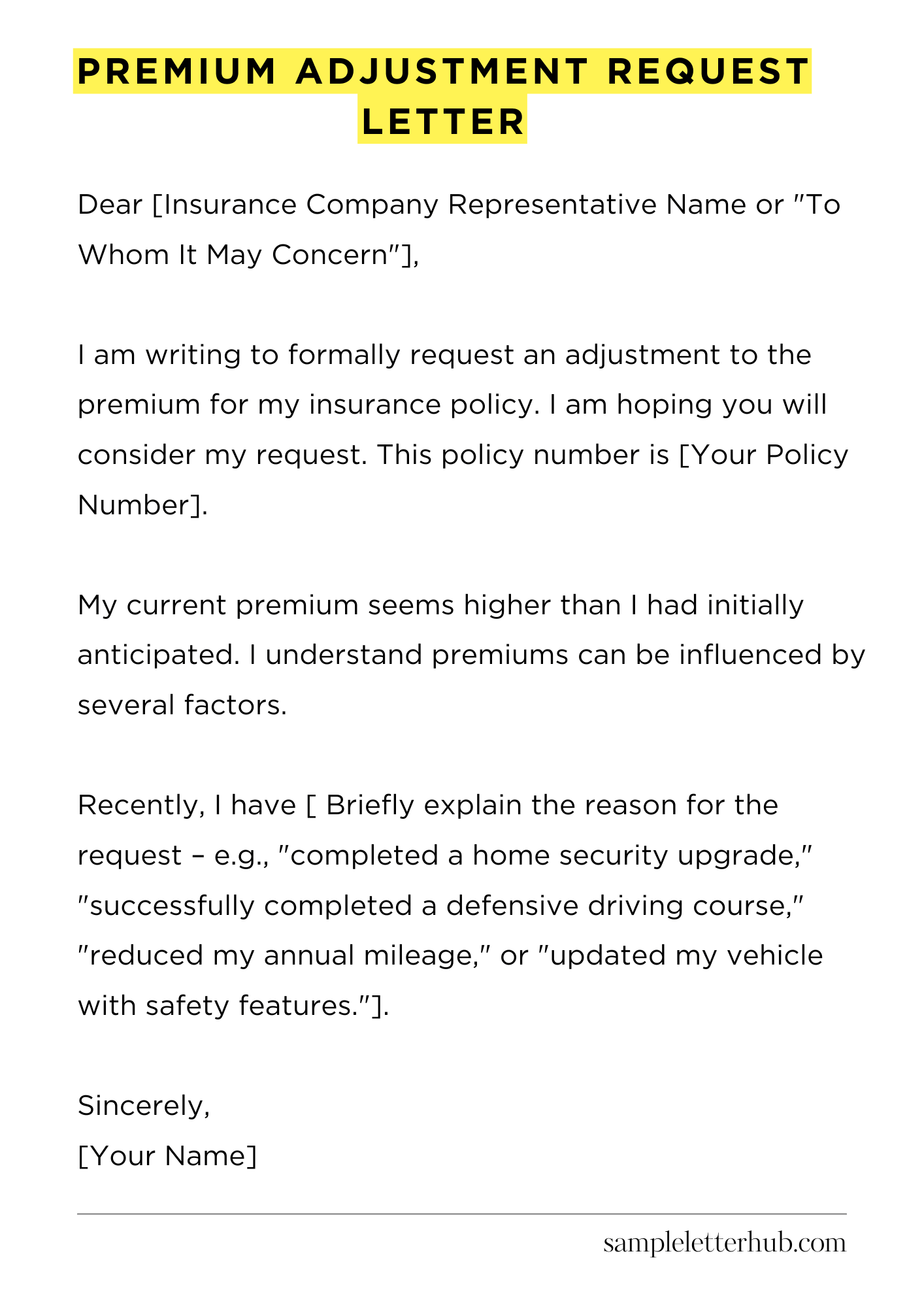
Dear [Insurance Company Representative Name or “To Whom It May Concern”],
I am writing to formally request an adjustment to the premium for my insurance policy. I am hoping you will consider my request. This policy number is [Your Policy Number].
My current premium seems higher than I had initially anticipated. I understand premiums can be influenced by several factors. I would like to review my current policy details to see if some adjustments can be made.
Recently, I have [ Briefly explain the reason for the request – e.g., “completed a home security upgrade,” “successfully completed a defensive driving course,” “reduced my annual mileage,” or “updated my vehicle with safety features.”]. These changes, I believe, have reduced my risk profile significantly. This means my risk has become much lesser than before.
I have attached [Mention any supporting documents you are attaching – e.g., “copies of the home security system invoices,” “a certificate of completion for the defensive driving course,” “proof of reduced mileage,” etc.]. These documents provide proof of the mentioned changes.
I would appreciate it if you could review my policy and these supporting documents. Could you consider adjusting my premium to reflect these changes? Your understanding in this matter is highly appreciated.
I am available to discuss this further at your earliest convenience. Please feel free to contact me by phone or email. Thank you for your time and attention to this matter. I am hopeful about this.
Sincerely,
[Your Name]
How to Write Premium Adjustment Request Letter
Crafting a compelling premium adjustment request letter can feel like navigating a legal labyrinth. Don’t be dismayed! It’s actually a manageable task when you approach it methodically. Understanding the nuances is pivotal to successfully obtaining the desired financial amendment.
1. Initiate with Formality
Begin your missive with impeccable formality. Address the recipient, typically an underwriter or claims adjuster, by their full title and name. Employ a formal salutation such as “Dear Mr./Ms. [Last Name]”. Avoid casual phrasing; this sets the tone. Your address and the date should be at the top left and right corner respectively.
2. Clearly State Your Intent
Immediately declare the purpose of your communication. The first paragraph needs to be crystal clear. Explicitly state you are requesting a premium adjustment and concisely identify the policy number and the specific period you are addressing. Ambiguity is the enemy of efficiency.
3. Substantiate Your Claim with Precision
This is where the rubber meets the road. Provide concrete, irrefutable evidence supporting your request. This could encompass medical records, repair estimates, or any documentation that validates your claim for a reduced premium. Present your argument meticulously, leaving no room for conjecture. Thoroughness is paramount; leave nothing to chance.
4. Highlight the Pertinent Details
Select only the most salient facts. Your letter should not become an exhaustive recitation of every minor detail. Focus on the core aspects directly impacting the premium calculation. This will streamline the decision-making process. Succinctness is a virtue.
5. Maintain a Professional Demeanor
Keep your tone civil and professional. Even if you’re frustrated, avoid acrimonious language. Diplomacy is critical, especially when requesting financial reconsideration. A calm, collected approach is more likely to yield positive results. Consider it a strategic asset.
6. Enclose All Supporting Documentation
Include copies of all the supporting documentation. Never submit originals unless specifically requested. Label each document clearly and reference them within the body of your letter. This ensures the recipient can easily cross-reference your claims. Organization accelerates processing.
7. Conclude with a Call to Action
Politely conclude your letter with a clear call to action. State precisely what you expect the recipient to do, whether it’s reviewing the provided documentation or contacting you for further clarification.
Provide your contact information, including phone number and email address, for expeditious communication. Finish with a professional closing, such as “Sincerely,” or “Respectfully,” followed by your full name and signature.
FAQs about Premium Adjustment Request Letter
What is a premium adjustment request letter, and why is it needed?
A premium adjustment request letter is a formal document submitted to an insurance provider to ask for a change in the premium amount charged for a policy. It is needed when circumstances affecting the risk associated with the policy have changed, potentially warranting a lower or higher premium.
These changes can include updates to information, such as mileage, address change, and or if the policy holder is eligible for a discount. It is important to submit to ensure your policy accurately reflects your current risk profile and to potentially avoid overpaying or being underinsured.
What information should be included in a premium adjustment request letter?
A comprehensive premium adjustment request letter should include the policyholder’s full name, policy number, and contact information. Clearly state the reason for the requested adjustment, providing specific details and supporting documentation.
For example, if requesting a change due to reduced mileage, include the old and new mileage figures and, if possible, supporting documentation like an odometer reading or maintenance records. The date of the change and the desired effective date of the adjustment should also be clearly stated. Finally, include any additional information to support your request.
What types of premium adjustments can be requested?
Various types of adjustments can be requested, depending on the insurance policy and the change in circumstances. These may include a decrease in premium due to reduced usage (like fewer miles driven), changes in the insured vehicle (adding safety features), or changes in eligibility for discounts (e.g., student discounts, professional association discounts).
Conversely, an adjustment might also lead to an increase in premium if the risk profile increases (e.g., a change of address to a higher-risk area). Adjustments are generally based on the details of the policy and the changes provided.
How should a premium adjustment request letter be submitted?
The method of submission will vary depending on the insurance provider. Options may include submitting the letter by mail, email, or through an online portal if available. Some insurers also accept requests over the phone, but a written confirmation is still often recommended for documentation purposes.
Always retain a copy of the letter and any supporting documentation for your records. Check the insurance policy or contact the provider for their preferred method of submission and any specific instructions they might have.
How long does it take to process a premium adjustment request?
The processing time varies from insurer to insurer and depends on the complexity of the request and the volume of requests the insurer is currently handling. In general, allow for a few weeks for the insurer to review the request, verify the information, and make a decision.
After your request is processed, the insurer will notify you of the outcome, whether the premium has been adjusted and provide details of your new premium amount and payment schedule. If you have not heard back after a reasonable period, it’s advisable to contact the insurer to inquire about the status of your request.
Related:
Resignation letter due to rude boss
Resignation letter moving to another state
Resignation letter due to illness of family member
Resignation letter due to study