

A “Practice Administrator resignation letter” is a formal document. It is written by a Practice Administrator. The letter announces their departure from a healthcare practice. It serves as an official record of their resignation.
We know it can be tough to write such a letter. It needs to be professional and clear. That’s why we’ve got you covered. This article offers several templates.
You’ll find various examples here. We offer options to fit different situations. They will make your writing task much easier.
Practice Administrator Resignation Letter
Below is a sample of a Practice Administrator Resignation Letter:
[Your Name]
[Your Address]
[Your Phone Number]
[Your Email Address]
[Date]
[Hiring Manager Name (if known), or “Hiring Manager”]
[Practice Name]
[Practice Address]
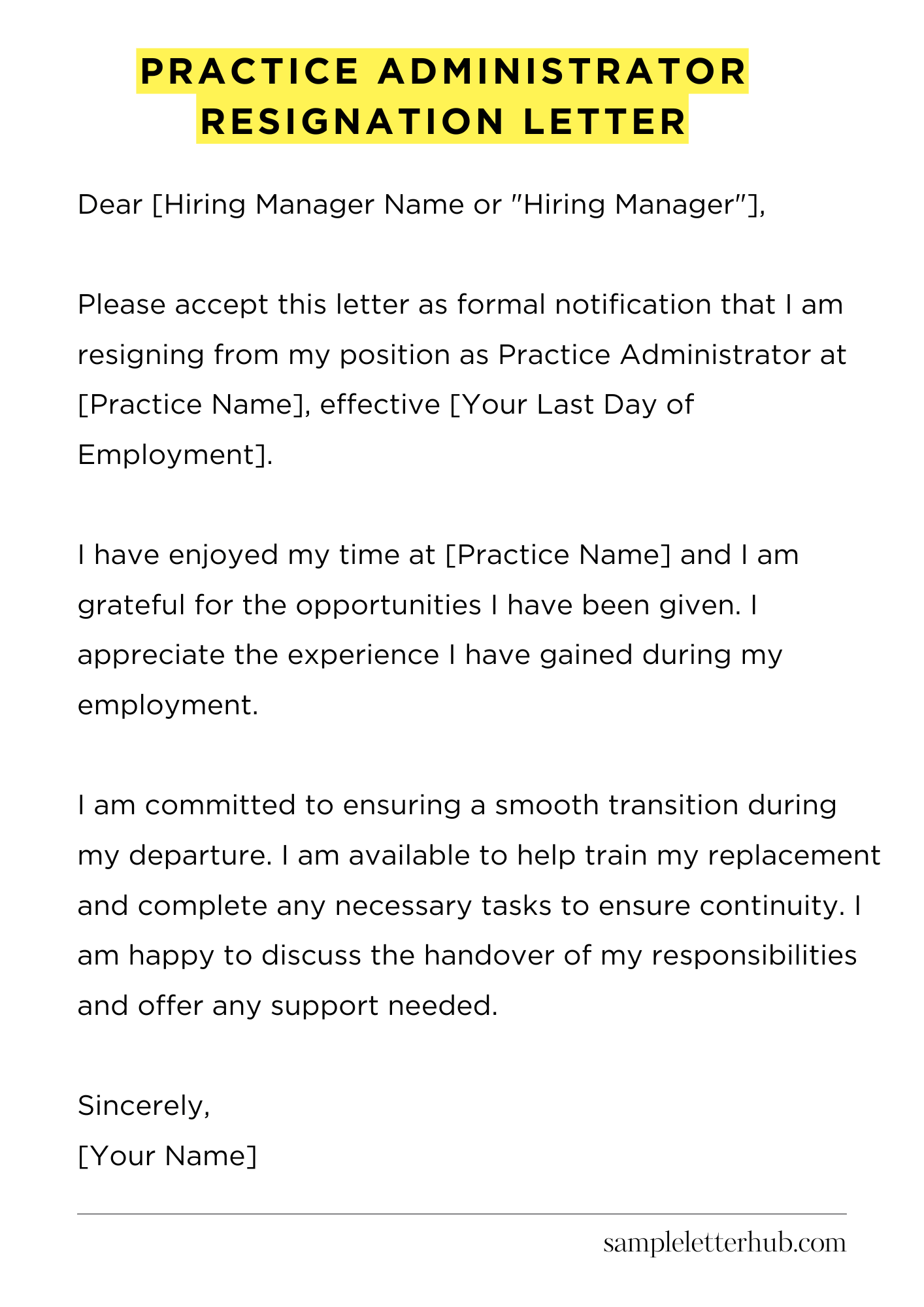
Dear [Hiring Manager Name or “Hiring Manager”],
Please accept this letter as formal notification that I am resigning from my position as Practice Administrator at [Practice Name], effective [Your Last Day of Employment].
I have enjoyed my time at [Practice Name] and I am grateful for the opportunities I have been given. I appreciate the experience I have gained during my employment.
I am committed to ensuring a smooth transition during my departure. I am available to help train my replacement and complete any necessary tasks to ensure continuity. I am happy to discuss the handover of my responsibilities and offer any support needed.
Thank you for your understanding. I wish you and [Practice Name] all the best in the future.
Sincerely,
[Your Name]
How to Write a Practice Administrator Resignation Letter
1. Getting Started: The Basics You Can’t Skip
Resigning from any job can be tricky. It’s especially sensitive when you’re a Practice Administrator. You’re likely involved in a lot of important things.
So, let’s get you set up to write your resignation letter. It is a formal communication, so make sure your tone is professional. You need to include your name, address, the date, and the recipient’s information. Double-check the formatting. You want it to look polished.
This shows respect for your employer and will help ensure a smooth transition. That’s always the goal, isn’t it?
2. The Core: State Your Intent and Date
This is where the rubber meets the road. The first key element is clearly stating that you are resigning from your position. Be direct and unambiguous. Avoid any flowery language or ambiguity.
Follow this with your last day of employment. Make sure this date aligns with your employment contract or any company policies regarding notice periods. Common practice is to give at least two weeks’ notice.
For example, you might write: “Please accept this letter as formal notification that I am resigning from my position as Practice Administrator, effective [Your Last Day of Employment].” Remember, clarity is your friend here.
3. Showing Gratitude and Offering Support
Even if you’re leaving, a little gratitude goes a long way. Briefly express your appreciation for the opportunity you had. Maybe mention a specific experience or skill you gained while working there.
Next, offer to help with the transition. This demonstrates professionalism and helps leave a positive impression. You could offer to train your replacement or assist in any handover tasks.
For instance: “I am grateful for the opportunities I have been given during my time here. I am also happy to assist in the transition process in any way I can.”
4. Keeping it Concise: Avoid Over-Sharing
Resignation letters aren’t the place to air grievances or get into lengthy explanations about why you’re leaving. Keep it focused on the essential information.
Short and sweet is the name of the game. Unless specifically requested, you don’t need to go into the details of your next role or why you decided to move on.
Avoid negativity. The goal is to leave on a good note. Save the in-depth discussions for an exit interview, if you choose to have one.
5. Proofreading and Final Touches: Ensuring Perfection
This is perhaps the most critical step. Proofread your entire letter carefully. Check for any typos, grammatical errors, and ensure the formatting is perfect. A poorly written letter undermines your professionalism.
Have someone else review it too. A fresh pair of eyes can often catch mistakes you might miss. It is always helpful.
Sign the letter and keep a copy for your records. Finally, deliver the letter in the manner requested by your employer (usually in person or by email). You’re all set!
FAQs about Practice Administrator Resignation Letter
What is the primary purpose of a Practice Administrator resignation letter?
The primary purpose of a Practice Administrator resignation letter is to formally notify the employer (typically the managing partners, board of directors, or owner) of the employee’s intent to leave their position.
This document serves as an official record of the resignation, the effective date of departure, and, often, a brief explanation or acknowledgment of the situation. It initiates the process of transition and allows the practice to begin planning for the replacement of the departing administrator.
What essential information should be included in a Practice Administrator resignation letter?
A well-crafted resignation letter should include: a clear and direct statement of resignation; the specific job title (Practice Administrator); the effective date of resignation (last day of employment); a formal closing (e.g., “Sincerely,” or “Respectfully,”); the administrator’s printed name; and the administrator’s signature.
Optional, but frequently included, are a brief expression of gratitude for the opportunity to work at the practice and/or a willingness to assist with the transition process.
How much notice should a Practice Administrator give when resigning?
The standard notice period for a Practice Administrator is usually two to four weeks, although this can vary depending on the employment contract, company policy, and the complexity of the role.
Reviewing the employment agreement is crucial to determine the required notice period. Providing more notice than required, if feasible, can often be beneficial for a smoother transition.
Should a Practice Administrator include a reason for resigning in the letter?
While not strictly required, a Practice Administrator may choose to include a brief, professional reason for resigning in the letter. This could be a statement such as “to pursue other opportunities,” “for personal reasons,” or “to relocate.”
It is generally recommended to keep the explanation brief and positive, avoiding negative comments about the practice or its employees. Detail of the reason for resignation can be provided later in a face-to-face conversation if the administrator chooses.
What is the appropriate tone and format for a Practice Administrator resignation letter?
The tone of a resignation letter should be professional, respectful, and courteous. The language should be clear, concise, and avoid any emotional language or negative comments.
The format should be a standard business letter format, including the date, the recipient’s name and title, the practice’s name, and the administrator’s contact information. Proofreading the letter for any spelling or grammatical errors is crucial before sending the letter.
Related:
Resignation letter due to rude boss
Resignation letter moving to another state
Resignation letter due to illness of family member
Resignation letter due to study