

Do you need to update a policyholder’s signature? A Policyholder Signature Update Request Letter is the official document. Insurance companies use it. They use it to update their records. The letter gets the necessary signature. This makes sure the policy information is correct. It helps maintain the policy.
Writing these letters can seem like a headache. But it doesn’t have to be. We are here to help you get the ball rolling. This article provides helpful letter templates. You will find examples and samples of these letters here. It simplifies the process for you. Policyholder Signature Update Request Letter samples are now at your fingertips!
Need to get it done fast and efficiently? Consider our templates. Find the perfect signature update request letter for your needs. We’ve got you covered! You can customize these samples. Easily create your own Policyholder Signature Update Request Letter.
[Your Name/Company Name]
[Your Address]
[Your City, Postal Code]
[Your Email]
[Your Phone Number]
[Date]
[Policyholder Name]
[Policyholder Address]
[Policyholder City, Postal Code]
Subject: Important: Request to Update Signature on File for Your Policy
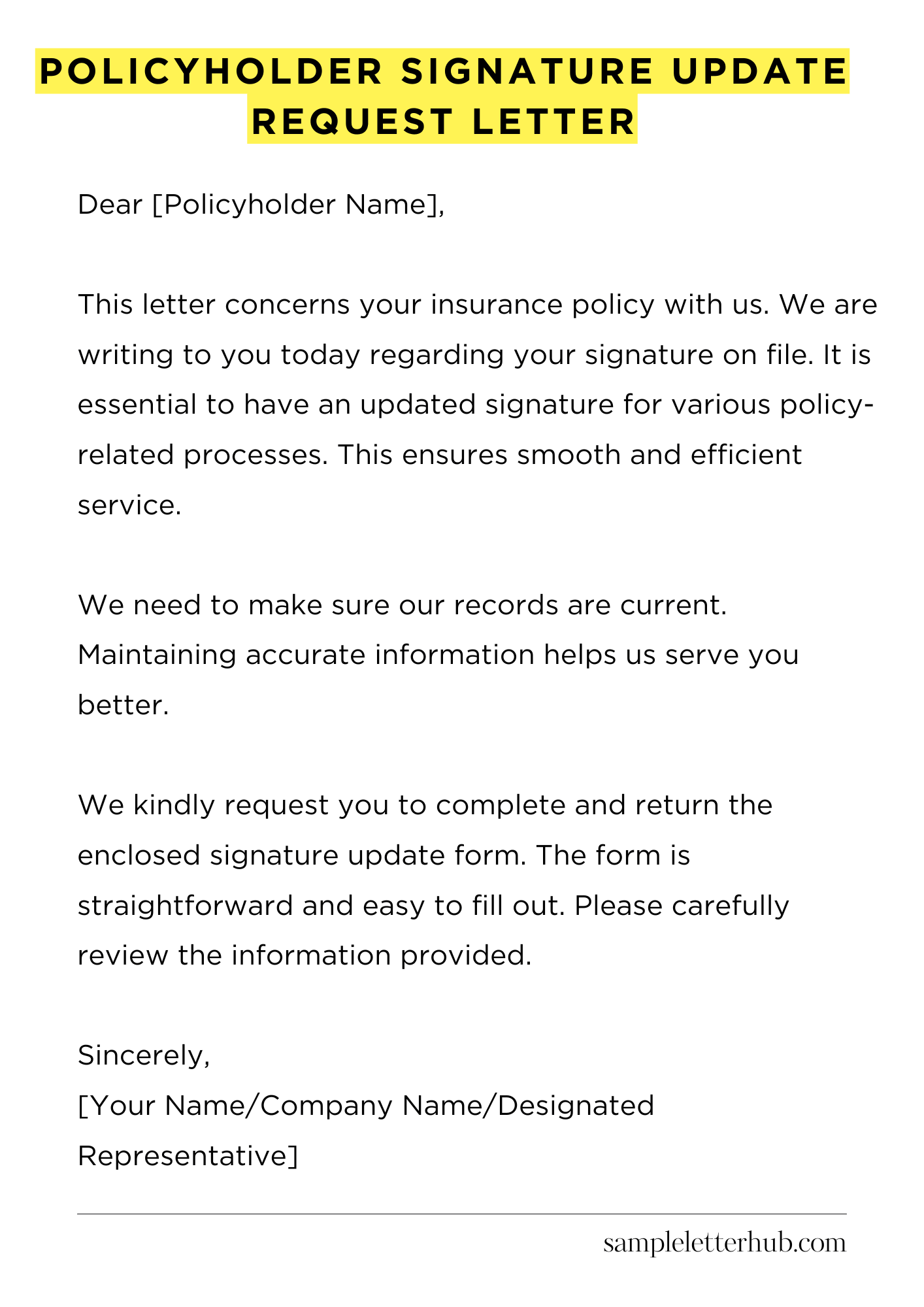
Dear [Policyholder Name],
This letter concerns your insurance policy with us. We are writing to you today regarding your signature on file. It is essential to have an updated signature for various policy-related processes. This ensures smooth and efficient service.
We need to make sure our records are current. Maintaining accurate information helps us serve you better. This update is a standard practice that assists in preventing any possible delays in the future.
We kindly request you to complete and return the enclosed signature update form. The form is straightforward and easy to fill out. Please carefully review the information provided.
Simply sign the form where indicated. Then, please date it. You can return the completed form in the pre-addressed, postage-paid envelope. We have made it as convenient as possible for you.
If you have any questions or require assistance, please do not hesitate to contact us. Our customer service team is ready to help you. You can reach us at [Phone Number] or reply to this email. We are committed to providing you with excellent service.
Thank you for your cooperation in this matter. We appreciate your prompt attention to this important request. We look forward to receiving your updated signature soon.
Sincerely,
[Your Name/Company Name/Designated Representative]
How to Write Policyholder Signature Update Request Letter
A policyholder signature update request letter is a critical instrument in insurance correspondence. It facilitates the seamless modification of signature records, ensuring legal compliance and operational efficacy. Following these directives will enable you to craft a letter that is both perspicuous and action-oriented.
1. Header Section: Setting the Stage
The header forms the epistolary foundation. Begin by situating your company’s letterhead at the top. This includes your business’s legal name, address, phone number, and any relevant branding elements.
Below this, on the left, include the date the missive is being dispatched. On the right, position the policyholder’s full name and current address. Precision here is paramount; any discrepancies can impede the process.
2. Salutation: A Polished Commencement
A cordial salutation can set a positive tone. Employ a formal salutation like “Dear [Policyholder’s Name],” Avoid casual greetings. If the recipient is unknown, use “To Whom It May Concern.” Make sure to personalize it whenever possible; it demonstrates an extra degree of care.
3. Subject Line: Clarity in a Nutshell
The subject line must be explicit. Use a concise phrase like “Policyholder Signature Update Request.” This immediately signals the letter’s purpose, enabling efficient processing by the recipient. A succinct, yet impactful subject line is essential.
4. Body: Detailing the Directive
The body is where you present your request. First, formally identify the policy number involved. Then, clearly state the need for a signature update. Detail the reason for the update. This may be due to a change in the policyholder’s name, a clerical error, or a need for a more recent signature for legal purposes.
Clearly articulate any actions required from the policyholder, like signing and returning a specific form or providing a new signature. Provide a precise deadline for response. This fosters a sense of urgency without being unduly oppressive.
5. Documentation and Forms: The Necessary Appendices
If applicable, incorporate any forms or documentation that the policyholder needs. Ensure each document is easily accessible. Include clear instructions on how to fill them out. Mention all the required information in advance. Provide self-addressed, stamped envelopes for expeditious return. This demonstrates an unwavering commitment to convenience.
6. Closing: Courtesy and Confirmation
End the letter with a polite closing, such as “Sincerely,” or “Respectfully,” followed by your full name and title. Include your contact information—phone number, email address—so that the policyholder can readily reach you with any queries. Reiterate your commitment to assisting them, affirming your dedication to a seamless procedure.
7. Review and Dispatch: Ensuring Immaculate Execution
Before mailing, rigorously review the entire letter. Verify the accuracy of all details – the policy number, names, addresses, and dates. Ensure all enclosures are included. Proofread for grammatical errors and typographical blunders. After final approval, make a copy for your records.
Then, dispatch the letter via certified mail with a return receipt requested. This provides proof of delivery and ensures a secure transaction. This is the final and crucial step, leading to the successful completion of the signature update process.
FAQs about Policyholder Signature Update Request Letter
Why is a Policyholder Signature Update Request Letter necessary?
A Policyholder Signature Update Request Letter is necessary to ensure that the insurance company has the most current and valid signature on file for a policyholder.
This is crucial for various reasons, including processing claims, making policy changes, and preventing potential fraud. Outdated signatures can lead to delays or rejection of important requests related to the insurance policy.
What information is typically included in a Policyholder Signature Update Request Letter?
A typical Policyholder Signature Update Request Letter usually includes the policyholder’s full name, policy number, current mailing address, and the specific reason for the signature update (e.g., outdated signature, change of name).
The letter will also contain instructions on how to provide the new signature, which often involves signing a provided form or document and returning it to the insurance company. Sometimes, the letter may also include a deadline by which the updated signature needs to be received.
What happens if a policyholder doesn’t respond to a Signature Update Request Letter?
If a policyholder does not respond to a Signature Update Request Letter, the insurance company may be unable to process certain requests, such as policy changes or claim submissions.
This could potentially lead to delays in claim payments or difficulties in making updates to the policy. In some cases, if the signature is critical for policy validation, the insurance company might take further action, like suspending certain policy features or requesting further proof of identity.
How do I know if the Signature Update Request Letter is legitimate?
To verify the legitimacy of a Signature Update Request Letter, you can take a few steps. First, check the sender’s contact information against the information you already have for your insurance provider. Contact your insurance company directly using a known phone number or email address to confirm if they sent the letter.
Do not use contact information provided in the suspicious letter. Also, be wary of any requests for sensitive information like bank account details or social security numbers, as these could be signs of a phishing attempt.
What are the legal implications of not updating the signature on file?
The legal implications of not updating your signature on file vary based on the specific insurance policy and state regulations. If your signature on file is not up to date, it could hinder your ability to legally make changes to the policy, such as naming a beneficiary or transferring ownership.
It could also cause issues if a dispute arises, as the insurance company may require a valid signature for all policy-related actions. In certain cases of fraud or identity theft, an outdated signature could make the policyholder more vulnerable to financial losses.
Related:
Resignation letter due to rude boss
Resignation letter moving to another state
Resignation letter due to illness of family member
Resignation letter due to study
Resignation letter due to long commute