

A Policyholder Information Update Request Letter is a formal document. It is sent by an insurance company. The purpose is to collect updated policyholder information. This helps keep records accurate. It ensures smooth communication. It also helps in claim processing.
Want to update your insurance policy details? Writing the perfect Policyholder Information Update Request Letter can be tricky. Don’t worry, we’ve got you covered. We’ll share several templates. We’ll provide helpful examples. These sample letters will make the process easy.
Our goal? To simplify your life. Crafting a professional policy update request will be a breeze. You’ll have various options. Choose the best letter for your needs. Quickly and easily update your insurance policy.
[Your Name/Company Name]
[Your Address]
[Your City, Postal Code]
[Your Email]
[Your Phone Number]
[Date]
[Policyholder Name]
[Policyholder Address]
[Policyholder City, Postal Code]
Subject: Important Information Update for Your Insurance Policy
Dear [Policyholder Name],
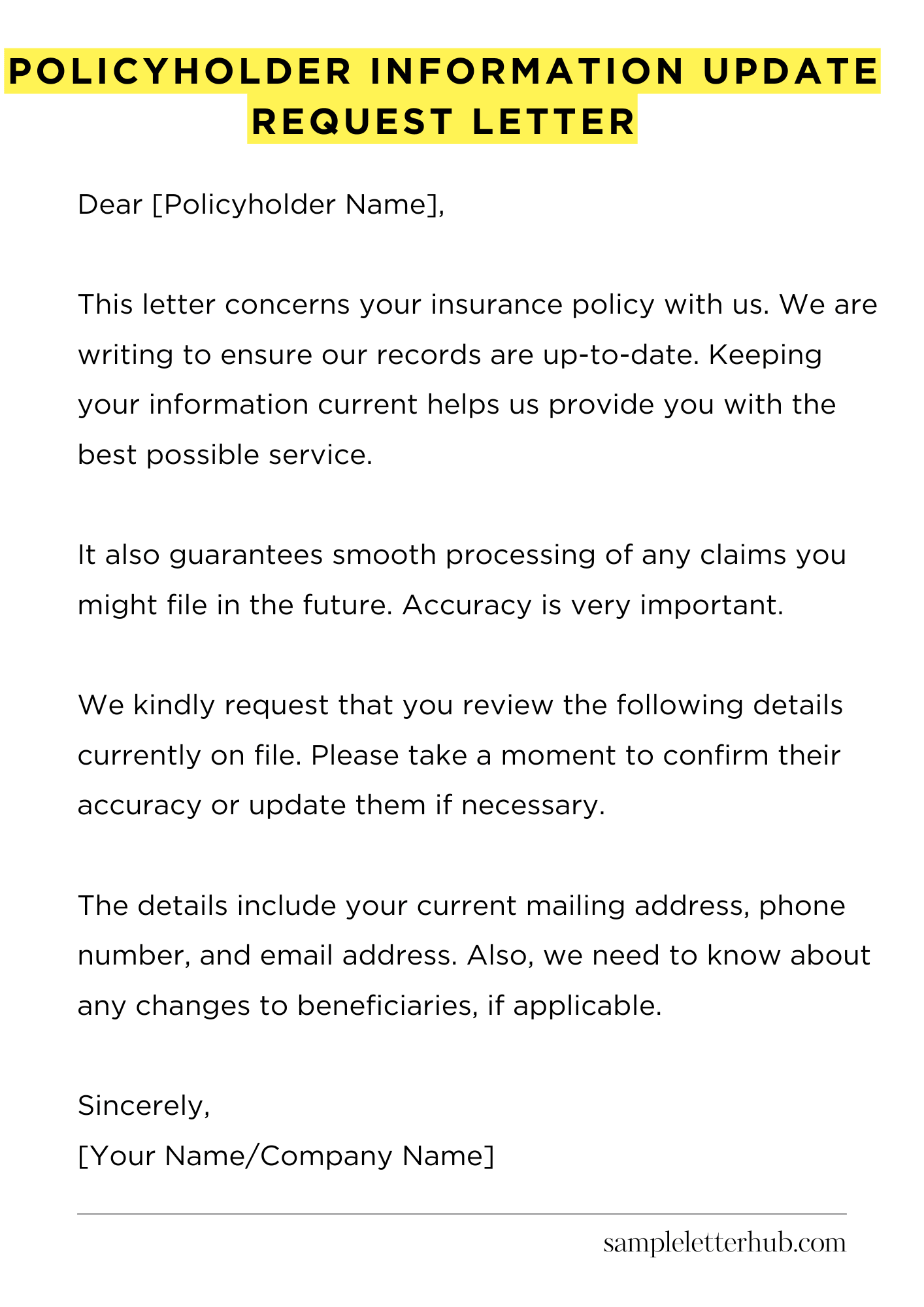
This letter concerns your insurance policy with us. We are writing to ensure our records are up-to-date. Keeping your information current helps us provide you with the best possible service.
It also guarantees smooth processing of any claims you might file in the future. Accuracy is very important.
We kindly request that you review the following details currently on file. Please take a moment to confirm their accuracy or update them if necessary. The details include your current mailing address, phone number, and email address. Also, we need to know about any changes to beneficiaries, if applicable. Your beneficiaries must always be up to date.
You can easily update this information. There are several convenient options available. You can either visit our website at [Website Address] and use our secure online portal. Alternatively, you can call us directly at [Phone Number] and speak with a customer service representative.
We have also enclosed a pre-addressed, postage-paid envelope. You can use it to return the completed form attached to this letter. The attached form is very easy to use.
We understand that things change. Therefore, it is important to keep your records current. Please submit your updated information by [Date]. This will help us avoid any potential delays in the future.
If we do not hear from you by the stated date, we will attempt to contact you by phone to confirm your information. This is to ensure we remain compliant with all current regulations.
Thank you for your prompt attention to this matter. We appreciate you choosing us as your insurance provider. We value your business and are here to help you.
Sincerely,
[Your Name/Company Name]
How to Write Policyholder Information Update Request Letter
Updating policyholder information is a crucial administrative task. A well-crafted letter can ensure a seamless transition and minimize potential discrepancies. This guide will help you construct a compelling “Policyholder Information Update Request Letter” that gets results.
1. Preambular Considerations: Setting the Stage
Before you commence, ascertain the precise information requiring amendment. Are we dealing with an address modification, a name alteration, or perhaps a beneficiary designation review?
Compile all pertinent policy details, including the policy number, the full name of the policyholder, and the current mailing address. Proper preparation ensures expediency. This preliminary groundwork is paramount for a frictionless process.
2. The Salutation: A Formal Introduction
Commence your letter with a formal salutation. Employ “Dear [Insurance Company Name] Customer Service,” or if known, “Dear Mr./Ms./Mx. [Last Name].”
This establishes a professional tone from the outset. Avoid casual greetings; formality demonstrates respect and professionalism. A well-chosen salutation immediately signals the seriousness of your request.
3. The Introductory Clause: Clearly Stating Your Purpose
Immediately state the purpose of your letter: “This letter serves to formally request an update of my policyholder information.” Specify the policy number for unequivocal identification. This concise introduction should leave no room for ambiguity. Clarity is your ally in this endeavor.
4. Detailing the Necessary Amendments: Precision is Key
Provide a detailed, itemized list of the information needing adjustment. Include the current information (as it appears on the policy) alongside the new, corrected information.
For instance: “Current Address: 123 Main Street, Anytown, CA 91234; Updated Address: 456 Oak Avenue, Anytown, CA 91235.” Be meticulous; accuracy prevents future complications. Enclose supporting documentation, such as a copy of your driver’s license or a change-of-name certificate, if applicable. Thoroughness safeguards against delays.
5. The Closing Affirmation: Reinforcing Your Request
Conclude the body of your letter with a clear restatement of your request. For example: “I kindly request that you update my policy records with the information provided above.” Express gratitude for their time and consideration. A polite closing fosters goodwill. A well-articulated request leaves no doubt about your intentions.
6. The Complimentary Close and Signature: Professional Demeanor
Close your letter with a professional complimentary close, such as “Sincerely,” or “Respectfully,” followed by your full name. If you are submitting a physical letter, sign your name above your typed name.
If submitting electronically, your typed name is sufficient, though an electronic signature is also acceptable. Ensure your signature is legible. Proper closing formalities convey professionalism and respect.
7. Delivery and Follow-Up: Ensuring Successful Transmission
Send your letter via certified mail with a return receipt requested. This provides proof of delivery. If submitting electronically, retain a copy of the email with the date and time of transmission. After a reasonable period (typically 2-4 weeks), follow up with the insurance company to confirm the information has been updated.
Document all communication, including dates, times, and names of individuals you speak with. Diligent follow-up ensures accountability and prompt processing. This meticulous approach guarantees your request receives the attention it merits.
FAQs about Policyholder Information Update Request Letter
What is a Policyholder Information Update Request Letter?
A Policyholder Information Update Request Letter is a formal document sent by an insurance company or financial institution to a policyholder, requesting them to update their personal and/or contact information. This may include changes to address, phone number, email, beneficiary details, or other relevant data necessary for the policy management and communication.
Why is it necessary to update my information?
Updating your information is crucial for several reasons. It ensures you receive important policy-related communications, such as renewal notices, claim information, and policy updates. It also helps your insurer contact you in case of emergencies and ensures the accuracy of your policy details, which can impact the processing of claims and other services.
What information typically needs to be updated?
The information typically requested for update includes your current mailing address, phone number, email address, and any changes to your beneficiary designations. Depending on the policy, other details such as marital status, name changes, or changes in employment might also be included. Always review the specific request letter for a comprehensive list.
How do I respond to a Policyholder Information Update Request Letter?
The response process varies. Often, the letter will include a pre-addressed, postage-paid envelope. You may be asked to complete and return an enclosed form, or you may be able to update your information online through a provided link or by contacting customer service directly. Always follow the instructions provided in the letter.
What happens if I don’t update my information?
Failing to update your information could lead to several issues. You may miss important communications from your insurer, such as policy renewals or claim notifications. Incorrect contact information can also delay or complicate the processing of claims or other policy-related actions. Furthermore, it might invalidate the policy or result in penalties.
Related:
Resignation letter due to rude boss
Resignation letter moving to another state
Resignation letter due to illness of family member
Resignation letter due to study
Resignation letter due to long commute