

A policy renewal request letter after grace period is a formal document. It asks an insurance company to reinstate a lapsed policy. This happens when a policyholder misses their payment deadline. The letter explains the situation and requests a second chance. Its main purpose is to prevent policy cancellation and maintain coverage.
Need to draft a policy renewal request but unsure where to start? We’ve got you covered! This article provides several sample policy renewal request letters after grace period. We offer ready-to-use templates for various scenarios. You can easily adapt these examples to fit your specific needs.
We aim to simplify your letter writing process. Browse through our policy renewal letter examples. You’ll find different formats and wording options. Choose the best template for your insurance renewal situation. Get back on track with your coverage quickly!
[Your Name/Company Name]
[Your Address]
[Your Phone Number]
[Your Email Address]
[Date]
[Insurance Company Name]
[Insurance Company Address]
Subject: Policy Renewal Request – Policy Number [Your Policy Number]
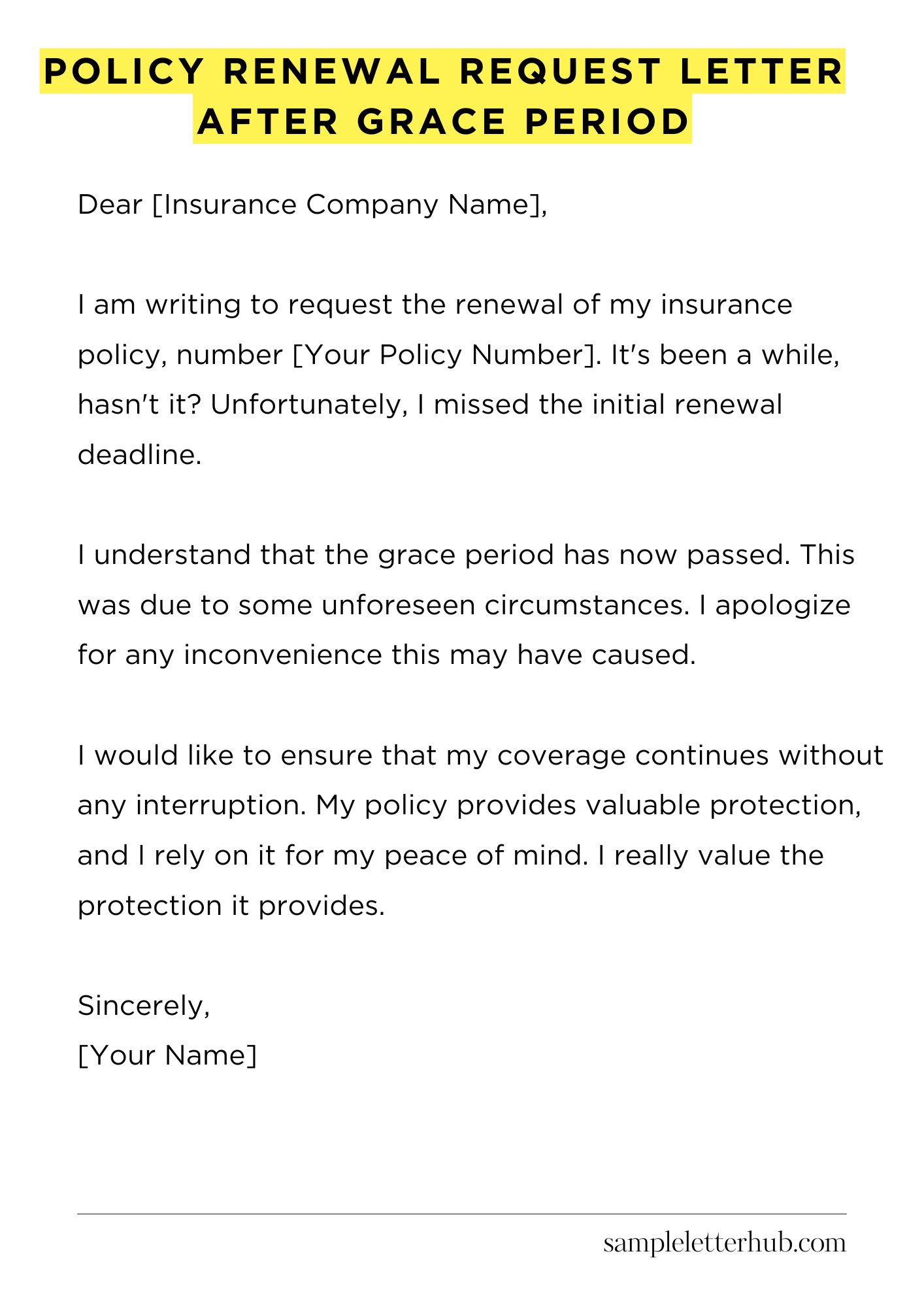
Dear [Insurance Company Name],
I am writing to request the renewal of my insurance policy, number [Your Policy Number]. It’s been a while, hasn’t it? Unfortunately, I missed the initial renewal deadline.
I understand that the grace period has now passed. This was due to some unforeseen circumstances. I apologize for any inconvenience this may have caused.
I would like to ensure that my coverage continues without any interruption. My policy provides valuable protection, and I rely on it for my peace of mind. I really value the protection it provides.
Could you please provide me with the necessary steps and any potential reinstatement requirements? I’m eager to get this resolved as quickly as possible. Please let me know if there are any outstanding premiums or fees. I am ready to take care of it immediately.
I am available to discuss this further at your earliest convenience. You can reach me by phone or email, and I look forward to hearing from you.
Thank you for your time and understanding in this matter. I very much appreciate your assistance.
Sincerely,
[Your Name]
How to Write Policy Renewal Request Letter After Grace Period
Life throws curveballs. Sometimes, these curveballs lead us to miss deadlines, including the all-important policy renewal. If you find yourself in this situation, don’t despair. You can write a compelling policy renewal request letter, even after the grace period has elapsed. Here’s a structured approach:
1. Commence with a Salutation and Identification
Begin by addressing the recipient formally. “Dear [Insurance Company Name] Renewal Department” is a safe bet. Immediately state your intention: “This letter constitutes a formal request for policy renewal for policy number [Your Policy Number].” Clearly, and unequivocally, identify the policy you’re aiming to reinstate. Precision is paramount here.
2. Articulate the Circumstances of Non-Renewal
This is where you tell your story, but keep it concise and factual. Briefly explain why you missed the renewal deadline. Were there extenuating circumstances? Did you suffer a bout of illness, experience a financial encumbrance, or perhaps a simple oversight? Whatever the case, be candid without being overly verbose.
Avoid embellishments; a straightforward explanation often suffices. For example: “Due to a recent unforeseen hospitalization, I was unable to submit the renewal payment within the stipulated timeframe.”
3. Emphasize Continued Coverage Importance
Now, underscore the significance of the policy to you. Highlight the reasons you value continued coverage. Is it your health insurance, vehicle insurance, or perhaps a property policy?
Remind them of your history, showcasing your reliability. For example, “I have been a loyal customer of [Insurance Company Name] for [Number] years and have consistently maintained a clean record without any claims.” The aim is to demonstrate you’re a valuable client who merits consideration.
4. Submit a Concrete Renewal Payment
The cardinal rule: Include the payment with the letter if at all feasible. This demonstrates your earnest intent and expedites the renewal process. If you can pay the full premium, that is best. Enclose a check, money order, or a pre-authorized payment form. Make the renewal process straightforward for them. A preemptive action is always a plus.
5. Furnish Supportive Documentation (if needed)
Depending on the circumstances, consider including supporting documentation. This could include a doctor’s note, a financial statement, or any other proof relevant to the reason for the delay. This enhances your credibility and bolsters your request. Proof can go a long way.
6. Express Gratitude and Reiterate Your Request
Conclude with a polite and professional closing. Express your gratitude for their time and consideration. Explicitly reiterate your request for policy renewal.
A courteous tone increases the likelihood of a positive response. For example: “Thank you for considering my request. I earnestly hope you will grant the renewal of my policy. I have enclosed the full premium payment and supporting documentation.”
7. Include Contact Information and Signature
Provide your full name, address, phone number, and email address. Ensure you sign the letter with your handwritten signature. This leaves no doubt about your identity and facilitates easy communication. This final touch adds a sense of legitimacy and makes the process more organized.
FAQs about Policy Renewal Request Letter After Grace Period
What is the purpose of a policy renewal request letter after the grace period?
The primary purpose of a policy renewal request letter after the grace period is to formally communicate to the insurance provider the policyholder’s desire to reinstate their policy.
This letter serves as a crucial document, especially if the policy has lapsed due to non-payment within the standard grace period. It aims to persuade the insurer to consider the renewal despite the delay and outlines the reasons for the late payment, along with a request to reactivate the coverage.
What information should be included in a policy renewal request letter after the grace period?
A comprehensive policy renewal request letter should include the policyholder’s full name, policy number, and contact information. It must clearly state the request for policy renewal, acknowledging the lapse due to exceeding the grace period.
Furthermore, it should explain the reason for the late payment, provide proof of payment (if applicable), and any other supporting documentation that validates the circumstances. It is important to also express a willingness to fulfill any additional requirements the insurer might have.
What are the possible consequences if the renewal request is denied?
If the insurance provider denies the renewal request, the policyholder will lose coverage. This means they will no longer be protected against the risks the policy was designed to cover.
Depending on the type of policy, this could lead to financial losses due to unforeseen events. In some cases, if the policy is related to a legal requirement (like car insurance), a denial may have further ramifications such as fines or penalties.
How does the insurance company decide whether to accept a renewal request after the grace period?
The insurance company’s decision to accept a late renewal request is based on several factors. These often include the policyholder’s past payment history, the reason for the delay, and any applicable underwriting guidelines.
They might also consider the duration of the lapse, the type of policy, and the potential risk associated with reinstating coverage. The insurer will assess the situation and consider whether the policyholder presents an acceptable level of risk.
Is it possible to negotiate the terms of renewal after the grace period?
While the initial terms of the policy are typically set, it might be possible to negotiate some aspects of the renewal. However, the scope for negotiation often depends on the insurer’s policies and the specific circumstances of the late payment.
The policyholder could potentially negotiate a payment plan if back payments are due or, in specific situations, seek clarification on conditions for re-instatement. Any negotiation should be pursued proactively and documented in writing.
Related:
Resignation letter due to rude boss
Resignation letter moving to another state
Resignation letter due to illness of family member
Resignation letter due to study