

Moving to a new home? You’ll need to update your policy address. A policy address change letter after relocation is crucial. It informs your insurance company, bank, or other institutions about your new address. This ensures you continue receiving important documents and information.
Don’t worry about the writing process. We’ve got you covered. We’ll share policy address change letter templates. These are examples and samples you can adapt. They’re designed to simplify the whole thing. Writing a change of address letter becomes quick and easy.
Need a sample letter for address change? You’re in the right place! We’ll show you different formats. We want to make it effortless. You can customize them for your needs. This article makes your address change notification process a breeze.
[Your Name]
[Your Address – New]
[Your Phone Number]
[Your Email Address]
[Date]
[Insurance Company/Bank/Relevant Institution Name]
[Their Address]
Subject: Notification of Address Change
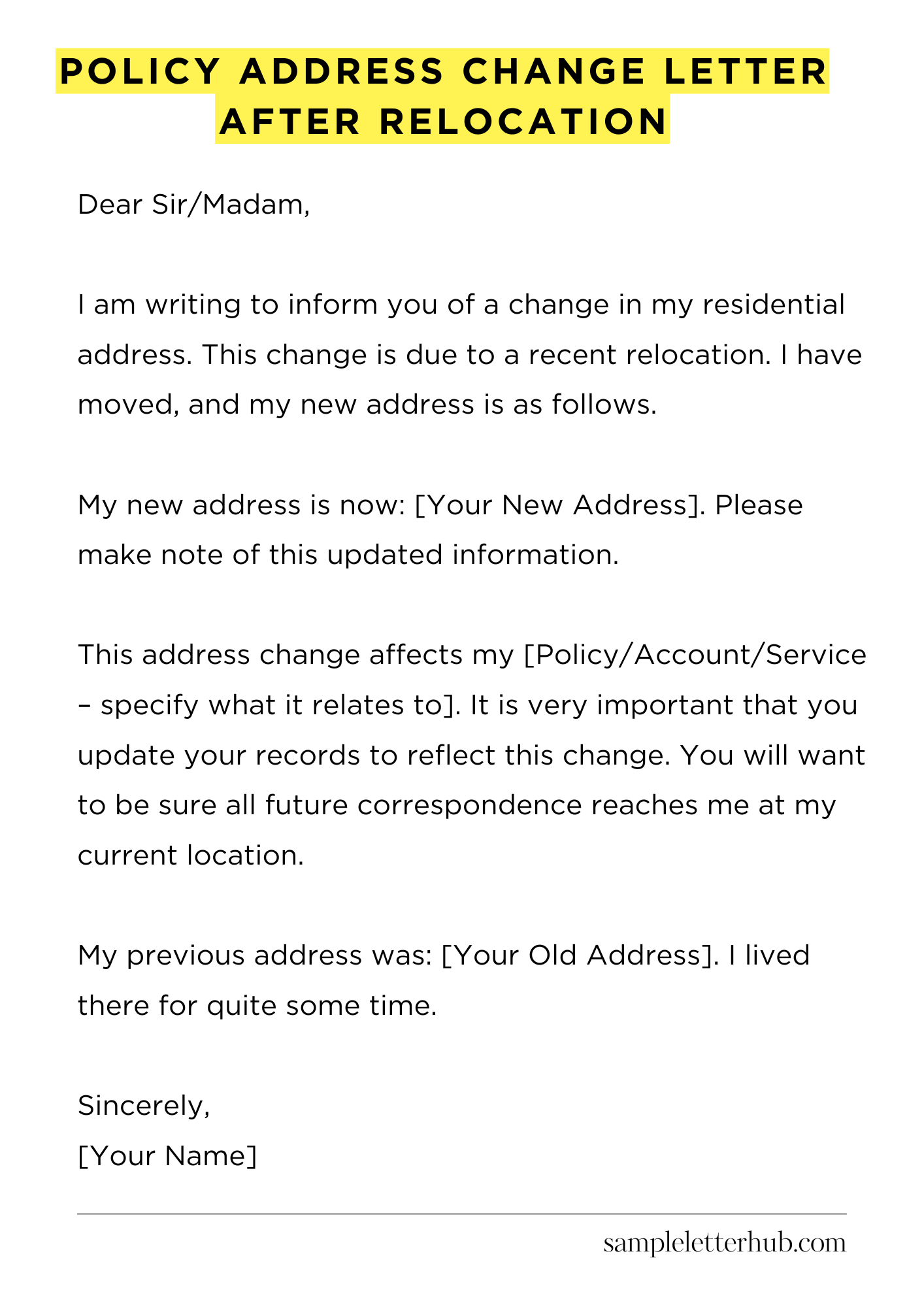
Dear Sir/Madam,
I am writing to inform you of a change in my residential address. This change is due to a recent relocation. I have moved, and my new address is as follows.
My new address is now: [Your New Address]. Please make note of this updated information.
This address change affects my [Policy/Account/Service – specify what it relates to]. It is very important that you update your records to reflect this change. You will want to be sure all future correspondence reaches me at my current location.
My previous address was: [Your Old Address]. I lived there for quite some time.
For verification purposes, my [Policy Number/Account Number/Relevant ID] is [Your Policy/Account/ID Number]. I want to ensure that all my details are correct. Please confirm the change.
Thank you for your prompt attention to this matter. I appreciate you making this important update.
Sincerely,
[Your Name]
How to Write Policy Address Change Letter After Relocation
Relocating is a multifaceted process, and amidst the chaos of packing and unpacking, updating your address across various policies can feel like a herculean task. However, neglecting this crucial step can lead to a plethora of inconveniences, from missed correspondence to potential lapses in coverage.
Fortunately, drafting a policy address change letter is a straightforward endeavor. Here’s a comprehensive guide to navigate this bureaucratic requirement with aplomb.
1. Identify the Policies Requiring Modification
Before you even begin to formulate the letter, conduct a thorough audit. Scrutinize your records – both physical and digital – to ascertain all the policies impacted by your relocation.
This typically encompasses insurance policies (home, auto, life), financial accounts (credit cards, loans, investments), subscriptions, and any other agreements where your residential address is specified. Compilation of this information is paramount; It provides a roadmap for the subsequent stages.
2. Gather Pertinent Information
Once you’ve cataloged your affected policies, collate the essential data. This includes your policy numbers, the names of the issuing companies, your old address, your new address, and the effective date of the change.
Having this information readily available will expedite the writing process and minimize the chances of errors. Additionally, ascertain the preferred method of communication for each policy – some companies might favour email, while others mandate postal mail.
3. Craft a Concise and Polished Salutation
The salutation sets the tone for your communication. If addressing an individual, use a formal greeting like “Dear [Recipient’s Name].” If you’re unsure of the recipient, “To Whom It May Concern” is a safe and professional choice. Remember, the initial impression matters; A well-crafted salutation underscores your attention to detail.
4. Articulate the Purpose of Your Correspondence
The opening paragraph should immediately state the purpose of your letter: to formally notify the company of your address change. Clearly reference the policy numbers to allow for expeditious processing. Be transparent and straightforward in your intent. Keep it short and easy for them to understand. This is where your message becomes crystal clear.
5. Present Your Updated Address Details with Precision
Provide your new address in an organized and unequivocal manner. Include the street address, apartment or unit number (if applicable), city, state, and zip code. This ensures accurate and timely delivery of future correspondence. Moreover, provide the effective date for the change, to avoid confusion. Accuracy and clarity are indispensable here.
6. Include Supporting Information, if Needed
Depending on the policy, you might be required to include supporting documentation. For example, if you’re updating your address on a driver’s license, you might need to furnish a copy of your new lease agreement or utility bill.
If in doubt, review the company’s guidelines or contact their customer service to determine what documentation, if any, is needed. Anticipate any needs upfront, thereby streamlining the process.
7. Conclude with a Professional Closing and Contact Details
Conclude your letter with a formal closing, such as “Sincerely,” or “Respectfully,” followed by your full name and signature (if sending a physical letter). Include your phone number and email address, so the company can contact you if they have any questions or require further information.
Always proofread your letter before sending it to ensure accuracy and professionalism. A well-executed conclusion reinforces the impression you’ve made.
FAQs about Policy Address Change Letter After Relocation
What is a policy address change letter after relocation, and why is it important?
A policy address change letter is a formal notification sent to insurance companies, financial institutions, or other entities to update your mailing address following a move.
It’s crucial because it ensures you continue to receive important documents like policy updates, bills, statements, and other vital communications related to your policies or accounts. Failure to update your address could result in missed notifications, late payments, or even policy cancellations.
What information should be included in a policy address change letter?
A comprehensive policy address change letter should include your full name, old address, new address, policy or account numbers (if applicable), the type of policy or account (e.g., auto insurance, credit card), the date of the move, and your signature. It’s also helpful to include your phone number and email address for easier contact and verification by the recipient.
How do I submit a policy address change letter, and what are the accepted methods?
Policy address change letters can typically be submitted through various methods. These include mailing a physical letter to the address provided by the policy provider, submitting the change online through the company’s website or portal (if available), emailing a scanned copy of the letter to a designated email address, or calling the customer service line to request the change.
Always confirm the accepted methods with the specific company or institution.
When should I send a policy address change letter after relocating?
It’s best practice to send a policy address change letter as soon as possible after moving. This helps prevent delays in receiving important mail.
Ideally, you should notify all relevant institutions before or immediately after you settle into your new residence. Prompt notification ensures continuous access to essential information and avoids potential disruptions to your policies or accounts.
What happens if I don’t update my address with my policy providers?
Failing to update your address can have several negative consequences. You might miss important communications, leading to late payments, penalties, or even policy cancellations. You could also fail to receive essential updates about your policies, such as changes to coverage or renewal notices. Moreover, if your mail is sent to the wrong address, you might be at risk of identity theft or fraud.
Related:
Resignation letter due to rude boss
Resignation letter moving to another state
Resignation letter due to illness of family member
Resignation letter due to study
Resignation letter due to long commute