

A police resignation letter is a formal document. It informs the police department of your intention to leave. Its purpose is to officially end your employment. It allows a smooth transition.
This can be a tough process. We want to help make it easier. We will share several templates. We’ve got you covered with examples. Find the perfect starting point.
Writing this letter doesn’t have to be hard. We’ll give you different samples. You can personalize them. Make it your own. Get started today.
Police Resignation Letter
Below is a sample of a Police Resignation Letter:
[Your Name]
[Your Address]
[Your Phone Number]
[Your Email Address]
[Date]
[Recipient’s Name]
[Recipient’s Title]
[Police Department Name]
[Police Department Address]
Dear [Recipient’s Name],
Please accept this letter as formal notification that I am resigning from my position as a police officer with the [Police Department Name], effective [Your Last Day of Employment].
I am grateful for the opportunities and experiences I have gained during my time with the department. I appreciate the support and training I have received.
I will ensure all my outstanding duties are completed before my departure. I will also cooperate fully in the handover process to ensure a smooth transition.
Thank you for your understanding. I wish the department continued success in the future.
Sincerely,
[Your Signature]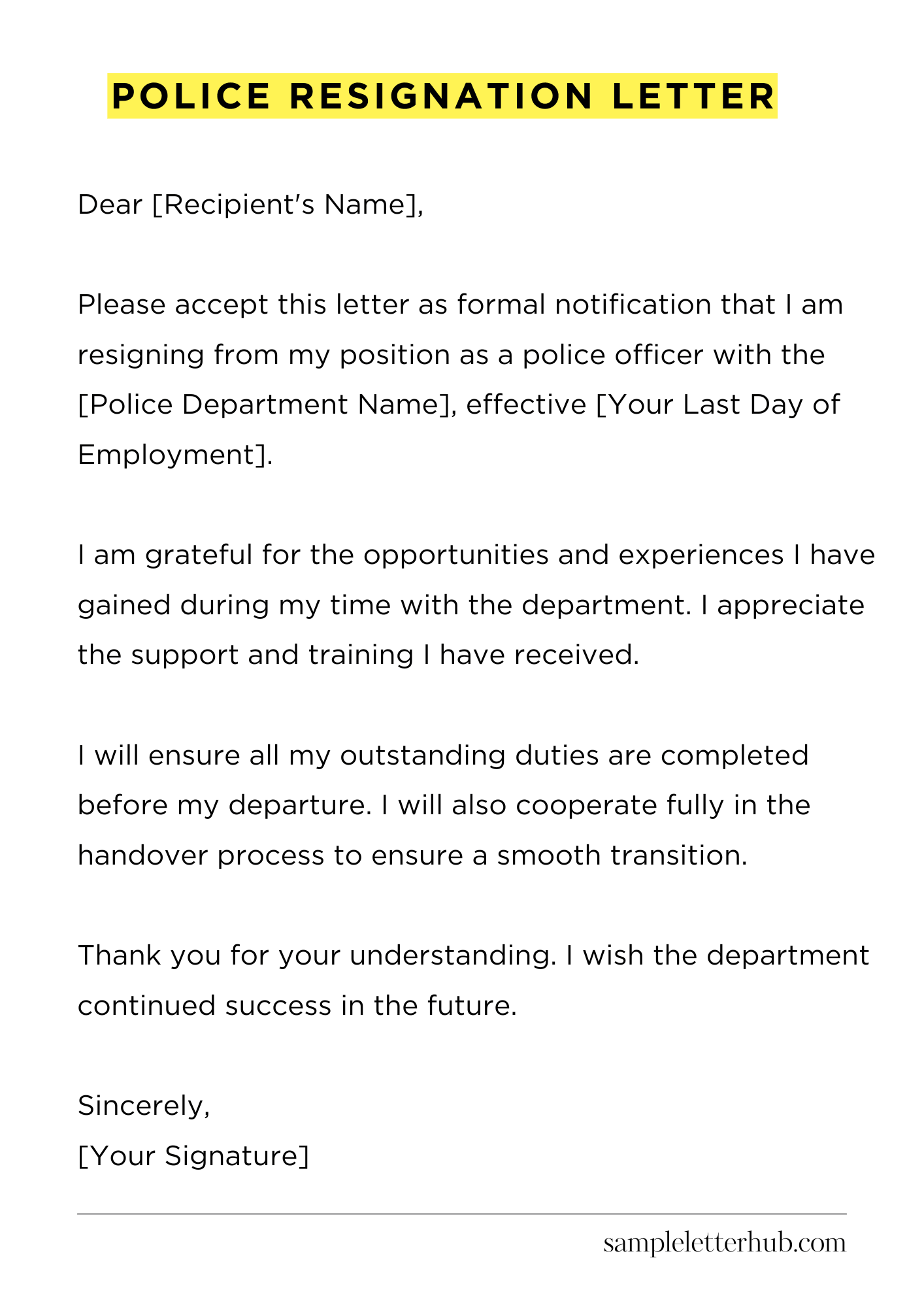
How to Write a Police Resignation Letter
Leaving the police force is a significant decision. You’ve served your community, faced challenges, and likely formed strong bonds. But when the time comes to move on, crafting a professional resignation letter is essential. This document serves as your official notice and helps ensure a smooth transition. Getting this right is critical.
1. Start with Clarity and Respect
Your letter should begin by clearly stating your intent: to resign from your position as a police officer. Keep it concise. Start with a straightforward statement. Always be respectful. Address your letter to the appropriate authority, usually your Chief of Police or a similar high-ranking officer. This shows professionalism. Mention the effective date of your resignation.
For example, you could start with: “Please accept this letter as formal notification that I am resigning from my position as Police Officer, effective [Date].” Simple and direct, yet conveys your message clearly. Avoid any ambiguity.
2. Include a Brief Statement of Gratitude
Even if your departure is for personal reasons or you’ve experienced difficulties, expressing gratitude is beneficial. Acknowledge your time served. Mention any positive experiences or opportunities you appreciated. You don’t need to write a lengthy tribute, but a few well-chosen words can make a good impression.
You might write: “I am grateful for the opportunities I’ve had during my [Number] years of service with the [Police Department Name]. I appreciate the training and experiences I have gained.” Remember, you are building bridges, not burning them.
3. Address the Logistics of Your Departure
This section is practical. It’s important to provide information to help with the transition. Mention any outstanding uniform or equipment that needs to be returned. You should also offer to assist with the handover process. Be willing to help train your replacement, if asked.
A typical line might read: “I am available to assist with the handover process and will ensure all department-issued equipment is returned by my last day.” Being helpful and professional will reflect well on you. Include your contact information for future correspondence. State that you would be happy to have any conversation in future.
4. Keep it Concise and Professional
Lengthy explanations or negative comments about your experience are generally best avoided in a resignation letter. This is not the place to air grievances. Stick to the essentials: your intention to resign, gratitude, and willingness to assist with the transition. Use formal language. Avoid slang or overly casual terms.
Proofread carefully. Check for any grammatical errors or typos. A polished letter demonstrates respect for the department and your professionalism. Keeping it concise and simple is the most effective approach.
5. Proofread and Submit Appropriately
Before submitting, always proofread. Read the entire letter aloud. Ask a friend or colleague to review it as well. Once you are satisfied with the final version, make a copy for your records. Submit the letter according to department policy. This might involve handing it directly to your superior, or going through a specific channel.
Follow all instructions. Sending it via certified mail can provide proof of delivery. This is your final chance to showcase your commitment to professionalism. Following these guidelines ensures you leave the force with a positive and respectful impression, even as you move forward. Your future depends on your conduct now.
FAQs about Police resignation letter
How do I write a police resignation letter?
A police resignation letter should be formal and concise. Begin by clearly stating your intention to resign and your last day of employment. Include your name, rank, and badge number.
Express gratitude for the opportunity to serve, and maintain a professional tone throughout. You may optionally include a brief reason for your resignation, although this is not always necessary. It is important to adhere to the guidelines provided by your department.
What information should be included in a police resignation letter?
Your resignation letter must include your full name, rank, badge number, and the date of your last day of service. It should be addressed to the appropriate authority within your department, typically the Chief of Police or the designated person for handling resignations.
The letter should clearly state your intent to resign, and you should consider including a brief, professional thank you for the experience. Follow any specific formatting requirements laid out by your department’s policies.
What is the proper format for a police resignation letter?
The format should be professional. Begin with your contact information (name, address, etc.) and the date. Address the letter to the appropriate authority. Use a formal business letter style.
Maintain a clear and concise tone. Use appropriate margins and font, and keep the letter to one page if possible. It’s often advisable to use the same format as other official correspondence within your department.
When should I submit my police resignation letter?
Submit your resignation letter in accordance with your department’s policy, usually at least two weeks before your intended last day. Ensure you understand the required notice period to avoid any potential issues.
It’s prudent to deliver the letter in person if possible and to retain a copy for your records. Consider the processing time needed for paperwork, exit interviews, and the return of departmental property.
What happens after I submit my police resignation letter?
After submitting your letter, your department will likely begin processing your resignation. This process typically involves an exit interview, the return of departmental property (e.g., uniform, badge, firearm), and the completion of necessary paperwork. You may also need to attend a final meeting with your supervisor or Human Resources.
Ensure you comply with all departmental requirements during this process to ensure a smooth transition. You will also receive your final paycheck, including any accrued benefits, according to your department’s standard procedures.
Related:
Resignation letter due to rude boss
Resignation letter moving to another state
Resignation letter due to illness of family member
Resignation letter due to study