

A podiatrist resignation letter is a formal document. It announces your decision to leave your job. The letter informs your employer of your departure date. It also helps to ensure a smooth transition.
This can be a tricky thing to write! We’re here to help. We’ll provide you with various templates. You’ll find examples and samples. These will cover different scenarios.
Use these to craft your perfect resignation letter. Make your exit professional and respectful. We’ve got you covered.
Podiatrist Resignation Letter
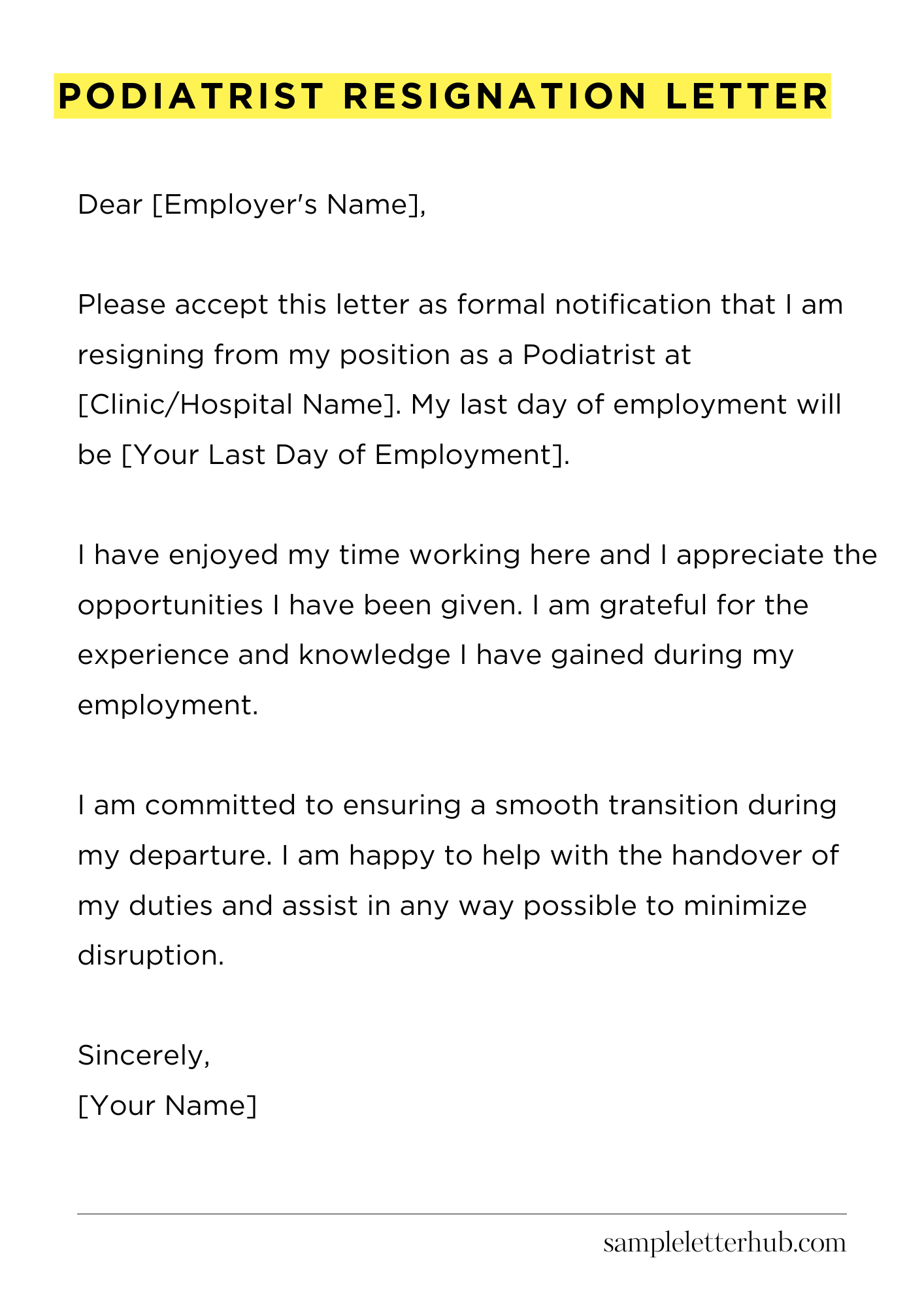
Below is a sample of a Podiatrist Resignation Letter:
[Your Name]
[Your Address]
[Your Phone Number]
[Your Email Address]
[Date]
[Employer’s Name]
[Clinic/Hospital Name]
[Clinic/Hospital Address]
Dear [Employer’s Name],
Please accept this letter as formal notification that I am resigning from my position as a Podiatrist at [Clinic/Hospital Name]. My last day of employment will be [Your Last Day of Employment].
I have enjoyed my time working here and I appreciate the opportunities I have been given. I am grateful for the experience and knowledge I have gained during my employment.
I am committed to ensuring a smooth transition during my departure. I am happy to help with the handover of my duties and assist in any way possible to minimize disruption.
I wish you and the clinic/hospital all the best in the future.
Sincerely,
[Your Name]
How to Write a Podiatrist Resignation Letter
1. Grasping the Basics: Why a Resignation Letter Matters
Leaving a job, especially in a professional field like podiatry, requires a formal resignation. This isn’t just about saying “I quit” to your boss. A well-crafted resignation letter is critical. It provides a clear, documented record of your departure. Moreover, it ensures a smooth transition for both you and your employer.
This simple document is the cornerstone of your professional exit. It’s also often a legal necessity. Consider it a key step in protecting your reputation and future job prospects.
2. Essential Elements: What Your Letter Needs
Your resignation letter should contain a few key elements. First, you should clearly state your intention to resign. Then, mention the exact date of your last day of employment.
This is incredibly important. Follow this with a brief, professional statement of gratitude. Thank your employer for the opportunity, experience, or training they provided. Keep it concise. Expressing gratitude goes a long way. Consider including a sentence or two acknowledging colleagues. It shows your professional respect.
3. Crafting the Content: Specifics for Podiatrists
As a podiatrist, your letter should be tailored to your specific circumstances. Mentioning specific projects or aspects of your role can be helpful. Keep your tone professional and respectful. Avoid negativity. If you’re leaving for another opportunity, you can briefly mention it without going into detail. Include your contact information.
This is to allow for any exit interviews or handover requirements. Remember that your letter reflects your professionalism. Thus, it’s a crucial aspect of your brand. Proofread carefully before sending!
4. Delivery and Timing: When and How to Submit
Timing is everything. Typically, it’s best to submit your resignation letter at least two weeks before your intended departure date. Always check your employment contract for specific notice requirements. Deliver the letter to your immediate supervisor. Ensure you retain a copy for your records.
Consider a formal handover. If possible, offer to assist in the transition process. This can include training a replacement or completing ongoing patient care. Being helpful makes a positive impact.
5. Beyond the Letter: Next Steps and Considerations
The resignation letter is just the first step. After submitting it, prepare for an exit interview. This is a common practice. You’ll need to organize your patient files, and ensure a smooth handover of your patients. Also, return any company property. Be prepared to answer questions about your departure.
Remember, maintaining a positive attitude throughout this process is crucial. It’s important to end your employment on a good note. Your reputation as a podiatrist is at stake. Proper handling of this process will greatly help in the long run.
FAQs about Podiatrist resignation letter
Understanding the nuances of a podiatrist’s resignation letter is crucial for a smooth transition. Here are some frequently asked questions and their answers:
What is the essential information to include in a podiatrist resignation letter?
A podiatrist’s resignation letter should contain the following essential information:
- A clear and concise statement of resignation.
- The effective date of resignation.
- A brief expression of gratitude for the opportunity (optional).
- Any necessary handover plans or arrangements.
- Contact information (optional).
- Signature.
This ensures the letter is professional and legally sound.
How much notice should a podiatrist provide when resigning?
The notice period for a podiatrist’s resignation depends on the employment contract and local regulations. It’s generally recommended to provide the notice period outlined in the employment agreement, which is often two to four weeks. However, consulting the contract and potentially legal counsel is advisable to ensure compliance.
Should a podiatrist explain the reason for resignation in the letter?
It is generally not required to detail the reasons for resignation in the letter. However, depending on the circumstances, a brief and neutral statement may be included if desired (e.g., “I am pursuing other opportunities”). It is best to keep the reasons concise, and if necessary, elaborate in a separate conversation with the employer.
What are some important considerations for the handover process in a podiatrist resignation?
The handover process is critical for ensuring continuity of patient care. Podiatrists should address the following:
- Identifying and documenting ongoing patient cases.
- Providing information on treatment plans.
- Communicating with patients about the transition (with employer approval).
- Assisting in training a replacement podiatrist (if applicable).
A well-executed handover minimizes disruption to patients and the practice.
How should a podiatrist handle references after resigning?
Upon resignation, the podiatrist should:
- Ensure they have copies of any employment records they might need.
- Prepare a list of potential references (supervisors, colleagues).
- Notify these references that they may be contacted.
- Obtain permission from the employer before using them as a reference.
This prepares the podiatrist for future employment applications.
Related:
Resignation letter due to rude boss
Resignation letter moving to another state
Resignation letter due to illness of family member
Resignation letter due to study