

So, you’re a Piping Engineer ready to move on? A resignation letter is the official document. It formally communicates your decision to leave your job. The purpose? To notify your employer of your departure. It’s a professional courtesy, and it sets the stage for a smooth exit.
Writing a resignation letter can feel tricky. You want to be clear, concise, and professional. We’ve got you covered. We’ll provide a variety of templates and examples. These are designed specifically for Piping Engineers.
Use these samples to craft your own perfect letter. Need to keep it short and sweet? We’ve got it. Want to express gratitude? We have options. Find the perfect starting point for your letter.
Piping Engineer Resignation Letter
Below is a sample of a Piping Engineer Resignation Letter:
[Your Name]
[Your Address]
[Your Phone Number]
[Your Email Address]
[Date]
[Hiring Manager Name] (If known, otherwise use title)
[Hiring Manager Title]
[Company Name]
[Company Address]
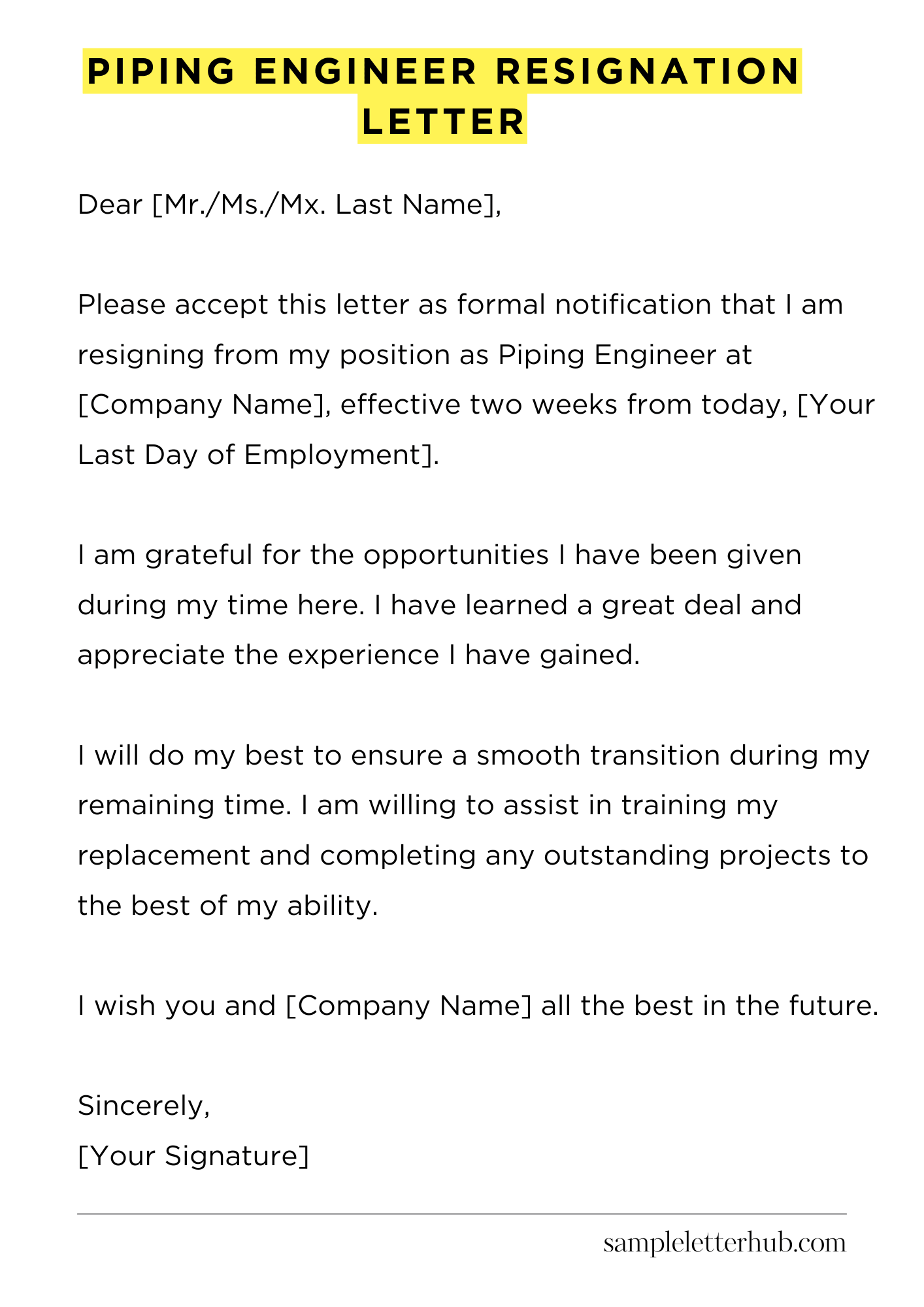
Dear [Mr./Ms./Mx. Last Name],
Please accept this letter as formal notification that I am resigning from my position as Piping Engineer at [Company Name], effective two weeks from today, [Your Last Day of Employment].
I am grateful for the opportunities I have been given during my time here. I have learned a great deal and appreciate the experience I have gained.
I will do my best to ensure a smooth transition during my remaining time. I am willing to assist in training my replacement and completing any outstanding projects to the best of my ability.
I wish you and [Company Name] all the best in the future.
Sincerely,
[Your Signature]
How to Write a Piping Engineer Resignation Letter
Know Your Audience (Your Boss!)
Alright, so you’re moving on. Leaving your piping engineering gig is a big step! But before you draft that goodbye letter, remember who you’re writing to: your boss. This isn’t the time for venting or settling scores. You need to keep it professional. Think about the company culture and your boss’s personality.
Is your boss someone who appreciates brevity? Or do they prefer a more detailed explanation? Tailor your tone accordingly. Consider how your relationship has been with your boss. This will guide you in making the right decisions. Keep in mind that you might need to use your boss as a reference in the future.
The Essential Ingredients: What to Include
Every good resignation letter has a few must-haves. First, the date. Always. Then, the most important part: a clear and concise statement of resignation. State explicitly that you are resigning from your position. Next, include your last day of employment.
This should align with your contract and any company policies regarding notice periods. Beyond that, a brief expression of gratitude is always a good idea. Thank your employer for the opportunity and any experiences gained.
Also, it is good to have a simple offer of assistance during the transition. This shows your professionalism. Mentioning your willingness to help with handover tasks makes you look good.
If you are comfortable, you may add the reason for your departure. This could be for a better opportunity, personal growth, etc. It should be kept short and positive. Finally, sign off with a formal closing, such as “Sincerely” or “Best Regards,” and your name.
Crafting the Right Tone: Keep it Professional
This is not a casual email to a friend. Maintain a formal and respectful tone throughout. Avoid slang, jargon, or any overly emotional language. Focus on the facts. The letter is a formal document.
Be polite but direct. Keep your sentences clear and concise. Ensure your language doesn’t leave room for misinterpretations. Double-check your grammar and spelling. It reflects your professionalism. It will impact your reputation.
The Handover Helper: What About Transition Assistance?
Offering to assist with the handover is a great way to leave on good terms. Be specific. You can offer to train your replacement. You may document ongoing projects or prepare summaries of your responsibilities.
Outline your willingness to help with specific tasks. This shows that you are committed to a smooth transition. Check your company’s policy on handover procedures to ensure you’re aligned with expectations. It eases the burden on your former colleagues and maintains a positive image of you. A good handover leaves a lasting impression.
The Final Review: Before You Hit Send!
Before you send your resignation letter, take a deep breath and review it one last time. Does it include all the essential information? Is the tone professional and respectful? Are there any typos or grammatical errors? Read it out loud. Doing so helps you catch any awkward phrasing. Ask a trusted colleague or friend to proofread it.
A fresh pair of eyes can catch mistakes that you might miss. Once you’re completely satisfied, send the letter via the appropriate channels, following your company’s protocol. Be ready to answer questions regarding your departure. Sending the letter is the end of one chapter and the beginning of another.
FAQs about Piping Engineer resignation letter
How much notice should a Piping Engineer give in their resignation letter?
The standard notice period for a Piping Engineer is typically outlined in their employment contract. Common notice periods range from two weeks to a month. It’s crucial to review the contract to determine the specific requirement.
Providing the agreed-upon notice period is professional and helps ensure a smooth transition for the employer. Ignoring this aspect may cause legal ramifications or damage your professional reputation.
What key information should be included in a Piping Engineer’s resignation letter?
A well-crafted resignation letter should include: a clear statement of resignation (e.g., “I am writing to formally resign from my position as Piping Engineer”), the effective date of resignation, a brief and professional expression of gratitude for the opportunity (optional), and any necessary information regarding the handover of responsibilities.
It’s wise to avoid overly emotional language or negative comments about the workplace. It is important to remember that all previous tasks and documentation should be left behind or handed over to the necessary parties.
Should a Piping Engineer explain their reason for leaving in the resignation letter?
While not mandatory, briefly mentioning the reason for leaving can be helpful, but it should be concise and professional. Common reasons might include “pursuing a new opportunity” or “seeking career advancement.”
Avoid lengthy explanations or negative criticism. If you are comfortable and there is a proper channel, you may schedule an exit interview where more detail can be provided if asked.
How should a Piping Engineer handle the handover of projects and responsibilities in their resignation letter?
The resignation letter should mention a willingness to assist with the transition. Offer to help with the handover of ongoing projects, documentation, and training of a replacement (if applicable).
Providing a list of active projects and contact information for ongoing work is a plus. Detail specific tasks or responsibilities that you are willing to help with during your remaining time. Providing this offers a smoother transition and demonstrates professionalism.
What is the proper format for a Piping Engineer’s resignation letter?
A standard business letter format is recommended. Include your contact information (name, address, phone number, and email address), the date, the recipient’s information (name, title, and company address), a formal salutation (e.g., “Dear [Manager’s Name]”).
Related:
Resignation letter due to rude boss
Resignation letter moving to another state
Resignation letter due to illness of family member
Resignation letter due to study