

So, you’re a pilot ready to move on. A pilot resignation letter is how you officially inform your current employer of your departure. This letter serves as a formal notice. It also documents the end of your employment. It’s a crucial step in maintaining a professional relationship.
We understand writing this letter can be tricky. It needs to be clear and concise. It also needs to be professional. We’ve got you covered.
Here are examples of pilot resignation letters. We will provide different templates. You can use these to create your own. It’s designed to make your writing process simpler. Crafting your letter will be a breeze.
Pilot Resignation Letter
Below is a sample of a Pilot Resignation Letter:
[Your Name]
[Your Address]
[Your Phone Number]
[Your Email Address]
[Date]
[Recipient Name] (If known, otherwise use title)
[Recipient Title]
[Airline/Company Name]
[Company Address]
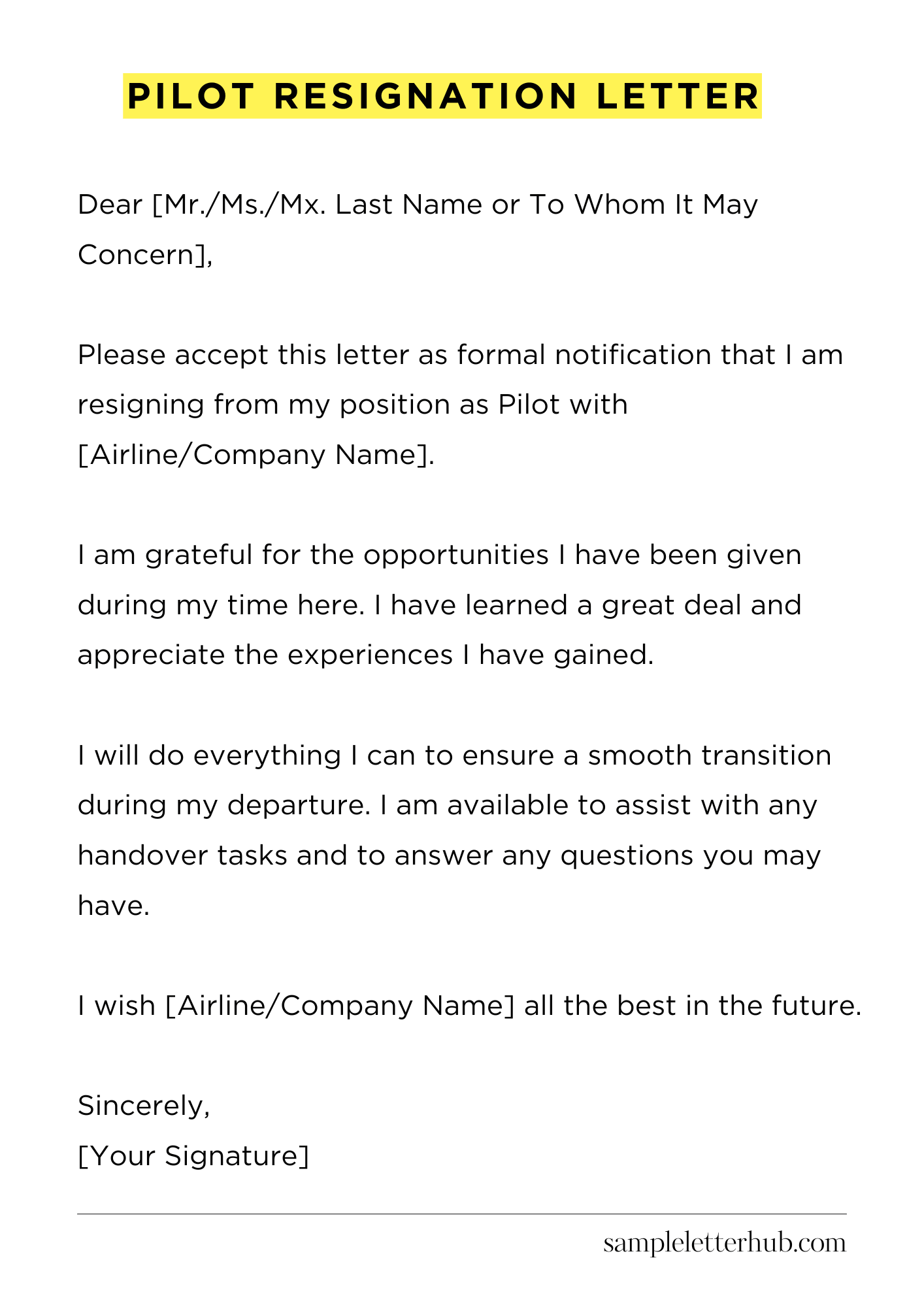
Dear [Mr./Ms./Mx. Last Name or To Whom It May Concern],
Please accept this letter as formal notification that I am resigning from my position as Pilot with [Airline/Company Name], effective [Your Last Day of Employment].
I am grateful for the opportunities I have been given during my time here. I have learned a great deal and appreciate the experiences I have gained.
I will do everything I can to ensure a smooth transition during my departure. I am available to assist with any handover tasks and to answer any questions you may have.
I wish [Airline/Company Name] all the best in the future.
Sincerely,
[Your Signature]
How to Write a Pilot Resignation Letter
Setting the Stage: Your Preparation is Key
So, you’re ready to hang up your wings, at least with your current employer. That’s a big decision! Before you even begin to type, there are a few important things to do. Firstly, carefully review your employment contract. Understand the specifics of your resignation obligations.
This includes the notice period, any financial penalties for early departure, and any clauses regarding confidentiality or non-compete agreements. This is critical. Next, think about when you want your resignation to be effective. This is important too. Consider your company’s operational needs and personal commitments to choose the best date.
Finally, gather relevant information, such as your employee ID number, your official job title, and the name of your direct supervisor. These details will ensure your letter is accurate and professional.
Crafting Your Letter: The Essential Elements
Your pilot resignation letter should be concise, professional, and respectful. Start with a formal salutation, addressing your supervisor by name. Begin the body of the letter by clearly stating your intention to resign. This is the main point. Specify your final date of employment. It needs to be clear.
Then, briefly express your gratitude for the opportunity to work with the company. Keep it short but sincere. You could mention the experience you gained or the relationships you forged. You can also mention it here. Next, provide a brief, respectful closing, perhaps wishing the company success in the future.
Remember to keep the tone positive and professional, even if you’re leaving due to negative circumstances. Avoid complaints or criticisms. A well-written letter reflects positively on you, even as you move on.
Structure and Tone: Making It Readable
Structure is important. Your letter should be well-organized and easy to read. Use short, clear paragraphs. Each should focus on a specific point. Maintain a professional tone throughout. This is non-negotiable. Avoid slang, jargon, or overly emotional language. Stick to the facts and your intentions. The language needs to be straightforward.
Proofread carefully. Check for any grammatical errors, typos, or inconsistencies. A polished letter shows that you care about your professionalism and your reputation. Consider having a friend or colleague read it over as a second pair of eyes. They might catch something you miss.
The Details: Specifics for Pilots
While the general principles apply to all resignation letters, there are a few pilot-specific considerations. Depending on your role, you might want to briefly mention the handover process. This might involve transferring your flight documentation, ensuring continuity in aircraft operations, or assisting with pilot training.
However, this is optional, and the specific needs will depend on your company’s processes. Be sure to address your accountabilities to make the process smoother.
Remember that you might be required to participate in an exit interview. Be prepared to answer questions about your experience, your reasons for leaving, and your future plans. Remaining professional and respectful during the exit interview is essential, even if you have had negative experiences. Keep the communication channels open.
Final Steps: Submission and Follow-Up
Once you’re satisfied with your letter, print it on high-quality paper. If possible, deliver it in person to your supervisor. Obtaining a copy for your records is also suggested. If in-person delivery isn’t possible, send it via registered mail or email with a read receipt requested. This ensures that the company received the letter. This is very important.
After submitting your resignation, be prepared to fulfill your notice period professionally and diligently. You might be needed for the handover. This can include assisting with training, completing outstanding tasks, and offering assistance to your colleagues during the transition.
By following these steps, you can ensure a smooth and professional departure, leaving a positive impression as you take off for your next adventure.
FAQs about Pilot Resignation Letter
What information should I include in my pilot resignation letter?
Your pilot resignation letter should include your full name, employee ID (if applicable), the date of the letter, a clear and concise statement of your resignation, the effective date of your resignation (typically two weeks from the date of the letter or as per your contract), and a statement of gratitude to the company (optional but recommended).
It’s also important to follow any specific guidelines your company provides for resignation letters. Be professional and avoid any negative comments about your experience with the company.
How far in advance should I submit my pilot resignation letter?
The required notice period typically depends on your employment contract or company policy. It is common for pilots to provide a notice period of at least two weeks, but it can be longer, especially in more senior roles or if the contract dictates a longer period.
Always refer to your contract and any company handbooks to determine the appropriate notice period. Giving ample notice allows for a smoother transition and demonstrates professionalism.
Should I provide a reason for resigning in my pilot resignation letter?
While not always required, it is generally recommended to keep the reason for your resignation brief and professional. You can simply state that you are pursuing other opportunities or that you are seeking a career change.
Avoid detailing negative experiences or complaints. If you have a particularly positive experience with a supervisor or team member, you may include thanks to them specifically. The primary purpose is to formally notify of your departure, and the level of detail is optional.
What is the proper format for a pilot resignation letter?
The standard format for a professional business letter should be followed. Use a formal business letterhead, or your name and address. Include the date, the recipient’s name and title, and the company’s address. Use a professional salutation (e.g., “Dear [Recipient’s Name]”) and a clear, concise closing (e.g., “Sincerely” or “Best regards”).
Keep the letter to one page and use a professional font like Arial or Times New Roman, with standard font sizes and margins.
What should I do after submitting my pilot resignation letter?
After submitting your resignation letter, you should follow up with your supervisor or HR department to confirm receipt and discuss the next steps. This may include an exit interview.
You should cooperate with the company during the handover process, which typically involves training a replacement, providing documentation, or transferring knowledge. Be professional throughout the process, and return any company property (e.g., uniform, ID) as requested.
Related:
Resignation letter due to rude boss
Resignation letter moving to another state
Resignation letter due to illness of family member
Resignation letter due to study